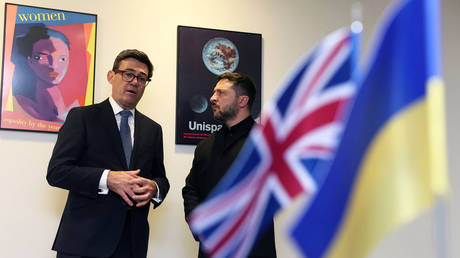
The headlines rolled across the wires with predictable mechanical panic. British Prime Minister offers solemn solidarity to Volodymyr Zelensky. The catalyst? Donald Trump reportedly floating the notion of freezing out the Ukrainian leader or forcing a swift territorial compromise that looks suspiciously like capitulation. Mainstream commentators wet their collective beds, framing this as a moral crisis for London, a sudden fracture in the Atlantic alliance, and a test of Western backbone.
They are missing the entire plot.
Downing Street is not losing sleep over the fate of the Donbas. Whitehall bureaucrats and cabinet ministers are sweating because a Washington that forces a hard, rapid peace deal in Eastern Europe strips away the ultimate geopolitical smoke screen British leadership has used for years to mask its own domestic decay. For a decade, foreign policy posturing has served as the ultimate political anesthetic in the UK. Whenever economic growth flatlined, public services crumbled, or tax burdens reached historic highs, politicians could conveniently pivot to the steps of Number 10, drape themselves in the blue-and-yellow flag, and talk about defending the rules-based international order.
When Trump threatens to pull the plug on the endless-war consensus, he is not just rattling Kyiv. He is threatening to expose the nakedness of British statecraft.
The Comfort Of Endless Conflict
Let us dismantle the prevailing consensus. The lazy narrative pushed by mainstream pundits assumes that Western foreign policy is driven by a coherent, long-term strategic vision for European security. It is not. It is driven by momentum, institutional inertia, and the sheer political convenience of avoiding hard choices.
Since 2022, the war in Ukraine has functioned as a marvelous distraction for British governance. It allowed successive administrations to project strength abroad while managing managed decline at home. Every billion-pound military aid package announced with great fanfare bought months of immunity from difficult domestic reckonings. It offered a rare point of bipartisan unity in a bitterly polarized parliament.
When a foreign leader like Trump steps onto the stage and says the quiet part out loud—that the status quo is financially unsustainable, strategically incoherent, and heading toward a dead end—the British establishment panics. Why? Because a negotiated settlement forces a return to reality. Once the war transitions from an active crisis to a frozen or resolved dispute, British politicians can no longer hide behind wartime rhetoric. They have to answer for the state of their own hospitals, their stagnant productivity, and their crumbling infrastructure.
Consoling Zelensky is easy. Balancing a national budget without economic growth is hard.
The Myth Of Independent British Clout
We need to talk honestly about power projection. British foreign policy suffers from a severe psychological hangover known as post-imperial phantom limb syndrome. Officials in London love to act as though Great Britain remains a primary global arbiter, whispering wisdom into the ear of the American superpower while guiding the European continent.
The reality is starkly different. Without the explicit backing of Washington, British military interventions and diplomatic crusades are paper tigers. The UK defense budget is stretched to its absolute breaking point, plagued by procurement scandals, dwindling stockpiles, and a Royal Navy that struggles to maintain continuous at-sea deterrence while fielding aircraft carriers that spend more time in dry dock than on deployment.
When Trump calls for a recalibration of American commitments, he exposes the hollowness of British grand strategy. For decades, London outsourced its heavy strategic lifting to the Pentagon while maintaining the comforting illusion of independent global leadership. A shift in American priorities under Trump does not just challenge Ukraine; it leaves British defense planners completely exposed. They built a strategic doctrine dependent on American staying power, and now that the bill is coming due, they are frantically pretending that moral outrage can substitute for industrial capacity.
Follow The Economic Realities
Look past the moral posturing and examine the fiscal ledger. The British state is borrowing at unprecedented rates to service national debt, while public services groan under structural deficits. Yet, whenever the conversation turns to defense spending or foreign aid, billions are found overnight because admitting fiscal constraint looks unpatriotic.
A sudden end to the conflict in Ukraine, forced by American diplomatic muscle, would instantly change the economic calculus. The defense industrial complex would face a reckoning. Questions would immediately be asked about where the hundreds of millions in military hardware went, how replenishment is being funded, and why domestic manufacturing cannot meet basic security needs.
Downing Street's frantic displays of support for Zelensky are designed to preempt these questions. By clinging tightly to the wartime orthodoxy, British leaders hope to lock the next US administration into a continuation of past policies. It is a desperate lobbying effort disguised as statecraft.
The Contrarian Truth About Peace
The mainstream commentariat treats any deviation from unconditional, indefinite funding of the Ukrainian war effort as a moral failure. This is naive thinking at best and cynical careerism at worst. Prolonging a war of attrition without a clear, achievable theory of victory is not a humanitarian triumph; it is a tragedy of compounding scale.
Trump's transactional approach to foreign policy is jarring to diplomatic traditionalists precisely because it strips away the sanctimonious language that governments use to justify endless engagements. Whether one likes his methods or not, his fundamental diagnosis is accurate: the current trajectory leads nowhere productive, and Europe must shoulder the ultimate responsibility for its own neighborhood.
British leadership knows this. Behind closed doors in Whitehall, senior civil servants are terrified of a negotiated settlement not because they care about Ukrainian borders, but because they know a peace deal forces a reckoning they have spent a decade avoiding.
When the music stops, the UK will have to look in the mirror and confront its own domestic rot, stripped of the grand theater of European war. That is why the Prime Minister is rushing to console Kyiv. He is not comforting an ally; he is mourning the end of his favorite distraction.