The fog over the Strait of Gibraltar rarely reaches the ground. Instead, it hangs heavy, a pale gray ceiling that blurs the line where the Atlantic meets the Mediterranean, obscuring the twenty-four miles of water separating Africa from Europe. From a hill on the Moroccan side, the lights of Spain look like fallen stars. They are close enough to tempt the imagination, distant enough to break a heart.
Dawn arrived cold.
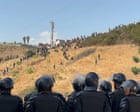
On a ridge overlooking Ceuta, the Spanish enclave clinging to the northern coast of Africa, over a hundred figures crouched behind scrub brush and jagged rocks. They were young men, mostly. Some carried water bottles refilled so many times the plastic had turned milky and opaque. Others wore layers of torn jackets despite the rising heat, hoarding their belongings against their skin because a backpack is too easy to grab when running.
They were waiting for a signal that never came.
By mid-morning, the operation was over before it reached the border line. Moroccan security forces, deployed in heavy concentrations along the perimeter, moved in with quiet efficiency. There were no dramatic clashes, only the dull, heavy thud of boots on dry earth and the swift containment of a crowd that had spent weeks planning an impossible dash. More than one hundred people found their journey halted at the edge of the wire, added to a statistic that will populate morning news feeds for twenty-four hours before fading into the archive.
Numbers are cold. They are designed to distance us from the pulse.
Consider instead what it means to stand before a double fence of galvanized steel topped with razor wire, knowing that on the other side lies a currency that can feed a family for a month, a passport that opens borders, an escape hatch from a future that ran out of air years ago.
Ceuta is an anomaly of geography and history. It is a scrap of Europe physically anchored to Morocco, a tiny Spanish territory measuring just seven square miles. For decades, it has functioned as a pressure valve for migration, a geographic quirk where the Global North and the Global South physically touch. To reach Ceuta is to set foot on European soil. To be turned away at its perimeter is to be thrown back into the gravity of circumstance.
To understand why a hundred people would risk broken bones, tear gas, and deportation for a stretch of wire, you have to look past the political debates in Madrid and Rabat. You have to look at the math of desperation.
When local job markets offer pennies a day, when agricultural yields fail for the third consecutive season because the rain simply stopped coming, and when the cost of bread doubles over the course of a single year, the calculation shifts. Risk ceases to be a deterrent. Risk becomes a utility. Staying put is the greater hazard.
The Moroccan authorities face an impossible calculus of their own. Caught between European demands to police the borders and domestic economic realities, security forces patrol these hills day and night. They operate in shifts, scanning the brush with thermal binoculars, listening for the snap of a twig in the ravine. They are agents of a state trying to manage a flood with sandbags. When they intercept a group of migrants, they are not just enforcing administrative law; they are interrupting a desperate prayer.
For the young men detained today, the immediate future is predictable. Buses will arrive. Names will be logged. They will be transported away from the northern coast, dropped off inland or returned to their regions of origin. Their shoes, caked in the red dust of the border hills, will carry them back to where they started.
Yet the fog over the Strait remains. The lights of Europe still blink across the water every single night.
As long as the distance between what people have and what they need can be measured in miles rather than light-years, the hills outside Ceuta will never truly be empty. The wire is sharp. The patrols are vigilant. But hope, however misplaced, is a stubborn architect. It builds ladders out of driftwood and dreams out of distant lights, refusing to acknowledge the mathematics of the wall until the very last second.