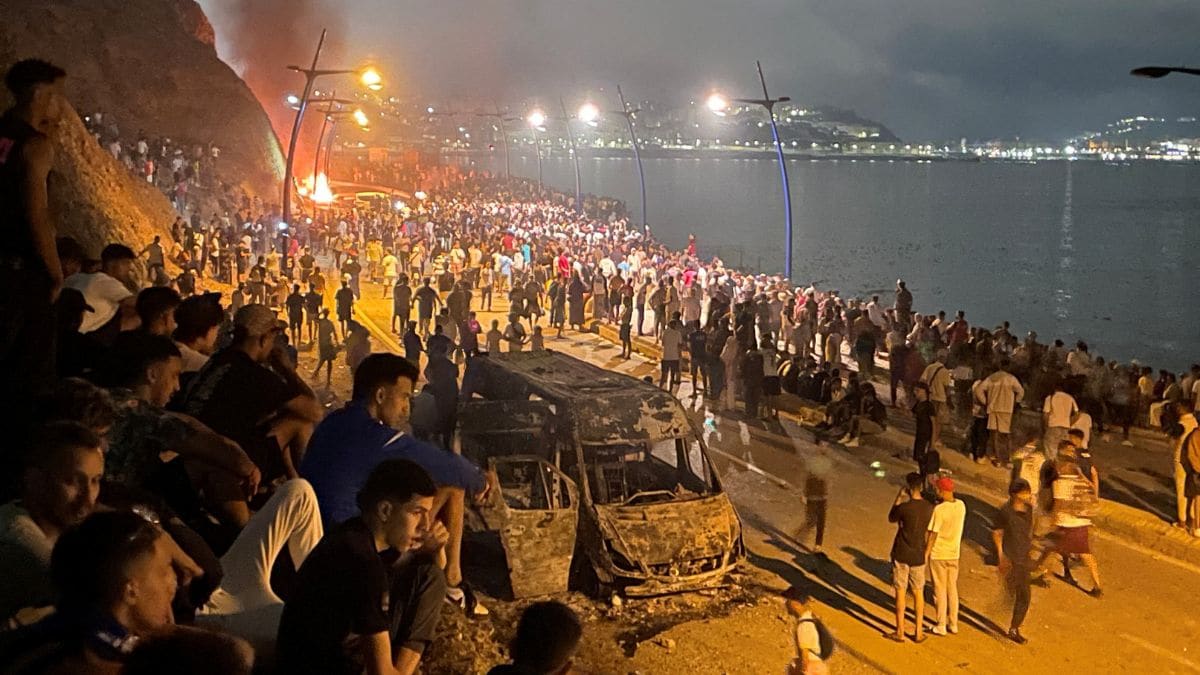
The screen glows in the dark room, casting a pale blue light across a young man’s face. It is past midnight in North Africa. Thousands of miles away, European streets gleam under amber streetlamps in viral clips, promising a future that feels close enough to touch. He swipes. Another video plays. A seamless loop of a coastal breakwater, a short sprint across the sand, and the illusion of a door swung wide open.
This is not just a digital feed. It is a map.
To understand how thousands of Moroccan migrants crossed the border toward the Spanish enclave of Ceuta, you have to look past the official press releases and security briefings. You have to look at the algorithms. We live in an era where the distance between a desperate hope and a physical frontier is measured not in miles, but in megabytes.
The Architecture of an Invitation
For generations, migration stories were shaped by word of mouth, faded photographs sent in letters, and the cautious warnings of those who had already made the journey. Today, the process is decentralized, accelerated, and broadcast in high definition.
Consider how information moves. A teenager sitting in a cafe in Fnideq pulls out a smartphone. Notifications buzz. Short-form video platforms serve up footage uploaded just hours earlier. The videos are rarely complex documentaries. They are visceral, sensory snippets: grainy drone shots of foggy coastlines, triumphant audio tracks overlaid on footage of people walking along rocky shores, and text overlays in Moroccan Darija offering unverified logistical tips.
Swim when the tide is low.
Look for the lighthouse.
The border fence has a blind spot.
These digital breadcrumbs bypass traditional checkpoints of truth. They carry an immediacy that official government warnings simply cannot match. When a young person sees someone who looks like them, speaks like them, and shares their daily frustrations successfully stepping onto European soil on a glowing screen, the psychological barrier to attempting the journey crumbles.
The Geography of Desperation
Ceuta has always been a paradox. A tiny Spanish territory clinging to the northern coast of Africa, it acts as a physical European outpost on the African continent. Surrounded by towering double fences topped with razor wire and monitored by thermal cameras, it looks impenetrable on paper.
Yet, borders are porous when desperation meets opportunity.
(Note: The following scenario is a composite based on documented behavioral patterns of migrants and border authorities during peak crossing events.)
Imagine Tariq. He is twenty-two, holding a university degree that has yielded no employment prospects, working odd jobs that barely cover his share of a cramped apartment rent. His world feels small, trapped behind invisible walls of economic stagnation. When his phone lights up with clips showing groups streaming toward the Moroccan-Ceuta border during periods of reduced visibility or heightened social unrest, the frustration boils over into action.
He packs a single change of clothes in a waterproof bag. He tells his mother he is going out with friends.
By dawn, he is part of a crowd. The energy in the air is electric, fueled by collective momentum and the hypnotic pull of social media coordination. People are streaming down hillsides and swimming around breakwaters not because they have a foolproof plan, but because the digital currents told them now is the time.
When Algorithms Outpace Policy
Governments are built for the physical world. They draft treaties, reinforce concrete, deploy patrol boats, and issue statements in bureaucratic prose. But algorithms operate at the speed of light.
When viral videos spark spontaneous surges toward border towns like Fnideq and Mdiq, law enforcement agencies find themselves reacting to ghosts. It is nearly impossible to trace the origin of a coordinated push that organizes itself organically through encrypted messaging groups and sudden algorithmic spikes. A single trending hashtag can mobilize hundreds of people within hours, turning a quiet stretch of coastline into a crowded focal point of international migration debates.
Security forces respond with tear gas, batons, and increased patrols. Yet, for every video taken down for violating terms of service, ten more are uploaded by secondary accounts. The digital ecosystem is resilient, decentralized, and infinitely replicable.
The Invisible Toll
The metrics reported by news outlets speak in dry integers. Three thousand arrivals. Five hundred turned back. Dozens rescued from cold waters.
These numbers flatten reality. They hide the salt stinging raw eyes in the dark ocean water. They mask the profound disappointment of those who make it to the breakwater only to be sent back across the border hours later, their phones waterlogged, their digital dreams crashing against bureaucratic brick walls.
Worse still are the stories that never make the feed. The currents off the coast of Ceuta are notoriously unforgiving. Undertows pull swimmers away from the safety of the rocks. Hypothermia sets in faster than expected when exhaustion takes over. The viral videos never show the aftermath of a failed attempt—the silent bus rides back south, the crushed pride, the debt owed to smugglers who profit off digital desperation.
The Lingering Horizon
The screen goes dark again. In rooms across North Africa and beyond, the glowing blue light continues to flicker in the dark, casting long shadows on walls decorated with patience and prayer.
The border fences remain standing, scarred by past attempts and reinforced with new technology. The algorithms continue to churn out stories of escape, freedom, and transformation, packaged in fifteen-second increments. And as long as the economic soil at home remains dry while the digital promise of Europe stays perpetually green, the human current will keep moving, pulled forward by the most powerful force on earth: the belief that life could be different just over the next wave.