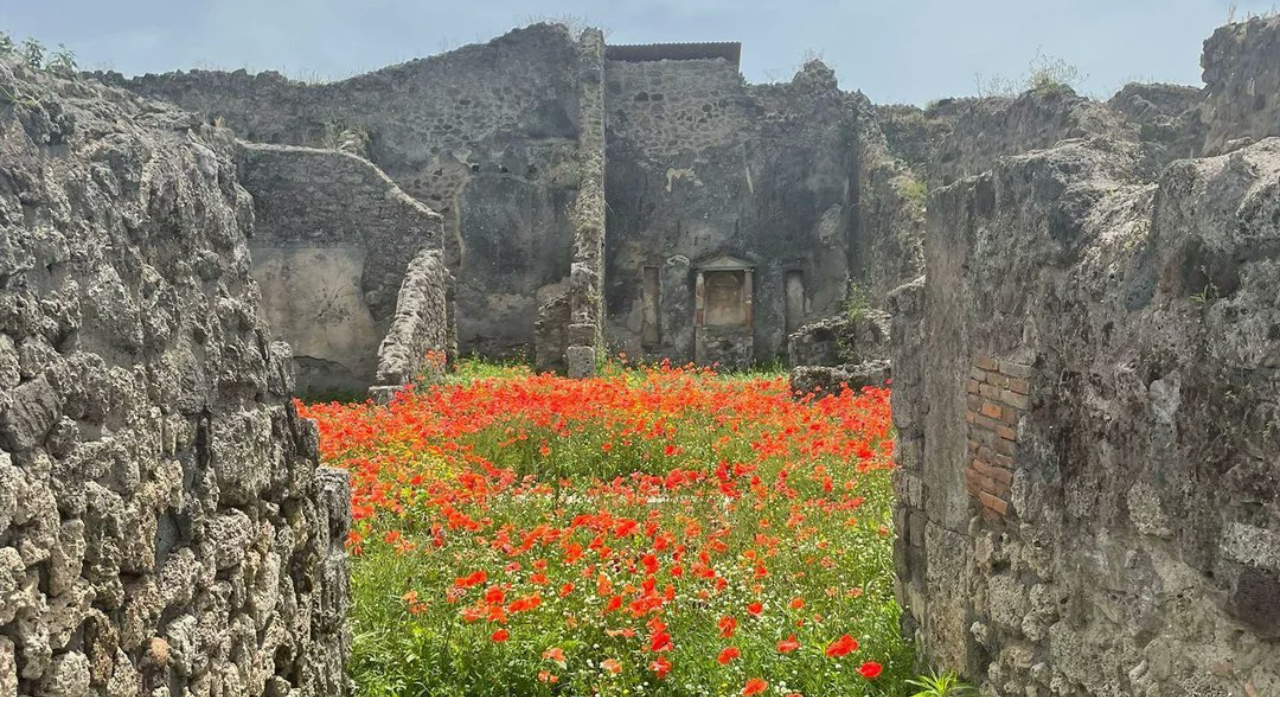
Stop crying happy tears over the weeds growing through the cracks of ancient Roman villas.
Every few months, a breathless travel column or viral social media post gushes about the "poetic beauty" of wildflowers blooming along the Via dell’Abbondanza in Pompeii. They call it a triumph of life over death. They write purple prose about nature reclaiming its territory, turning a site of ancient tragedy into a garden of rebirth.
It is a comforting, romantic, and profoundly stupid narrative.
What tourists call "nature's renewal" is actually a slow-motion wrecking ball. The greening of Pompeii is not a miracle; it is a relentless biological assault on the world’s most significant archaeological site. Every root, every patch of moss, and every wildflower is actively dismantling Roman history, grain by grain.
If you actually care about preserving the past, you need to stop cheering for the weeds.
The Chemistry of Destruction: How Roots Erase Roman Concrete
The romantic crowd looks at a sprig of wild chamomile growing from a 2,000-year-old wall and sees a photo opportunity. Conservation scientists look at it and see a structural emergency.
Plants do not just sit passively on ancient stone. They are aggressive biological agents. To understand why, you have to look at the mechanics of biological weathering.
Root Wedging and Mechanical Action
When a seed lands in a microscopic crack in Roman mortar, it finds a foothold. As the plant grows, its roots expand. The physical pressure exerted by growing root systems is immense. This process, known as root wedging, acts like a wedge driven into a wedge-shaped split.
- Mortar Disintegration: Roman concrete is famously durable, but it is not immortal. Root expansion shatters the binder between the aggregate, turning solid mortar back into loose sand.
- Structural Collapse: Once the mortar is compromised, gravity does the rest. Walls that survived the weight of pyroclastic surges and two millennia of burial are brought down by the slow, silent expansion of wild fig roots and ivy.
- Fresco Displacement: The most fragile elements of Pompeii are its plaster walls and vibrant frescoes. Even tiny rootlets of grass can slip behind a layer of painted plaster, separating it from the underlying stone and causing priceless artwork to flake off and crumble onto the floor.
Chemical Attack
Plants do not just break stone physically; they dissolve it chemically.
Root systems secrete organic acids—such as oxalic, citric, and tartaric acids—to break down minerals in the surrounding stone so the plant can absorb nutrients. When these acids interact with the calcium carbonate in Roman mortar and limestone, they trigger a chemical reaction that dissolves the stone.
Furthermore, the micro-environment created by vegetation is highly destructive. Plants trap moisture against the stone. In a Mediterranean climate, this moisture undergoes constant freeze-thaw cycles. Water gets trapped, expands as it freezes, and cracks the stone from the inside out.
To celebrate this process as "renewal" is like celebrating rust eating away at a classic car because the orange color looks warm and rustic.
The Tourist Fallacy and the Cult of the Picturesque
We have been conditioned to love ruins that look like they belong in a 19th-century romantic painting.
During the Romantic era, wealthy European travelers on the Grand Tour fell in love with the aesthetic of the "picturesque." They wanted their ruins overgrown, draped in ivy, and shrouded in melancholy. Artists like Giovanni Battista Piranesi made a living drawing exaggerated, weed-choked Roman ruins.
But there is a massive difference between a 19th-century painting and modern archaeological reality.
In the 1800s, archaeology was little more than high-society treasure hunting. Today, it is a race against time to preserve data. When vegetation covers a site, it does not just destroy the physical stones; it destroys the archaeological context.
What We Lose to the Greenery:
- Stratigraphy: Plant roots churn up the soil, destroying the delicate layers of earth that tell archaeologists the exact chronological order of historical events.
- Epigraphy: Roman walls are covered in priceless graffiti, from political slogans to ancient tavern jokes. Lichens and mosses feed on these exposed surfaces, completely erasing shallow inscriptions before they can be documented.
- Accessibility: Thick vegetation hides structural failures, preventing conservators from identifying and repairing weak points before a wall collapses.
If you let nature "renew" Pompeii, you will end up with a pile of generic gravel covered in grass. The history is gone. The story is wiped out.
The Conservation Battle You Do Not See
Managing an archaeological park like Pompeii is not just about selling tickets and dust-brushing skeletons. It is a constant, brutal war against biology.
For decades, the superintendency of Pompeii has fought to keep the vegetation at bay. In the mid-20th century, the approach was brute-force chemistry. Conservators flooded the ruins with aggressive chemical herbicides. While this killed the plants, it also left toxic residues that damaged the ancient stones and contaminated the local groundwater.
Today, the approach has to be far more sophisticated, expensive, and labor-intensive.
[The Infinite Loop of Archaeological Decay]
   Weeds sprout -> Roots penetrate mortar -> Moisture trapped -> Mortar dissolves -> Wall destabilizes -> Wall collapses
To break this loop without destroying the environment, conservators have to employ a mix of targeted methods:
- Manual Weeding: Teams of specialized workers physically pull weeds from the walls. This must be done with extreme precision; pulling too hard can bring an entire chunk of ancient plaster down with the root.
- Biocides: Applying highly targeted, low-toxicity chemical agents directly to root systems to kill the plant without harming the stone or leaving harmful residues.
- Preventative Planting: Interestingly, one of the best ways to fight destructive weeds is with other plants. Conservators are experimenting with planting non-invasive, shallow-rooted ground covers that crowd out the deeply rooted, destructive species.
Every single blooming flower you see on an ancient Roman street is not a sign of nature's harmony; it is a sign of a battle conservationists are currently losing due to lack of funding, staffing, or time.
Stop Treating Heritage Sites Like State Parks
There is a disturbing trend in modern travel writing that seeks to merge cultural heritage preservation with environmentalism. They are not the same thing.
Environmentalism seeks to preserve the natural world from human interference. Cultural preservation seeks to preserve human history from natural decay. These two goals are often in direct, violent conflict.
When a travel writer waxes poetic about the greening of Pompeii, they are prioritizing a fleeting, superficial aesthetic over the long-term survival of human history. They are telling you that a weed, which will die in a few weeks, is more valuable than a 2,000-year-old monument that survived the eruption of Mount Vesuvius.
If we want Pompeii to survive another two centuries, let alone another two millennia, we have to reject this romanticized complacency. We have to look at the green on the stones and see it for what it truly is: decay.
The next time you walk the streets of Pompeii and see a wildflower pushing through the ancient pavement, do not take a photo for your social media feed with a caption about "nature finding a way."
Understand that you are watching history dissolve in real-time.

