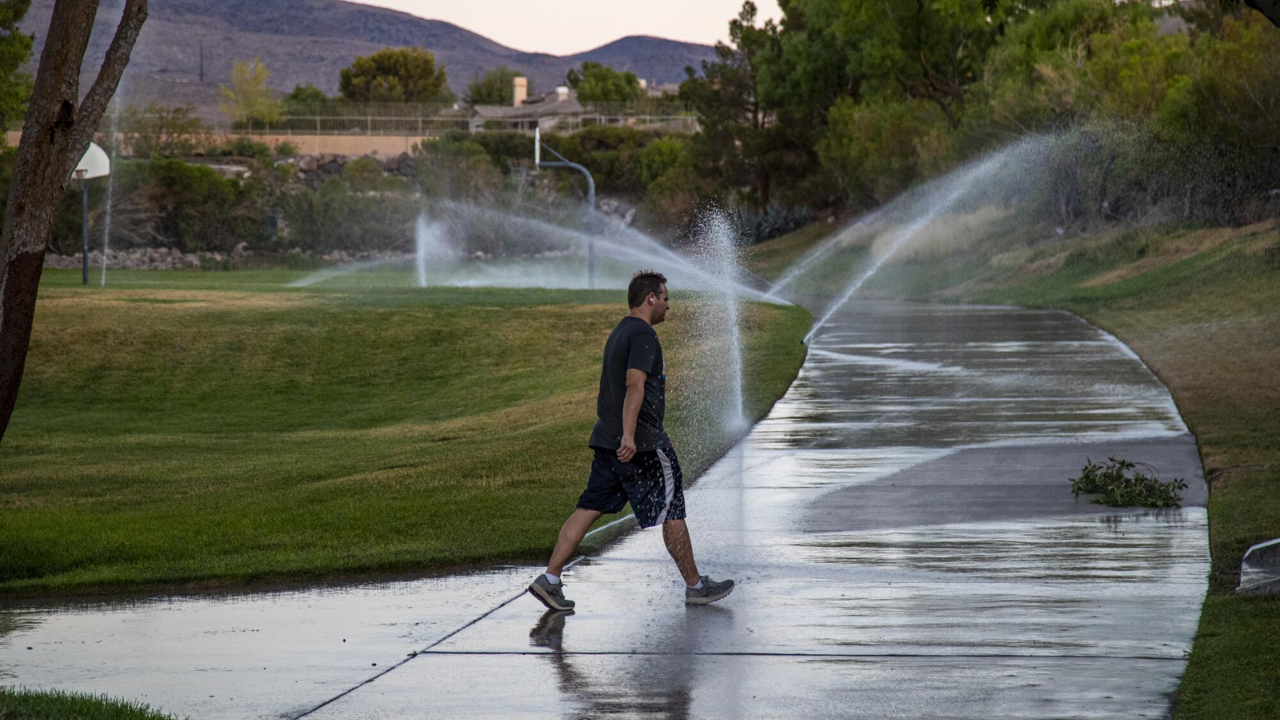
The arithmetic of the Mojave Desert is brutal. Every year, millions of tourists descend on a neon-lit basin, turning faucets, filling mega-resorts, and keeping sprawling golf courses green under a punishing sun. For decades, conventional wisdom dictated that a desert city of this magnitude was living on borrowed time. Then came the bureaucratic quiet revolution. Southern Nevada quietly executed a systemic transformation, ripping out two hundred fifty million square feet of ornamental grass and replacing it with arid-adapted gravel and native flora.
That massive turf removal saved over two hundred billion gallons of Colorado River water. It sounds like an environmental miracle. It looks like a pristine bureaucratic victory. But municipal water conservation on this scale is rarely just about saving drops. It is a calculated power struggle over resource allocation, political survival, and economic self-preservation in a drying American West.
The Anatomy of a Forced Evolution
Water policy in the Las Vegas Valley does not happen by accident. It is engineered through a blend of aggressive financial incentives and absolute regulatory bans. Years ago, local water authorities realized that residential turf was the single largest waste vector in the municipal supply. They did not ask property owners nicely to consider xeriscaping. They outlawed non-functional turf entirely across commercial properties, multi-family developments, and street medians, backing the mandate with hard cash.
Property owners were handed cash rebates to dig up their lawns. When voluntary compliance lagged, the Southern Nevada Water Authority raised the stakes. They banned new turf in all future developments outright.
- Commercial landscapes had to choose between compliance or steep, escalating municipal fines.
- Homeowners associations faced legal liability if they tried to enforce old covenant rules requiring green front yards.
- Municipal infrastructure shifted from passive monitoring to aggressive drone surveillance to spot hidden leaks and unauthorized irrigation.
This was not a grassroots environmental movement born of civic awakening. It was top-down resource management driven by existential panic. The Lake Mead intake valves were dropping toward dead pool status, and the regional water managers knew that if they did not cut consumption drastically, federal emergency mandates would step in and dictate the terms of their decline.
The Hidden Costs Beneath the Gravel
Swapping Kentucky bluegrass for decomposed granite and ocotillo drastically drops municipal demand charts. Yet every technical fix introduces a secondary crisis. The removal of millions of square feet of transpiring vegetation fundamentally alters the microclimate of an urban corridor. Turf acts as a natural cooling blanket through evapotranspiration. Pushing that much rock and hardscape into suburban neighborhoods supercharges the urban heat island effect.
Summer afternoon temperatures in recently converted subdivisions have risen noticeably. Air conditioning units work harder, drawing more power from a strained regional electrical grid. Water savings translate directly into electrical burdens.
"We successfully engineered our way out of a water crisis while inadvertently walking straight into a thermal trap. The rock doesn't sweat, and the concrete doesn't breathe."
Furthermore, the economic burden of this transition fell unevenly. While large corporate resorts and master-planned communities received heavy subsidies to flip their aesthetics, smaller commercial strips and independent landlords absorbed the high upfront capital costs of retrofitting irrigation systems and hauling away tons of organic waste.
The Downstream Illusion
Conserving two hundred billion gallons sounds like a permanent victory until you trace where that saved water actually goes. Under the archaic legal framework of the Colorado River Compact, saving water locally does not automatically mean it stays in the river to heal a dying ecosystem.
Las Vegas operates under a return-flow credit system. Every drop of indoor water that residents use is treated and returned to Lake Mead through advanced reclamation facilities, earning the valley credits to pull more water out. Outdoor water, however, is consumed entirely through evaporation and plant transpiration. That is why turf removal became the holy grail. It stopped water from evaporating into the desert sky.
Yet, when Nevada banks those savings or reduces its total take, the foundational math of the river basin does not necessarily reset for ecological recovery. Under current interstate compacts, saved water often remains vulnerable to being claimed downstream by agricultural juggernauts in Arizona and California under prior appropriation doctrines. Conservation without structural reform of century-old water rights is merely bailing water out of a sinking ship with a thimble.
The Limits of Suburban Minimalism
The Las Vegas experiment proves that modern cities can survive on a fraction of their historical water use if political leaders possess the will to impose harsh mandates. Turf is gone from medians, traffic circles, and corporate parks. The visual vocabulary of the city has adapted to a starker, desert-aware aesthetic.
The real question facing municipal planners is what happens after the easy grass is gone. Once every non-functional lawn has been ripped out and replaced with gravel, the remaining water use belongs to essential indoor plumbing, swimming pools, and the stubborn pockets of agriculture that still cling to the fringes of the basin.
You cannot pave over every living plant without turning the city into an uninhabitable oven. The desert always wins in the end, and managing the decline of an artificial oasis requires more than just pulling up the green carpet. It requires confronting the hard limits of growth in a basin that was never designed to hold two million people in the first place

