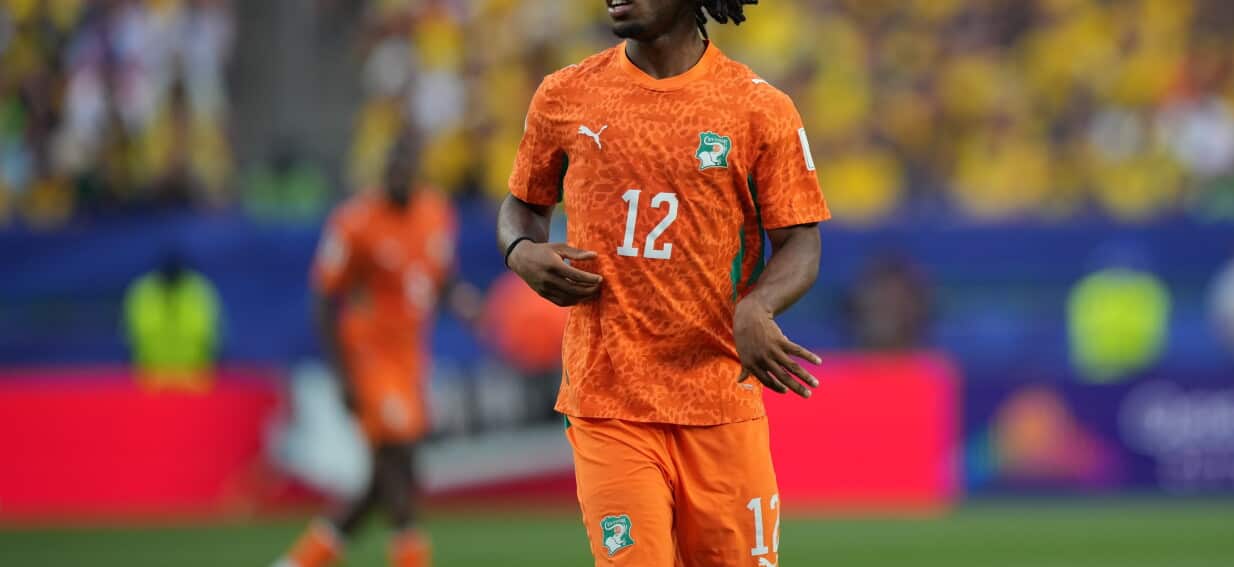
The Ivorian Football Federation scrambled to reverse what could have been a catastrophic blow to its World Cup campaign, announcing that forward Elye Wahi had finally secured the administrative clearance required to enter Canada for this weekend's pivotal fixture against Germany. The 23-year-old OGC Nice striker had initially been denied entry by Canadian immigration authorities, a direct consequence of a brewing French criminal investigation into organized sports corruption and spot-fixing. While the immediate logistical fire has been put out, the administrative whiplash underscores a much larger crisis looming over the modern game.
The official line from the Ivorian Football Federation, known as the FIF, attempted to project relief and stability. In a swift update following an initial panicked announcement, the federation thanked the various parties who smoothed over the border issue, stating that Wahi would travel to Toronto with the Les Elephants delegation as normal. But a high-stakes visa reversal does not erase a criminal probe. Beneath the surface of this bureaucratic scramble lies a disturbing narrative of spot-fixing allegations, late-night anti-corruption raids, and the increasingly murky relationship between international football tournaments and domestic criminal inquiries.
Inside the French Investigation
The roots of Wahi’s current predicament trace back to May 17, during a high-stakes Ligue 1 fixture between Nice and FC Metz. The Ligue de Football Professionnel flagged the match to judicial authorities after global betting monitors detected an unnatural, heavy spike in wagers specifically backing Wahi to receive a yellow card.
The sequence on the pitch mirrored the money moving in the dark. In the 35th minute of that scoreless draw, Wahi lunged into a late challenge on Metz's Sadibou Sané, earning exactly what the gamblers predicted. The booking was his fifth of the domestic season. That individual statistic triggered an automatic one-match suspension, sidelining him from the first leg of Nice's vital relegation play-off against Saint-Étienne.
On May 29, immediately after Wahi returned to score two goals in the second leg to preserve Nice’s top-flight status, French anti-corruption officers struck. He was arrested and taken into custody by order of the Marseille public prosecutor's office. The active file lists suspected offenses that read more like an organized crime indictment than a sports infraction: organized fraud, organized sports corruption, handling proceeds of crime, and money laundering.
Wahi was released without formal charges after a lengthy interrogation, leaving his legal status in a gray area. He had already switched his international allegiance from France to the Ivory Coast in March, and by May 15, head coach Emerse Faé had integrated him into the 26-man World Cup roster. Because no formal charges were filed, the striker was able to fly across the Atlantic to the Ivory Coast's base camp in Chester, Pennsylvania. He started and played 55 minutes in their opening 1-0 win over Ecuador in Philadelphia, even hitting the crossbar before being substituted.
The Canadian Border Friction
Crossing the border between the United States and Canada during a major tournament introduces entirely different legal mechanisms. Canadian immigration laws are notoriously stringent regarding individuals linked to ongoing criminal investigations, even when those individuals have not been formally convicted or charged.
Initially, Canadian authorities held the line. The FIF was forced to announce on Thursday morning that Wahi would be left behind in the United States while the rest of the squad flew to Toronto to prepare for the Germany match at BMO Field. The sudden realization that a starting World Cup forward could be grounded by a visa denial sent shockwaves through the tournament organizers.
The panic lasted only a few hours before intense diplomatic or bureaucratic leverage produced a corrected decision. Yet the fact that Wahi was granted a visa hours after an explicit denial reveals the immense pressure under which these international tournaments operate. FIFA and national federations frequently exert significant behind-the-scenes influence to ensure that star assets are not trapped at border checkpoints. It is a sticking plaster on a fundamentally broken system.
A Systemic Blind Spot
The Wahi incident is not an isolated administrative hiccup. Earlier in the same week, Ghana’s Thomas Partey was similarly refused entry by Canadian immigration authorities ahead of his country's fixture against Panama in Toronto, stemming from his own outstanding legal entanglements in Europe.
The sport is facing an unprecedented collision between border sovereignty and the globalized nature of football corruption. Spot-fixing, which targets isolated incidents like a yellow card or the timing of a throw-in rather than the final scoreline, is incredibly difficult to police but highly lucrative for criminal syndicates. When a national federation like the FIF publicly defends a player by asserting they have received no formal notifications of a judicial probe, they are choosing tactical convenience over long-term integrity.
The Ivory Coast’s squad must now shift its focus back to the pitch, where Germany awaits in a match that will likely decide who tops Group E. Faé has his primary attacking option back, but the cloud over the young striker has not dissipated. A frantic, last-minute visa approval from Ottawa does nothing to slow down the prosecutors waiting for Wahi back in Marseille.