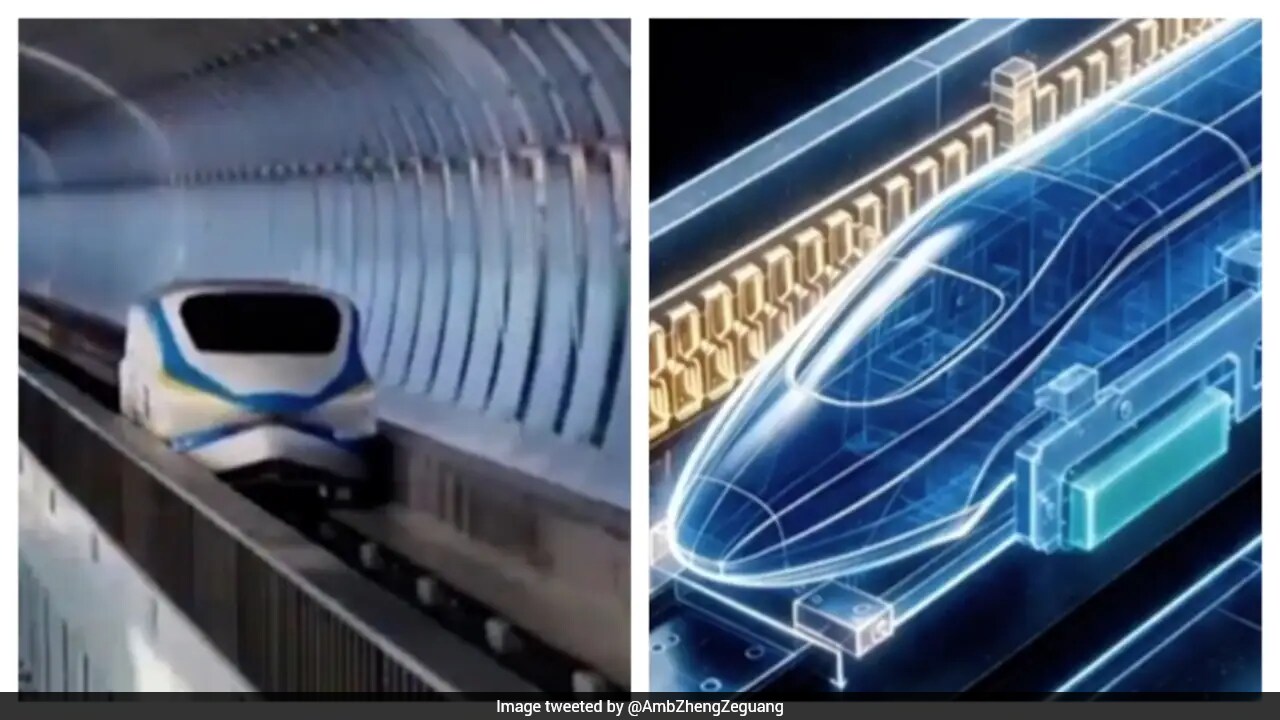
The recent test run at the Hubei East Lake Laboratory, where a 1.1-metric-ton maglev model vehicle accelerated from zero to 799.84 kilometers per hour in 5.3 seconds, represents an engineering milestone in linear synchronous motor performance rather than a functional preview of public transit. Media reports frequently conflate laboratory-scale model testing with commercial readiness. Deconstructing this achievement requires separating the underlying electromagnetic mechanics from the systemic scaling barriers that prevent immediate passenger application.
The Mechanics of Ultra Short Distance Acceleration
The test platform operates on a one-kilometer high-speed track utilizing electromagnetic propulsion. Thrust is generated via alternating magnetic fields within stator coils embedded in the guideway acting upon onboard permanent magnets, forming a linear synchronous motor.
Reaching 800 kilometers per hour within 5.3 seconds over a fraction of the total track length demands extreme power density. The physics of this acceleration profile involve several quantifiable parameters:
- Kinetic Energy Generation: A 1,110-kilogram vehicle moving at 222.2 meters per second generates kinetic energy exceeding 27 megajoules accumulated in slightly over five seconds.
- Transient Power Supply: The electrical grid infrastructure must deliver massive current spikes instantaneously, requiring localized capacitive storage or specialized flywheel energy systems to avoid destabilizing the regional power supply.
- Thermal Management: Rapid switching frequencies in the stator coils generate intense localized heat dissipation challenges, requiring active thermal management even during brief operational windows.
The test vehicle maintained stable levitation throughout the run, eliminating mechanical wheel-rail friction. At these velocities, air resistance scales quadratically, meaning aerodynamic drag management on an open-air or partial-tube test track dictates the upper bound of the vehicle's instantaneous acceleration limits.
The Deceleration Vector and Precision Control
An overlooked component of high-speed transit physics is the stopping phase. The test vehicle successfully initiated a controlled stop within roughly 200 meters from peak velocity.
Accomplishing deceleration from 800 kilometers per hour over such a short distance induces extreme G-forces on the chassis. While an empty 1.1-metric-ton model vehicle experiences structural loads safely within material tolerances, human physiology sets a strict boundary for passenger transport. Sustained deceleration exceeding 4G would cause physiological incapacitation for untrained travelers, meaning any human-rated implementation of this system would require a braking distance nearly ten times longer than the test track permits.
Simultaneously, the control architecture achieved millimeter-level positioning accuracy. Maintaining precise air gaps between the vehicle and the guideway while subjected to transient magnetic forces requires closed-loop feedback systems operating at microsecond intervals. Any latency in the levitation control loop at 222 meters per second risks catastrophic physical contact between the vehicle chassis and the track infrastructure.
Scaling Hurdles and Economic Constraints
The transition from a 1.1-ton laboratory model to a full-scale passenger train introduces non-linear cost and engineering functions.
The primary bottlenecks governing commercial viability include:
- Energy Intensity: Power consumption scales exponentially with speed due to aerodynamic drag. Propelling a multi-car passenger train weighing 50 metric tons or more to 800 kilometers per hour demands gigawatt-scale power availability along the entire corridor.
- Infrastructure Capital Expenditure: Tolerances for high-speed maglev guideways require sub-millimeter alignment stability. Thermal expansion of steel and concrete over long distances introduces geometric distortions that necessitate active alignment systems or evacuated tube enclosures, driving capital expenditures skyward.
- Acoustic and Pressure Shockwaves: Uncontained vehicles moving at transonic speeds generate severe sonic booms and atmospheric pressure transients, making open-air transit at these velocities regulatorily unfeasible near populated zones.
Alternative Industrial Applications
Because passenger deployment remains economically and physically impractical for regional commuting networks, the underlying technology targets alternative use cases where short-track, high-acceleration electromagnetic propulsion provides distinct operational advantages.
Aerospace electromagnetic launch assistance systems represent a primary beneficiary. Utilizing maglev sleds to accelerate cargo rockets, unmanned aerial vehicles, or aircraft initial stages before takeoff reduces onboard propellant mass requirements, increasing payload capacity. Similarly, industrial material handling equipment and heavy-load vertical transport systems can adapt these transient power supply and high-speed levitation control methods to eliminate mechanical wear in high-cycle environments.
Implement a phased diagnostic protocol focusing exclusively on closed-loop thermal regulation within the stator coils before scaling the linear synchronous motor architecture to heavier payload classes.