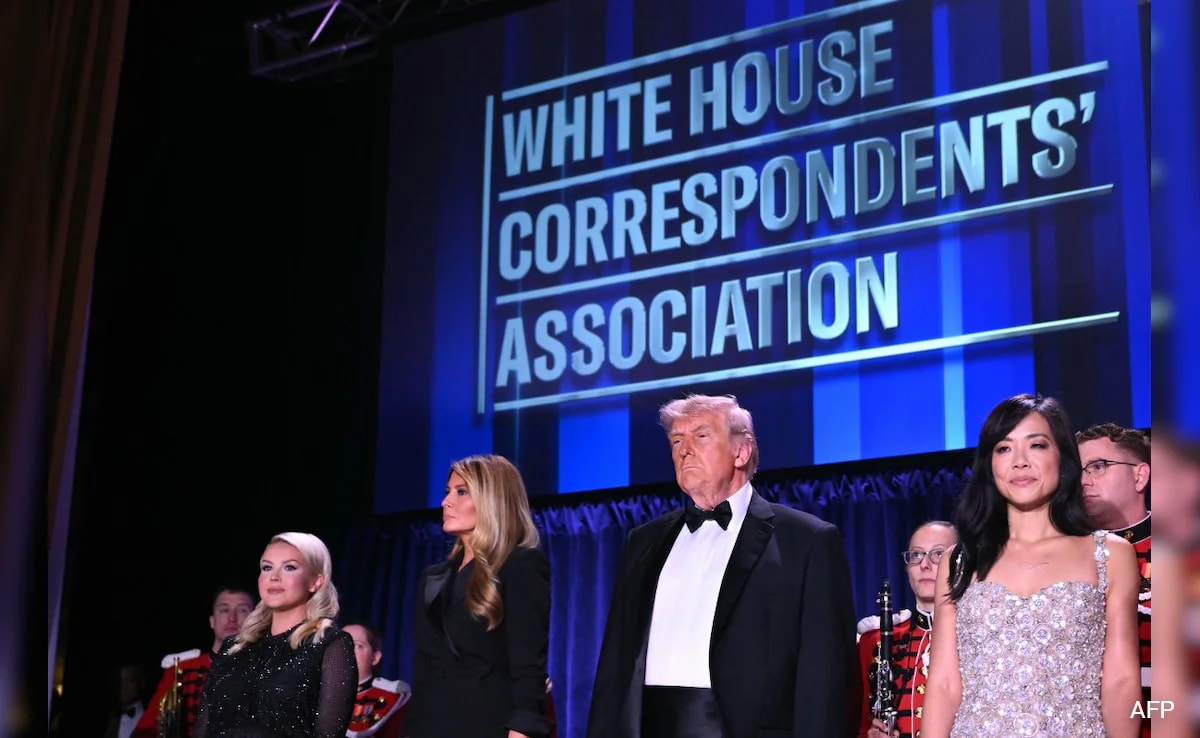
A startling 24% of Americans now believe the April assassination attempt on President Donald Trump at the White House Correspondents’ Dinner was a staged performance. This isn't a fringe whisper on a dark web forum; it is a mainstream breakdown of shared reality. Despite high-definition cameras, hundreds of witness testimonies from the nation’s top journalists, and a detailed federal indictment against suspect Cole Tomas Allen, nearly one in four citizens across the country view the event as a calculated theatrical production.
The data, pulled from a recent NewsGuard/YouGov survey, suggests that the United States has moved beyond mere political polarization. We have entered an era where physical evidence is secondary to tribal narrative. When the facts of a localized event—bullets fired, a gunman apprehended, a ballroom in chaos—cannot be agreed upon by a quarter of the population, the mechanisms of a functioning democracy begin to seize.
The Architecture of Doubt
The skepticism surrounding the Washington Hilton shooting follows a predictable, if grim, pattern. This was the third such threat against Trump in two years, following the 2024 incidents in Butler, Pennsylvania, and West Palm Beach. The "staged" narrative has gained significant ground with each successive event. In Butler, roughly 24% also believed the event was fake. By the time the shots rang out in the Washington Hilton ballroom this past April, the skepticism had hardened into a default setting for a large swath of the electorate.
This skepticism is not evenly distributed. The poll found that 34% of Democrats believe the dinner shooting was staged, compared to 13% of Republicans. While the "Blue Anon" phenomenon—left-leaning conspiracy theories—accounts for the bulk of these numbers, the 13% of Republicans doubting the event is perhaps the more significant data point. It represents a "splintering" within the MAGA base, where even the most loyal supporters are starting to view the administration’s narrative through a lens of suspicion.
| Event | Date | Believe Staged | Unsure |
|---|---|---|---|
| Butler Rally | July 2024 | 24% | 29% |
| West Palm Beach | Sept 2024 | 16% | 36% |
| Correspondents' Dinner | April 2026 | 24% | 32% |
Why the Eyes No Longer Believe
The "how" behind this mass disbelief is rooted in a total collapse of institutional trust. In previous decades, a shooting witnessed by the entire White House press corps would have been an indisputable historical fact. Today, the presence of those journalists is exactly what fuels the fire. To a skeptical public, the "mainstream media" is not a witness; it is a co-conspirator.
Social media amplifies this by rewarding speed over accuracy. Moments after the shooting, users on X and TikTok were already dissecting grainy footage, claiming that Secret Service response times were "too slow to be real" or that the President’s reaction was "too cinematic." These digital detectives aren't looking for the truth. They are looking for "glitches in the matrix" that confirm their existing distaste for the political figure in question.
There is also the matter of the "Trump Ballroom" controversy. Federal prosecutors recently used the shooting as a reason to push for the completion of a $400 million ballroom project at the White House, arguing that the current venues are a security nightmare. For critics, this timing is too convenient. They see a direct line between a security breach and a budget request, concluding that the former was manufactured to justify the latter.
The Youth Disconnect
The most alarming demographic shift involves Americans aged 18 to 29. This group was the most likely to believe all three assassination attempts were staged. This generation has been raised in an environment of deep-fakes, curated influencers, and a constant stream of "exposed" secrets. For them, the idea that a world-changing event is a "psyop" is more plausible than the idea that a lone, disgruntled individual could get past the most elite security detail in the world.
When a young person sees a headline, their first instinct is often to ask who is profiting from the news. In the case of the Washington Hilton, they see a President gaining a polling bump and a Justice Department gaining more funding. In their eyes, the motive for a hoax is clearer than the motive for a murder.
The Cost of Cynicism
The White House has taken a blunt approach to these numbers. Spokesman Davis Ingle recently called those who believe the event was staged "complete morons." While perhaps cathartic for the administration, this rhetoric only deepens the divide. It reinforces the "us vs. them" mentality that feeds conspiracy culture. If the authorities call you a fool for questioning the narrative, you become more convinced that the narrative is a lie.
The reality of the investigation into Cole Tomas Allen paints a much more mundane, yet terrifying, picture. Allen, a 28-year-old former computer engineer, left behind a trail of digital grievances that suggest a man struggling with isolation and a desperate need for significance. His actions were not a grand play directed by a shadow government, but the violent outburst of a radicalized individual.
The danger is that as 25% of the country retreats into a world of "staged" events, the real threats become harder to manage. If a large portion of the public does not believe political violence is real, they will not support the measures necessary to prevent it. They will view every security upgrade as a power grab and every arrest as a political kidnapping.
We are living in a country where the floor of objective fact has fallen out. If we cannot agree that a man with a gun in a room full of witnesses is a reality, there is very little left that we can agree on. The survey is a warning. The next time shots are fired, the number of people who believe their own eyes may be even smaller.
The Psychology of Conspiracy Theories
This video explores how political violence and the subsequent media coverage can inadvertently fuel the very conspiracy theories that undermine public trust.