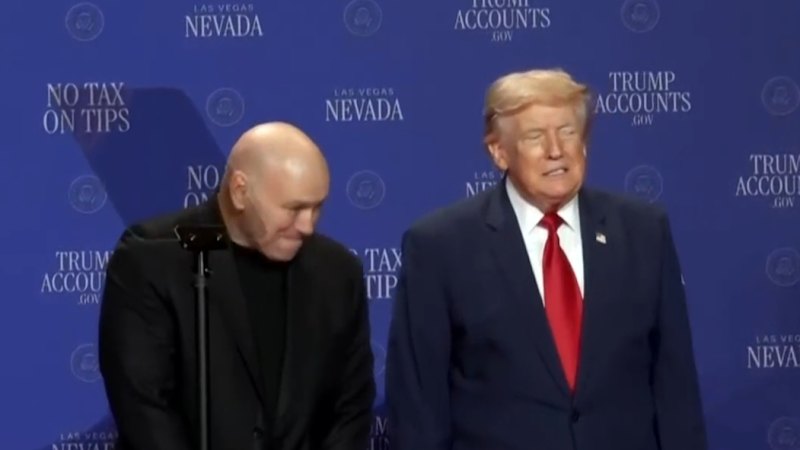
Every political pundit in Washington is clutching their pearls over the same tired headline. They see the words "Trump," "UFC boss," and "White House press secretary" in the same sentence, and their collective brains short-circuit.
The lazy consensus is predictable. Legacy media outlets frame the entire premise as a circus act—an insult to the sacred decorum of the James S. Brady Press Briefing Room. They argue that a fight promoter has no business standing behind the podium where seasoned Beltway operatives have spent decades carefully massaging talking points. For another perspective, check out: this related article.
They are completely missing the point.
If you strip away the pearl-clutching and look at the actual mechanics of modern political communication, Dana White isn't an unqualified outsider. He is arguably the most overqualified candidate to ever be floated for the job. The Beltway press corps isn't terrified that Dana White would fail at the podium. They are terrified because he would expose how obsolete their entire business model has become. Similar reporting on this trend has been shared by USA Today.
The Myth of the Polished Beltway Spox
For thirty years, Washington has operated under a rigid, unspoken rule about what a press secretary is supposed to be. You hire a former campaign communications director, a Hill staffer, or a cable news panelist. They wear an expensive suit, memorize a binder full of vetted non-answers, and spend forty-five minutes executing a masterclass in linguistic evasion.
I have sat in crisis-communications war rooms and watched executives burn millions of dollars on this exact playbook. They hire former political flacks to "manage the narrative." Nine times out of ten, it is a disaster. Why? Because modern audiences have developed an allergic reaction to polished corporate and political speak. When a spokesperson pivots away from a direct question with a rehearsed talking point, the audience doesn't think, What a deft display of message discipline. They think, This person is lying to me.
Message discipline—the practice of repeating a pre-approved phrase regardless of the question asked—used to be the gold standard of public relations. Today, it is a liability. In an era of fragmented media and zero institutional trust, sounding like a politician is the fastest way to lose an audience.
Washington pundits assume the press secretary's primary job is to appease the fifty reporters sitting in the briefing room. That was true in 1995. It is dead wrong now. The briefing room is a television set, and the reporters are just props. The real audience is the millions of people watching thirty-second clips on their phones.
Nobody on earth understands the mechanics of the thirty-second clip better than Dana White.
The Attention Economy vs. The Briefing Room
To understand why White breaks the Washington mold, you have to look at what he actually built. In 2001, when Zuffa bought the Ultimate Fighting Championship for $2 million, mixed martial arts was banned in almost every major state, kicked off cable pay-per-view, and treated as human cockfighting by the mainstream press.
White didn't save the UFC by hiring polite lobbyists to beg the New York Times for favorable coverage. He saved it by bypassing the gatekeepers entirely and weaponizing unfiltered confrontation.
Look at the numbers. Under White's leadership, the UFC grew from a bankrupt fringe spectacle into a combat sports juggernaut that Endeavor valued at over $12 billion when it merged with WWE to form TKO Group Holdings. You do not build a twelve-billion-dollar media empire by accident, and you certainly don't do it by reading off a teleprompter.
White's secret weapon has always been his post-fight press conferences. While other sports commissioners hide behind PR statements and release sanitised press notes, White sits in front of a bank of microphones at two in the morning, completely unscripted, and takes every single question until the room runs out of them.
He doesn't dodge. He doesn't pivot. When a reporter asks a stupid question, he tells them it's a stupid question. When he makes a mistake, he owns it in plain English. And when a narrative threatens his business, he dismantles it live on camera with blunt, aggressive candor.
Compare that to a standard White House press briefing. A typical briefing is an exercise in mutual exhaustion. Reporters ask gotcha questions designed to generate a partisan headline; the press secretary reads a pre-written paragraph from a thick binder; nobody learns anything; everyone goes home.
Imagine a scenario where Dana White steps up to that podium. There is no binder. There is no "I'll have to circle back to you on that." If a White House correspondent tries a three-part hypothetical trap question, White wouldn't try to dance around it. He would look them dead in the eye, dismantle the premise of the question in ten seconds, and move on to the next reporter.
The dynamic in that room would shift overnight. The press corps relies on the press secretary playing by the rules of Washington etiquette—rules that force the spokesperson to remain polite even when being ambushed. White does not care about etiquette. He cares about winning the exchange.
Dismantling the "Unqualified" Fallacy
Whenever the topic of White entering politics comes up, critics immediately raise the same three objections. Every single one of them is built on a flawed premise.
Would Dana White actually take the job?
This is the most common question floating around search engines, and it exposes how little people understand executive leverage. No, he wouldn't take it—not because he isn't wanted, and not because he couldn't do it, but because it would be a massive demotion.
The White House press secretary makes roughly $180,000 a year, works eighteen hours a day, gets subpoenaed by Congress, and ages ten years in twenty-four months. Dana White is the CEO of a multi-billion-dollar global sports league, makes tens of millions of dollars annually, and answers to almost nobody. Floating White for press secretary isn't a serious HR recruitment effort; it is a trial balloon and a political flex. Trump routinely floats high-profile loyalists for cabinet or staff roles to test media reactions and signal the style of administration he wants to run.
Doesn't a press secretary need deep policy expertise?
Beltway insiders love to claim that the press secretary must be an encyclopedia of legislative minutiae and foreign policy doctrine. This is pure institutional gatekeeping.
Think about the actual history of the role. Did C.J. Cregg—the fictional archetype Washington still worships—exist in real life? No. In the real world, administrations have hired journalists, campaign strategists, and cable TV personalities who had to be briefed by the National Security Council and the Office of Management and Budget every morning before going on camera.
A press secretary is not a policymaker. A press secretary is a communicator. Their job is to take complex policy decisions made by the cabinet and translate them into a language that the public understands and remembers. White has spent twenty-five years taking complex athletic commission regulations, broadcast rights deals, and fighter contract disputes and translating them into viral soundbites that sell pay-per-views. The underlying mechanics of translation are identical.
Wouldn't his temper cause a diplomatic incident?
Here is where the contrarian argument requires total honesty. Yes, this is the real risk, and pretending otherwise would be naive.
In sports promotion, burning a bridge with a journalist or calling a critic an idiot has zero geopolitical consequences. At the White House podium, every single syllable is analyzed by foreign intelligence agencies, bond markets, and military allies. An off-the-cuff insult aimed at a foreign leader—or an imprecise statement about a troop deployment—can move currency markets or escalate an international crisis in seconds.
White's greatest strength as a promoter is his lack of a filter. In the West Wing, a total lack of a filter is a loaded weapon. If you put a brawler behind the podium without a disciplined national security apparatus keeping him briefed on the red lines, you are courting chaos.
What Every Communicator Can Learn From the UFC Playbook
Whether Dana White ever sets foot in the West Wing is beside the point. The fact that the idea even resonates—and sends traditional media into a panic—proves that the old rules of public communication are dead.
If you run a company, lead a brand, or manage a public profile, you are facing the exact same shift in media consumption. Legacy gatekeepers have lost their monopoly on distribution. Your audience is skeptical, distracted, and allergic to corporate jargon.
If you want to survive in this environment, stop hiring polite spokespeople to read safe scripts. Adopt the promoter's playbook instead:
- Kill the script. People can tell when you are reading or reciting a memorized talking point. Know your three core facts cold, throw away the notes, and speak in the exact same cadence you use at a dinner table.
- Attack the premise, not just the question. When a critic or reporter asks a loaded question, don't accept their framing and try to defend yourself inside it. Call out the flaw in their premise immediately. If someone asks, "Why is your product failing?" you don't say, "Well, we're experiencing transitional headwinds." You say, "It's not failing—revenue is up forty percent, and you're looking at outdated metrics."
- Never let a bad narrative marinate. Traditional PR advises waiting twenty-four hours to gather all the facts and issue a carefully worded statement. By the time your lawyers approve that statement, the internet has already convicted you. Respond fast, respond directly, and take the hit in public if you were wrong.
- Understand who the real audience is. Stop trying to impress the critics, the trade press, or your industry peers. They aren't buying your product, and they aren't casting the votes. Speak directly to the end user, even if it makes the insiders cringe.
Washington's political class hates the idea of Dana White at the podium because he represents an existential threat to their cozy ecosystem. For decades, the press corps and the press secretary have performed a mutually beneficial kabuki dance. The reporters pretend to hold power to account; the spokesperson pretends to answer their questions; both sides walk away feeling important.
White wouldn't play along with the dance. He would kick over the table, turn on the house lights, and talk directly to the people watching at home. And once the public sees that kind of unfiltered combat at the podium, they will never tolerate a rehearsed politician again.