What Actually Happens When You Cry in Zero Gravity
Your lacrimal glands don't stop producing moisture just because you've left Earth's atmosphere. You can cry in orbit. The emotional trigger works identically, and the tears form normally.
The problem starts the moment those liquid drops leave your tear ducts.
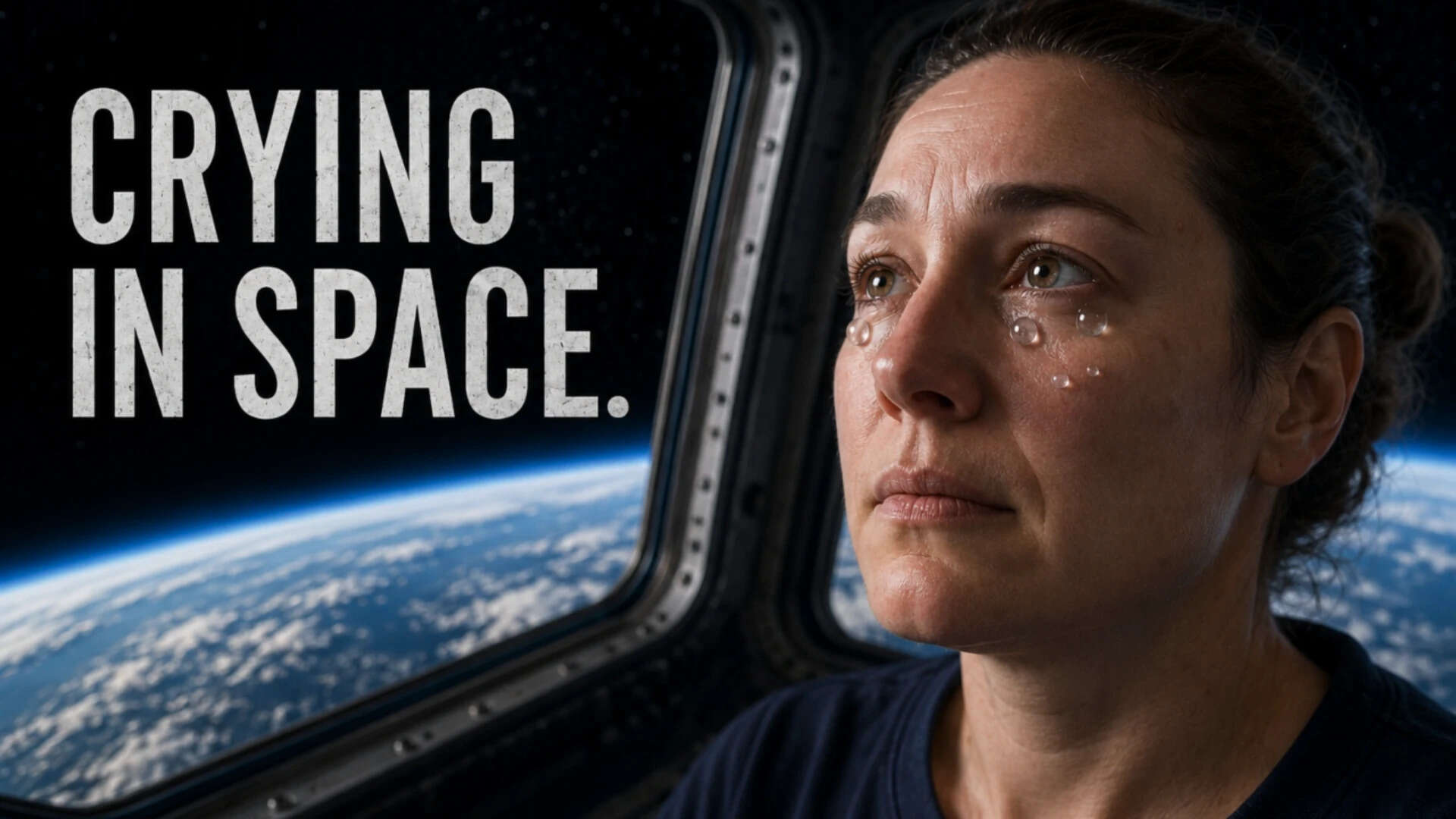
On Earth, gravity pulls liquid straight down your cheeks. In microgravity on the International Space Station, tears don't roll down. They don't float away into the cabin either, at least not initially. Surface tension takes over. Liquid adheres tightly to itself and to the human skin surrounding your eyes.
Instead of a dramatic, single tear cascading down a cheek, crying in orbit creates a growing, watery blob over your eye. Keep crying, and that liquid bubble expands across your nose until it engulfs both eyes, blinding you until you physically wipe it away with a cloth.
Physics of Liquid in Microgravity
Water behaves weirdly in space. Without downward gravitational pull competing against surface tension, water molecules prefer to cling tightly to each other and nearby surfaces.
Canadian astronaut Chris Hadfield famously demonstrated this phenomenon aboard the space station. Since he couldn't cry on command, he squirted fresh drinking water directly into his eye to simulate tears.
The result was immediate. The liquid didn't drip. It inflated into a glossy, bulging sphere resting against his eyeball.
- Surface tension dominates: Water clings tightly to the eyeball and skin.
- Zero drainage: The lacrimal punctum (your eye's natural drain) can't clear the excess fluid fast enough without gravity aiding the process.
- Stinging sensations: Human tears contain salt. On Earth, tears flush out quickly. In space, that salty mass sits directly on the cornea, causing intense irritation.
If you don't dab the liquid away with a towel, the saline mass keeps growing until surface tension breaks or it migrates toward your nose, ears, or mouth.
Why Tears inside a Spacesuit Are a Major Threat
A floating bubble of tear water inside a space station is an annoyance. Inside an Extravehicular Mobility Unit (EMU)—a spacesuit during an extravehicular activity (EVA)—it becomes a life-threatening hazard.
You can't reach inside a pressurized helmet to wipe your face.
Italian astronaut Luca Parmitano experienced this nightmare scenario firsthand in July 2013. During an EVA outside the ISS, water from his suit's liquid cooling garment leaked into his helmet. Because of microgravity, the liquid didn't pool in the boots of his suit; it migrated straight to his head.
The water covered his eyes, nose, and ears. He was completely blinded, couldn't hear radio communications properly, and risked drowning in his own helmet before he managed to navigate back to the airlock blindly using memory and tether points.
Emotional tears or eyes watering from chemical irritants trigger the exact same physical response. During a 2001 spacewalk, astronaut Chris Hadfield got a anti-fog chemical solution in his eye. His eye watered profusely to flush it out. The resulting tear blob spread across both eyes, temporarily blinding him in the vacuum of space. He had to blow air inside his helmet to dislodge the water bubble enough to regain partial vision.
"Your eyes will definitely cry in space, but the big difference is tears don't fall. So grab a hanky." — Chris Hadfield
How Astronauts Manage Eye Moisture and Tears
NASA and ESA don't ban emotional expression, but astronauts learn quickly to manage face moisture.
- Always keep absorbent towels nearby: Station crew members carry microfiber wipes in their flight suit pockets.
- Use the Valsalva device in helmets: Space helmets have a small foam piece attached near the chin. Intended to help clear ears during pressure changes, astronauts can also rub their faces against it in an emergency to clear moisture from their eyes or nose.
- Rely on environmental controls: ISS airflow systems constantly circulate air to prevent moisture blobs from hanging motionlessly in the cabin atmosphere, encouraging gradual evaporation.
If you ever find yourself working in low-Earth orbit, keep a towel within arm's reach before watching an emotional movie—or doing a routine maintenance walk.