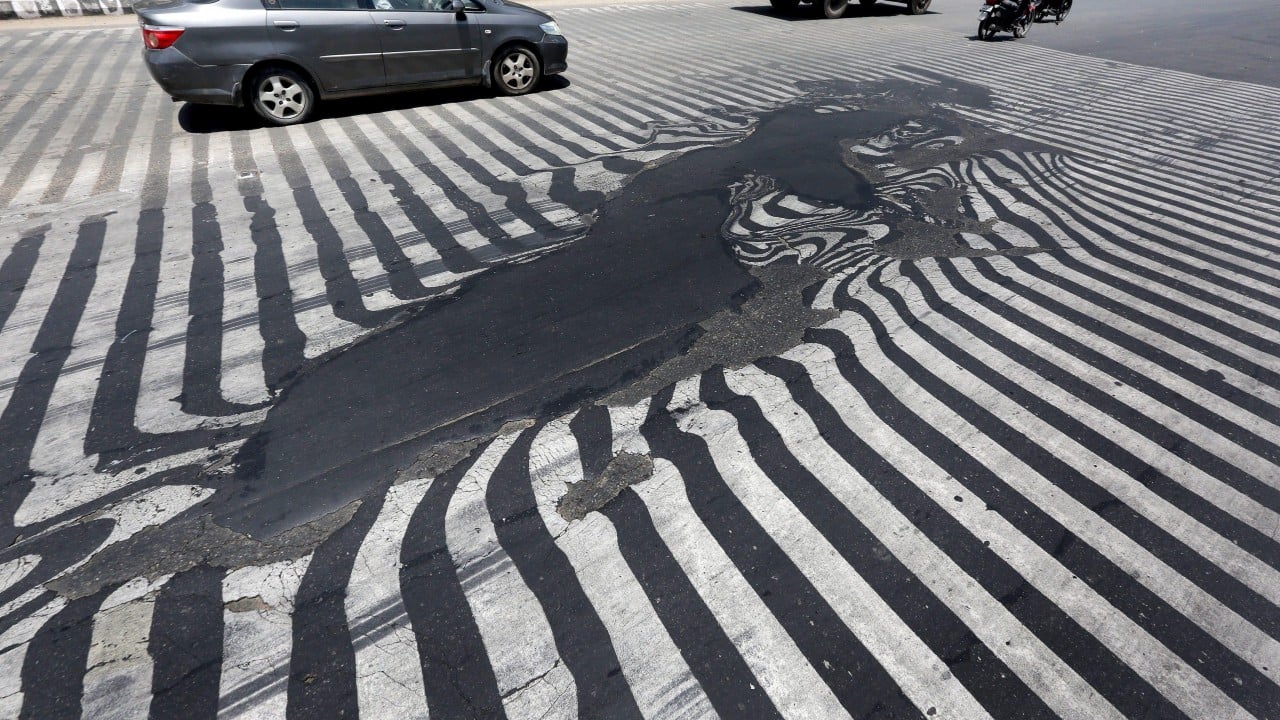
The air over the expressway shimmered at 114 degrees Fahrenheit, bending light into oily pools that vanished the moment you tried to reach them. Elena gripped the steering wheel, her knuckles pale, the cabin air conditioning blowing a frantic, futile whistle against the furnace outside.
Then came the jolt.
It was not a pothole. It was a violent, upward strike, as if the sedan had hit an unyielding stone wall hidden beneath the blacktop. The front passenger tire hissed, deflating instantly. Behind her, a semi-truck groaned, its driver wrestling with a chassis suddenly thrown off-kilter by a ridge of asphalt that had pushed upward, curling toward the sky like a baked crust of bread.
Roads do not just sit there. They breathe. They sweat. And when summer pushes them past their breaking point, they break.
We treat asphalt and steel as permanent monuments. We pour millions of tons of aggregate and bind it with petroleum, laying it across continents like a dark, flat promise of unhindered movement. We assume it is inert. We assume it is safe. But beneath the heavy rumble of morning commutes and midnight freight trains, the ground is cooking, and the materials we rely upon to connect our world are quietly losing their minds.
Consider what happens next: the bill arrives.
Who pays when overheated roads melt and rails buckle? The simple answer points to taxpayers, municipal budgets, and freight companies absorbing millions in delayed cargo. But that accounting misses the human toll. It misses the nurse missing a shift because a railway line warped under the midday sun, halting commuter trains for six agonizing hours. It misses the small-business owner whose daily shipment of perishable goods spoiled on a baking tarmac while crews hacked away at buckled concrete with jackhammers.
This is not a freak occurrence. This is the new baseline.
For decades, civil engineers designed our infrastructure using historical climate data as a crystal ball. They looked backward to predict forward. They poured mixes calibrated for summers that no longer exist, utilizing performance-graded asphalt binders tested for a maximum threshold that modern heatwaves routinely shatter. When a binder designed for a high temperature of 58 degrees Celsius encounters a pavement surface baking at 65 or 70 degrees Celsius—a routine occurrence during prolonged heat domes—the solid ground transforms into a thick, slow-moving fluid.
You can watch it happen in real-time. Heavy trucks leave deep, permanent ruts in the slow lane, pushing the soft asphalt into ridges that catch rainwater and hydroplane unsuspecting drivers.
Railroads suffer an even more unforgiving fate. Steel is stubborn. It wants to expand when heated, but steel rails are bolted down tightly to ties, locked in place to keep trains from derailing on straightaways. When the heat rises past critical thresholds, that trapped thermal stress has nowhere to go. The rail looks for relief. It bows outward or upward in a terrifying phenomenon known as sun kinks. A track that was straight an hour ago suddenly develops a violent lateral wave.
Imagine a freight locomotive barreling down the line at sixty miles per hour, carrying thousands of gallons of ethanol or consumer goods. The engineer spots the distortion too late. The brakes lock, sparks fly, and tons of heavy machinery jump the track.
This is the hidden cost of thermal fatigue.
Municipalities across the globe are caught in a reactive loop. They patch the blowout, level the buckled rail, and cross their fingers for autumn. Yet patching a symptom does nothing to cure the disease. Every dollar spent on emergency repairs is a dollar stolen from long-term adaptation.
Who bears the burden? The commuter waiting on a sun-baked platform, watching departure boards flicker with endless delays. The city dweller breathing toxic fumes from idling traffic backed up for miles behind a melted stretch of interstate. The municipal treasurer watching a contingency fund evaporate by July.
We built a civilization on materials that despise the sun, and the sun is losing patience.
Change requires a fundamental surrender of our architectural hubris. We cannot simply pour more of the same stuff and hope for a milder summer. Forward-thinking jurisdictions are beginning to rewrite their specifications, demanding polymer-modified binders that resist rutting at extreme temperatures. They are painting concrete surfaces with solar-reflective coatings to bounce the heat away before it penetrates the substrate. Railway operators are deploying continuous optical fiber sensors along tracks to detect micro-strains before a rail decides to snap sideways.
These interventions cost money upfront. They require political courage and long-term vision in a fiscal landscape obsessed with quarterly savings.
Elena finally got her car onto the shoulder, stepping out into a wall of heat that felt less like weather and more like a physical presence. Down the highway, emergency flashing lights strobed against the blinding glare. Traffic was deadlocked for three miles in either direction.
The asphalt beneath her sneakers was tacky, yielding softly to her heel, leaving a small imprint of a shoe in the skin of the road.
The road remembers every vehicle that crosses it, and it keeps a tally of every degree we add to the sky.