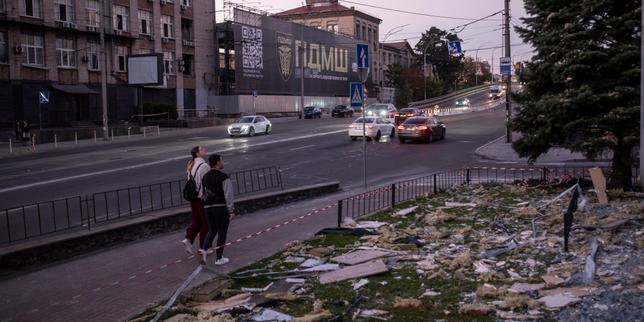
The air in Kyiv does not smell like gunpowder at first breath. It smells like damp asphalt, wet chestnut leaves, and the sharp, metallic tang of an electric tram braking too hard against the rails. But walk long enough down Volodymyrska Street, past the skeletal remains of a storefront where a bakery used to sell warm poppy seed rolls, and the scent changes. It turns into the dry, chalky odor of pulverized brick and old dust.
War in the twenty-first century is rarely a cinematic parade of marching boots. Here, it is an atmosphere. It settles into the margins of daily life like a fine, gray frost.
Consider the rhythm of a Tuesday afternoon in the capital. A young woman named Olena adjusts her headphones, her laptop balanced on a cracked ceramic table at an outdoor café. She is debugging code for a logistics firm in Munich. Two tables away, an elderly man in a faded windbreaker reads a crossword puzzle, a cane hooked over his chair. Above them, the sky is a brilliant, mocking shade of blue—the kind of spring afternoon that poets write about in peacetime.
Then, the phone in Olena’s pocket stutters with a low, vibrating hum.
It is not a call. It is an application. Air raid alert. Seek shelter immediately.
Neither Olena nor the old man flinches. They have memorized this choreography. The laptop closes with a sharp snap. The crossword puzzle is folded into quarters and tucked inside a pocket. They walk, at a measured, stubborn pace, toward the nearest metro station—not running, because running feels like panic, and panic is a luxury the city abandoned long ago. Down the concrete stairs they go, past the turnstiles where the ticket agents sit knitting behind bulletproof glass, deep into the subterranean labyrinth where the platform smells of ozone and damp wool.
This is the permanent war. It is not defined solely by the thunderous concussions of Patriot interceptors or the sudden, jagged orange flash of a Shahed drone chewing through the night sky. It is defined by the erosion of the ordinary. It is the psychic weight of living in a place where survival has become an administrative task.
The enemy outside the gates is not a faceless abstraction. It is systematic. Across the rolling hills of Ukraine, from the scarred industrial corridors of the east to the battered outskirts of the capital, the strategy is one of slow attrition. The objective is not merely to take territory, but to exhaust the spirit. To make the water run cold, to make the lights flicker, to make the act of waking up and making coffee feel like an act of quiet defiance.
Yet, life persists in the cracks of the wreckage.
Walk through the Bessarabsky Market on a Saturday morning, and you will find pyramids of scarlet radishes, jars of golden sunflower honey, and women selling bundles of fresh dill wrapped in newspaper. The prices are higher than they were three years ago. The supply chains are haunted by the ghost of blocked ports and bombed bridges. But the radishes are there. The merchants still argue playfully over the weight of a kilogram of potatoes.
"If we stop selling," a vendor named Mykola tells me, his hands blackened by grease and soil as he wipes them on a stained apron, "they win twice. First they take our land, then they take our appetite."
Mykola is fifty-two. Before the full-scale invasion, he ran a small auto-repair shop in Bucha. He lost the shop, his home, and his younger brother in the opening weeks of the onslaught. Now, he lives in a cramped sublet on the left bank of the Dnieper River, commuting two hours each way to sell root vegetables in the city center. When asked how he bears it, he does not offer a patriotic slogan. He simply points to a crate of crisp, green apples.
"You don't carry the whole war on your back," he says quietly. "You carry today. Tomorrow is none of your business until you wake up and find it has arrived."
This compartmentalization is the psychological armor of Kyiv. To survive here, one must master the art of the split consciousness. Half of your brain is calculating the trajectory of a ballistic missile reported by an OSINT Telegram channel; the other half is remembering to pick up dry cleaning before the curfew starts at midnight.
The physical city bears the scars of this dual existence with stoic grace. Historic facades are wrapped in heavy scaffolding and sandbags, like ancient statues mummified to protect them from flying glass. Saint Sophia’s golden domes still catch the morning light, gleaming above the square where pigeons flutter around monuments wrapped in corrugated iron. Every park bench has a story; every pothole is a reminder of a near miss.
Foreign journalists often look for grand metaphors in the ruins. They want a narrative of total despair or unyielding, Hollywood-style heroism. But reality is far more complex, messier, and infinitely more human. There are days of crushing fatigue—days when the siren wails four times before noon, keeping children in damp basements and turning school lessons into crackling Zoom calls conducted from bathroom floors. There are moments of cold, blinding rage when the power cuts out for eighteen hours straight, freezing the pipes and plunging apartment towers into medieval darkness.
And then there is the resilience that defies logic.
In a courtyard off Podil, young musicians set up an acoustic guitar and a battered upright piano on the back of a flatbed truck. Passersby stop. Someone opens a bottle of cheap Ukrainian wine and passes it around. A woman in a sharp business suit begins to sway to the rhythm, her high heels clicking softly against the paving stones. For twenty minutes, the war is pushed back to the edges of consciousness, contained by chords and human voices rising into the evening chill.
The world outside often grows weary of the cadence of conflict. News cycles shift. Attention spans fracture. Headlines about air defense packages and energy grids blur into background noise for people living thousands of miles away. But for the millions who walk these streets, the stakes remain absolute. They are not fighting for a geopolitical theory or a diplomatic compromise. They are fighting for the right to sit at a café table without checking the sky, to read a book in a room with the lights on, to live a life that belongs to them rather than to an aggressor's whim.
Dusk falls over the Dnieper. The water turns the color of hammered pewter, reflecting the silhouettes of the bridges that connect the two halves of the city. The curfew siren begins its low, mournful wail, signaling the end of the day's fragile truce with the sky.
In a high-rise apartment on the eleventh floor, Olena turns on a small battery-powered lamp. The main power is out again. She pours herself a cup of cold tea, sits down by the window, and opens her laptop. The screen casts a pale blue glow across her face. Outside, the city is silent, dark, and impossibly watchful, waiting for the dawn that it knows, with quiet certainty, will come anyway.