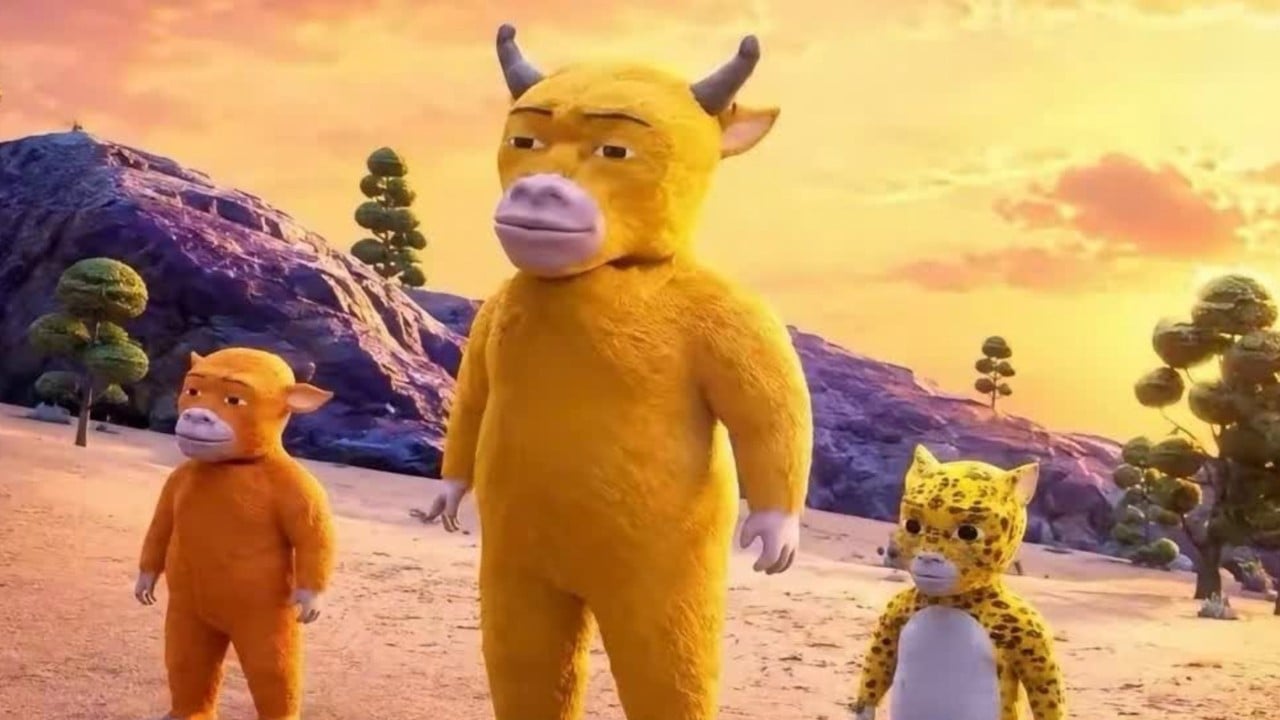
Western media pundits love a patronizing storyline. Whenever something raw, weird, and low-budget emerges from China and captures hundreds of millions of screens, the cultural commentariat reaches for the same tired script. They call it a quirky phenomenon. They frame it as a grassroots rebellion against heavy-handed censorship. They write think pieces about crude animations reshaping viewing habits through sheer accidental charm.
They are completely, embarrassingly wrong.
What is happening right now in Chinese digital entertainment is not a cute accident. It is a calculated, brutal dismantling of traditional Hollywood prestige formats. While legacy studios in Los Angeles and Beijing hemorrhage billions chasing cinematic universes and sterile high-definition gloss, indie creators and nimble digital houses are weaponizing internet absurdity. They are building a new attention economy fueled by speed, irony, and total contempt for conventional narrative structure.
I have watched traditional production executives burn entire quarters of cash trying to reverse-engineer viral hits, missing the plot every single time. They look at a chaotic flash-animation clip with crude voice acting and ask how to replicate the budget. That is like studying a lightning strike and trying to bottle the weather. The secret is not the cheap production values. The secret is the total abandonment of the audience-management model that has governed television for fifty years.
The Lazy Consensus of Artistic Decline
The standard media narrative goes like this: audiences are tired of over-regulated, state-approved dramas, so they are turning to messy, independent internet culture as a subversive outlet.
This view relies on a fundamental misunderstanding of how digital consumers actually behave. People do not watch low-fi digital shorts because they appreciate rough edges or low-resolution aesthetics as some kind of noble protest. They watch them because traditional prestige media has become an insufferable chore.
Look at modern streaming schedules. Every high-end drama demands a ten-hour commitment to a convoluted world-building exercise that eventually collapses under the weight of its own self-importance. Creators spend twenty minutes establishing atmospheric shots of empty landscapes before a single plot point occurs. Writers rooms treat pacing like a polite suggestion.
Crude digital animation and rapid-fire meme formats reject this bloat entirely. They operate on a principle of radical efficiency. If a joke does not land within three seconds, you swipe away. If a scene does not advance the premise, it gets cut. This format treats the viewer's attention not as an infinite resource to be milked, but as a scarce currency that must be earned continuously.
When Western critics dismiss these viral hits as primitive novelties, they reveal their own provincial bias. They assume that high production value equals high art, and that low-fi means low intellect. That hierarchy is dead. The market has moved past it, and crying about the loss of cinematic craft will not bring it back.
The Economics of Chaos
To understand why crude internet culture is winning, you have to look at the balance sheet. Traditional media relies on a high-risk, high-capital model. You spend one hundred million dollars on a project, lock down distribution, and pray that a global audience agrees to find it mildly entertaining for two hours. One misstep in casting or marketing wipes out the profit margin.
The new wave of Chinese digital content operates on asymmetric warfare economics.
By stripping away the layers of corporate bureaucracy, expensive render farms, and committee-driven script doctors, these creators drop production costs to near zero. When your overhead is pocket change, your risk profile changes completely. You can afford to be weird. You can afford to be offensive, hyper-specific, deeply cynical, or surreal. You do not need to appeal to a broad, homogenized global demographic to survive. You just need a hyper-engaged niche that shares your exact frequency of humor.
Imagine a scenario where a studio spends three years testing a concept through focus groups to ensure maximum demographic safety, only to release a show so sanded down of personality that nobody cares. Contrast that with a three-person team in a cramped apartment who animate a ridiculous, profane parody over a weekend. Which one captures the cultural zeitgeist? The one that speaks like a real human being rather than a corporate compliance department.
This economic reality breaks the old studio gatekeeping model. In the past, distribution was the ultimate bottleneck. If you did not own the broadcast towers or the cinema chains, you did not exist. Today, distribution is democratized, meaning the only remaining competitive advantage is velocity. Who can translate a cultural moment into content the fastest?
The answer is rarely the company with the biggest budget. It is always the team with the smallest approval chain.
Why the West Misreads the Subversion
Western analysts love to project their own political obsessions onto Chinese media. Every time a piece of counter-culture gains traction, foreign journalists rush to frame it as a heroic crusade against censorship.
This is lazy analysis. While censorship is a real and rigid boundary in the Chinese media landscape, it is not the primary driver of this content revolution. The primary driver is generational exhaustion.
Young audiences across Beijing, Shanghai, and secondary tech hubs are living through intense economic competition, brutal work hours, and hyper-saturated digital environments. They do not want escapism that lectures them about morality or offers slow-burn emotional catharsis. They want aggressive absurdity that matches the surreal pace of their daily lives.
When internet animators combine traditional idioms with modern internet slang, distorted voice modulation, and frantic visual gags, they are creating a shared dialect. It is a language designed to bypass the fatigue of modern existence. It says: the world is chaotic, expensive, and absurd, so let us laugh at the pixels instead of crying over the plot holes.
Prestige television asks you to suspend your disbelief. Crude internet culture asks you to suspend your need for dignity. The latter is a much easier sell when you are riding the subway home from a twelve-hour workday.
The Death of the Cinematic Universe
For a decade, Hollywood and its global imitators were hypnotized by the interconnected cinematic universe. The promise was simple: build a sprawling, endless narrative sandbox, hook the audience with recurring characters, and milk the intellectual property forever.
That model is currently choking on its own bloat. Audiences are experiencing severe franchise fatigue. The mechanics of world-building have become so transparent and mechanical that watching a new franchise launch feels like reading an instruction manual for a piece of furniture you didn't buy.
The viral wave of raw, bite-sized digital animation does the exact opposite. It rejects continuity in favor of the standalone gut punch. Characters can die, reappear, transform into abstract geometric shapes, or break the fourth wall entirely within the span of a ninety-second clip. There is no lore bible to memorize. There is no homework required to understand episode forty.
This is the ultimate evolution of content consumption. It respects the viewer's right to drop in and drop out without penalty.
If legacy entertainment companies want to survive this shift, they need to stop trying to protect their prestigious brands and start learning how to fail fast. They need to dismantle their expensive development pipelines and embrace the mess. But they won't. They are too invested in the myth that art requires a massive budget and a union crew to matter.
Let them keep funding their multi-million dollar vanity projects while the rest of the world clicks away to something weirder, faster, and infinitely more alive.