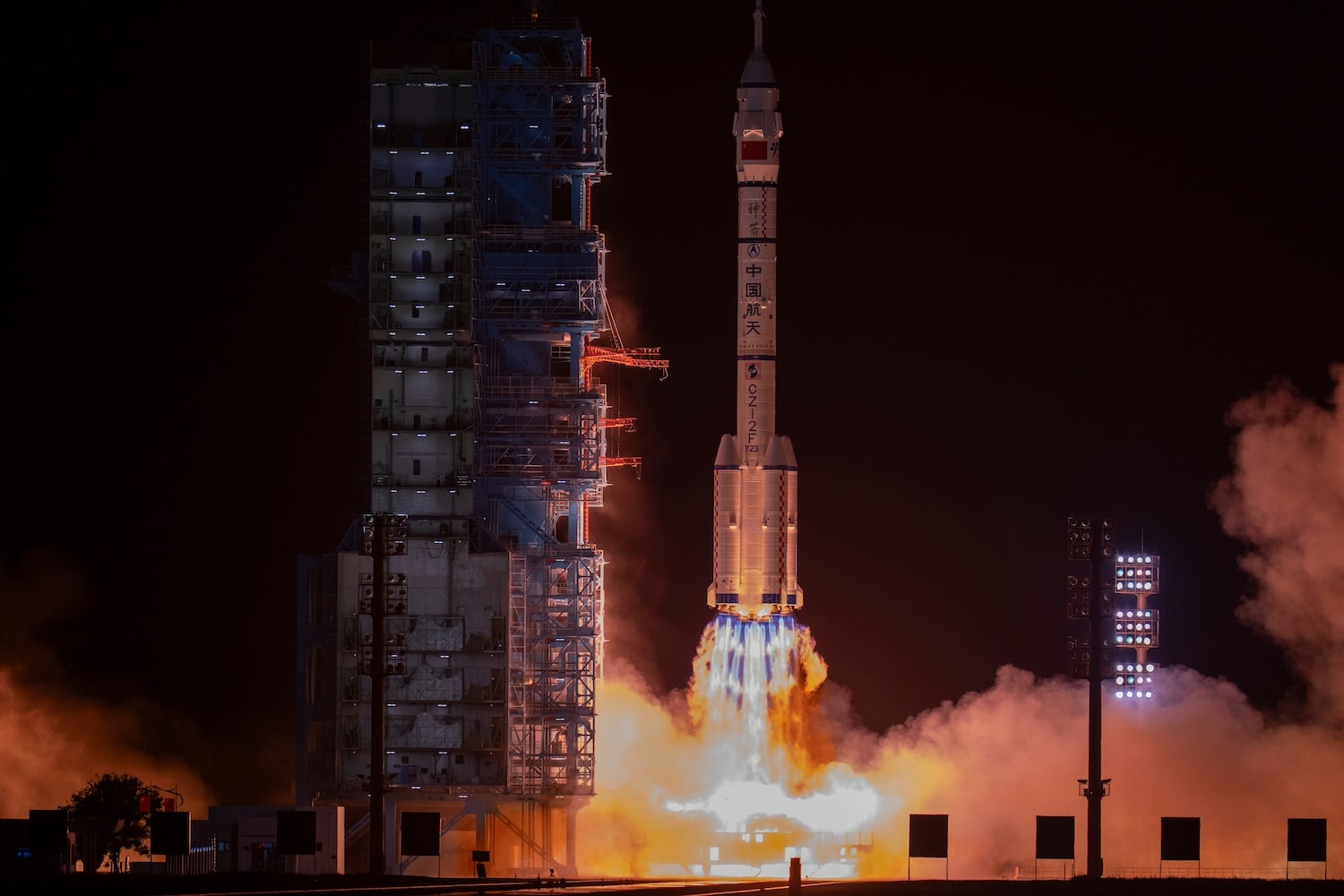
China just raised the stakes in the modern space race. The launch of the Shenzhou 23 spacecraft isn't just another routine crew rotation for the Tiangong space station. It marks a major shift in Beijing's orbital strategy. For the first time, a Chinese astronaut is locking in for a continuous 365-day stay in low-Earth orbit.
If you think this is just about matching old Cold War records, you're missing the bigger picture. This mission is a direct dress rehearsal for deep space. China is actively gathering the endurance data it needs to put boots on the moon and, eventually, Mars.
The three-person crew lifted off from the Jiuquan Satellite Launch Center, anchoring another chapter in China’s rapidly accelerating space program. While the China Manned Space Agency (CMSA) keeps certain engineering metrics close to the chest, the strategic intent is glaringly obvious. They aren't just visiting space anymore. They're learning to live there permanently.
The Reality of a Year in Orbit
Most space station missions last about six months. That's the sweet spot. It's long enough to get serious research done but short enough that the human body doesn't completely break down. Pushing that stay to a full year changes the biological math entirely.
When you spend a year in microgravity, your body pays a steep price. Muscle atrophy kicks in fast. Bones lose density at an alarming rate, roughly 1% to 1.5% every single month. The fluid shifts inside the body put immense pressure on the optic nerve, which can permanently alter vision. NASA learned this firsthand during Scott Kelly’s famous one-year mission, and Russia has its own deep well of long-duration data dating back to the Mir space station days.
China needs its own data. They can't rely on Western research papers because NASA is legally barred from direct cooperation with Chinese space entities due to the Wolf Amendment passed by Congress in 2011.
The Shenzhou 23 astronaut staying behind for the full year will undergo rigorous medical monitoring. Every drop of sweat, every change in bone density, and every psychological shift will be tracked. The other two crew members will follow the standard six-month rotation, serving as a baseline control group right there in the same environment.
Breaking Down the Shenzhou 23 Mission Profile
The Tiangong space station is now a fully operational orbital laboratory. It's a three-module setup, shaped like a T, consisting of the Tianhe core module and the Wentian and Mengtian science labs. It's smaller than the International Space Station (ISS), but it's newer, highly efficient, and entirely under one nation's control.
During this mission, the crew faces a grueling schedule.
They will manage dozens of scientific experiments, mostly focusing on space life sciences, microgravity physics, and materials science.
They have several spacewalks on the calendar. These extravehicular activities (EVAs) are crucial for maintaining the exterior of the station and installing new external payloads.
The crew will test advanced regenerative life support systems. When you're in space for a year, recycling water, oxygen, and waste isn't just an environmental goal. It's a survival requirement.
The logistical choreography behind this is immense. Before Shenzhou 23 even left the pad, a Tianzhou cargo spacecraft had to deliver tons of propellant, food, customized gear, and medical monitoring equipment specifically designed for the yearlong occupant.
The Geopolitical Clock is Ticking
The timing of this mission isn't accidental. The ISS is aging. It has been flying for over two decades, and the structural fatigue is showing. Current plans see the ISS being safely deorbited and crashed into the Pacific Ocean around 2030.
When the ISS goes dark, Tiangong could easily become the only operational space station in low-Earth orbit.
China is leveraging this transition perfectly. They've already started opening up Tiangong to international payloads and have expressed openness to training foreign astronauts. While the US scrambles to transition low-Earth orbit operations to commercial stations like Axiom Space or Voyager’s Starlab, China’s state-backed model is delivering consistent, uninterrupted results.
This yearlong mission tells global partners that China is ready to handle the toughest logistical challenges in space flight. It builds immense trust with nations looking for an alternative to NASA-led programs like the Artemis Accords.
What This Means for the Moon and Mars
You don't send someone to space for a year just to see if they can hack it. You do it because a round-trip mission to Mars takes at least 500 days.
A crew traveling to Mars won't have a medical team waiting for them when they land. They will have to step out onto a harsh environment while suffering from the exact bone and muscle degradation that Shenzhou 23 is studying right now. By mastering long-duration stays at Tiangong, Chinese scientists can develop better countermeasure routines, like targeted resistance exercise protocols and specialized pharmaceutical interventions, to protect their crew.
Furthermore, China has stated its goal to land astronauts on the moon by 2030. While a lunar transit only takes a few days, building a permanent base on the lunar surface requires long-term human endurance.
Tracking the Next Steps in Orbit
If you want to understand how this race unfolds, stop looking at individual launches and start looking at operational runtime. The true metric of space dominance is turning into hours spent in microgravity.
Keep a close eye on the upcoming medical updates released by the CMSA over the next twelve months. Watch for how they handle the psychological toll of isolation on the long-term crew member, which is often harder to manage than the physical toll. The success of Shenzhou 23 will determine exactly how fast Beijing pushes its lunar timeline forward. Space enthusiasts should watch the orbital tracking data closely, because the next twelve months will redefine what China's space program is capable of achieving.