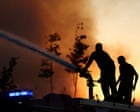
We talk about climate change as a distant threat, but new data proves it is already rewriting the baseline of ordinary life for the youngest generation. A landmark study published in Environmental Research Letters reveals that children born in Europe today will experience nearly twice as much extreme fire weather over their lifetimes compared to their grandparents.
This isn't about a single bad summer or an isolated wildfire season. It is a compounding, multi-decade reality that shifts what it means to grow up on the continent.
The Numbers Behind the Intergenerational Gap
Researchers at Vrije Universiteit Brussel tracked how lifetime exposure to extreme fire weather shifts across generations under current policy trajectories. The findings are stark. A child born in 2025 across Europe is projected to face an 84% increase in extreme fire weather days over their expected lifespan compared to someone born in 1950.
Most people assume this gap exists simply because modern generations live longer. More years on Earth naturally mean more seasons witnessed. But the research team ran the math to separate longevity from climate drivers. They discovered that longer lifespans account for only 14% of the difference. The other 86% stems directly from climate change making hot, dry, and windy weather conditions increasingly frequent.
If you look at Southern Europe—particularly regions in Spain and Portugal—the burden multiplies. In those hard-hit areas, a child born today is projected to live through up to 2.5 times the extreme fire weather of their 1950 counterpart, translating to more than five extra years of dangerous meteorological conditions.
Why Every Fraction of a Degree Matters
The historical generation born in the mid-20th century lived through a relatively stable climate envelope. Their lifetime exposure to extreme fire weather hovered predictably between half a year and four years total, regardless of which future warming path unfolded.
Today’s babies don't have that luxury. Their entire exposure window depends heavily on political and industrial choices made right now. The study evaluated futures ranging from 1.5°C to 3.5°C of global warming by 2100. The results show that every fraction of a degree we manage to avoid translates directly into fewer months or years of smoke-filled skies and scorched earth for tomorrow's adults.
Sticking strictly to the Paris Agreement target of 1.5°C of warming wouldn't completely erase the gap, but it would substantially slash lifetime exposure—saving children in high-risk zones like Portugal over a year of severe fire weather compared to current policies.
Moving Beyond Short-Term Disaster Management
For decades, political response to wildfires has been reactive. Governments mobilize aircraft, dispatch ground crews, and draft emergency relief funds after towns are already burning. But treating mega-fires as sudden, unpredictable acts of God ignores the systemic trajectory laid out by scientific projections.
When children born today reach retirement age, they will look back at a childhood spent under entirely different atmospheric rules. Protecting them requires treating emissions reductions not as an abstract environmental goal, but as a direct form of public health and child protection. The choices made this decade dictate whether the next generation inherits a manageable environment or a permanent state of emergency.