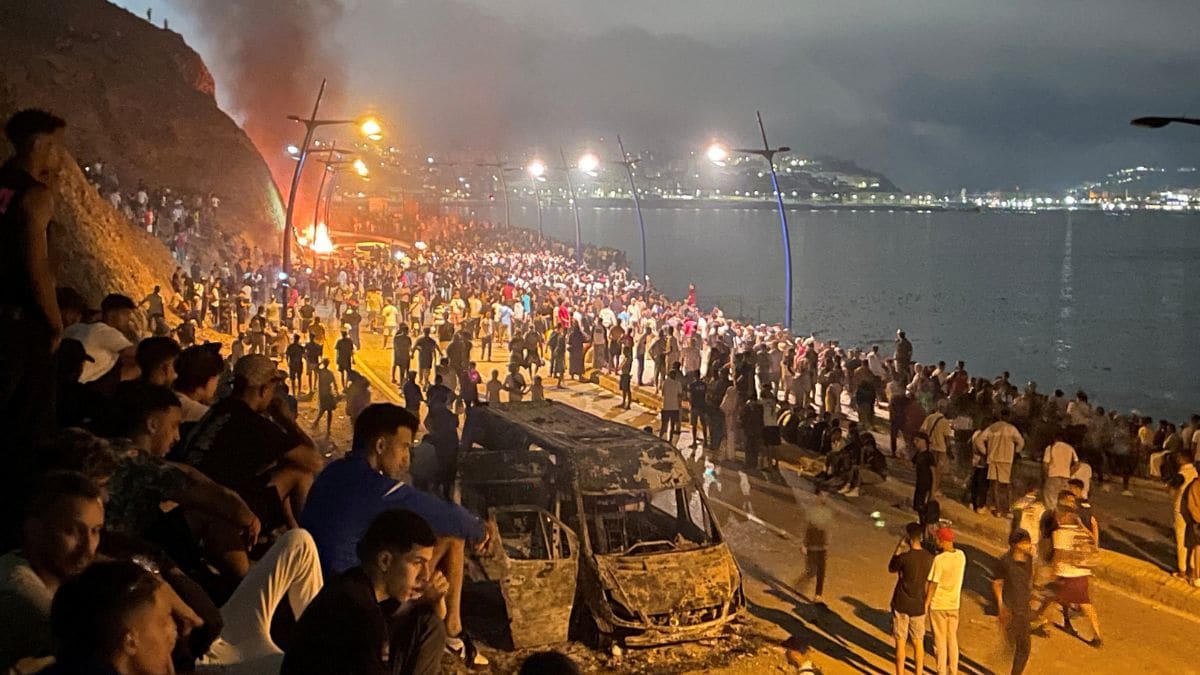
Geopolitical leverage points rarely manifest with the raw, structural visibility of an international border collapse. When tens of thousands of individuals traverse marine breakwaters and scale perimeter barriers into the Spanish exclave of Ceuta, observers frequently misdiagnose the event as an accidental failure of perimeter security. Rigorous geopolitical analysis reveals a different reality. The massive surge functions as a calibrated pressure mechanism, exposing the fragility inherent in the intersection of bilateral diplomacy, territorial sovereignty, and regional migration corridors.
The Mechanics of State Friction and Border Enforcement
Borders shared between developed economic zones and developing transit states rarely operate on purely administrative logic. They function as transactional valves. The border between Morocco and the Spanish exclave of Ceuta represents the European Union's sole physical land boundary on the African continent. This unique geography transforms a municipal perimeter into a strategic pressure point.
When diplomatic friction occurs between Madrid and Rabat, the enforcement posture of local security forces shifts from active deterrence to tactical passivity. Border control requires active resource allocation, intelligence sharing, and physical interdiction. When the state apparatus overseeing the departure point alters its enforcement threshold, the structural cost of crossing drops precipitously. The migration surge is not an autonomous natural disaster; it is the direct output of a state-managed relaxation of perimeter defense.
Diplomatic Friction -> Relaxation of Local Security Threshold -> Drop in Crossing Friction -> Accelerated Migration Volume
Security forces do not need to actively herd individuals across a frontier to engineer a crisis. They merely need to create an enforcement vacuum. By reallocating personnel or ignoring staging activities in adjacent towns like Fnideq and Belyounech, authorities can permit a critical mass of individuals to accumulate at the physical threshold. Once the density of the crowd reaches a tipping point, physical barriers designed to deter small-scale incursions become entirely obsolete through sheer mass.
The Economic Cost Function of Peripheral Enclaves
To understand why northern African border zones remain perpetual volatility centers, one must evaluate the economic cost function imposed by colonial-era enclaves on neighboring sovereign states. Ceuta and Melilla have historically operated as nodes for intense cross-border commercial activity, much of it reliant on contraband and tax-exempt trade.
While these enclaves generate municipal prosperity for their resident populations, they impose significant macroeconomic externalities on the surrounding northern regions of the host state. Smuggling networks suppress domestic industrial development and deprive central tax authorities of substantial revenue streams. When the host state moves to choke off this informal trade economy by closing commercial customs posts and restricting border permeability, local populations lose their primary economic survival mechanism.
This policy creates a localized economic depression in the immediate border hinterland. Populations previously sustained by cross-border arbitrage find themselves economically displaced. Consequently, the propensity to undertake high-risk irregular migration rises sharply. The structural suppression of regional commerce directly fuels the human supply chain available for sudden border pressures.
Spillover Effects Across the Schengen Perimeter
An operational breach at a peripheral node immediately threatens the integrity of continental transit architectures. Because Ceuta integrates into the broader Spanish state, individuals entering the exclave enter the legal and geographic jurisdiction of the European Union. This triggers complex domestic and international legal obligations regarding asylum processing, detention limits, and non-refoulement principles.
The immediate consequence is a systemic strain on regional infrastructure. A municipal entity with a baseline population of roughly 84,000 residents cannot absorb tens of thousands of arrivals within a forty-eight-hour window without total administrative collapse. Reception centers saturate instantly, forcing national governments to deploy emergency military reinforcements, naval surveillance assets, and specialized diving units to stabilize the perimeter.
Enclave Breach -> Legal Ingress to EU Jurisdiction -> Municipal Infrastructure Saturation -> Emergency National Deployment
This operational shock immediately ripples outward into broader geopolitical friction. Neighboring member states within the open-borders Schengen zone respond to potential secondary movements by unilaterally imposing tighter internal border checks or demanding extraordinary punitive measures against the external border state. The crisis ceases to be a bilateral dispute between two immediate neighbors and metastasizes into an internal institutional battle over continental migration governance and open-border integrity.
Strategic Forecast and Systemic Vulnerability
Mitigating future border shocks requires recognizing that perimeter fortification alone cannot resolve structural imbalances. Physical barriers, razor wire, and military deployments act as lagging indicators of control; they respond to pressure after it has already materialized at the gate.
As long as border enclaves remain asymmetric economic outliers and bilateral relations depend on transactional migration management, structural vulnerability will persist. Future stability is entirely contingent upon decoupling diplomatic disputes from border enforcement protocols and restructuring the economic dependencies of adjacent frontier regions. Until structural economic integration replaces transactional deterrence, the perimeter will remain vulnerable to sudden, state-calibrated surges.