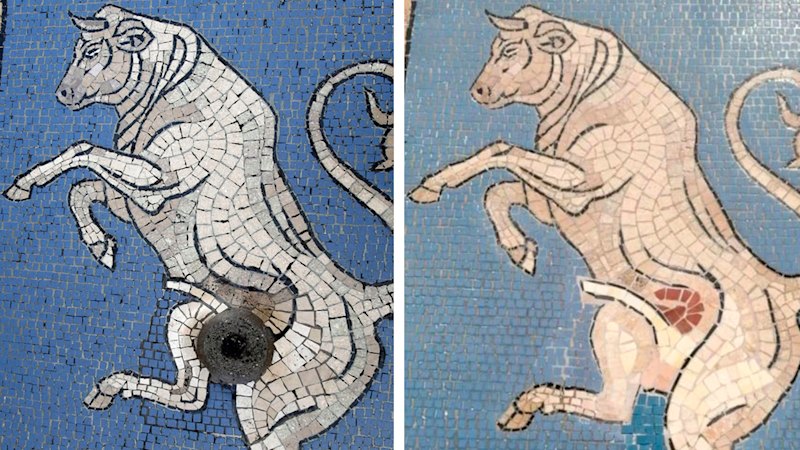
A €30,000 public restoration intended to preserve one of Milan's most beloved local superstitions has dissolved into a civic controversy, leaving city officials facing accusations of aesthetic censorship and historical erasure.
When the newly refurbished mosaic of the Rampant Bull was unveiled to the public on June 1, 2026, in the historic Galleria Vittorio Emanuele II, visitors did not find a glorious return to 19th-century form. Instead, they found a smooth, uniform patch of pink stone where the bull's prominent testicles used to be. The distinct anatomical details that generations of travelers had used as a literal pivot point for good fortune had been entirely ironed out.
The municipal intervention, intended to repair a deep crater worn into the floor by millions of pirouetting heels, has backfired. Milanese residents and art purists have openly accused the city council of intentionally "castrating" the historic symbol to covertly discourage tourists from continuing the destructive ritual.
The Chemistry of Luck and the Mechanics of Destruction
To understand the controversy, one must understand the precise physics of tourist friction. The mosaic, laid into the central octagon of the 1860s shopping arcade, features the coat of arms of Turin—a majestic bull standing on its hind legs. For more than a century, a local superstition dictated that if you place your right heel directly onto the bull’s testicles and spin clockwise three times, you will secure good luck, wealth, or a guaranteed return to Milan.
Superstition is a powerful solvent. When millions of people apply the full weight of their bodies onto a single square inch of stone, twisting a rubber or leather sole with mechanical force, it creates an effective grinding wheel. By late May 2026, the pink tesserae—the tiny glass and stone tiles forming the anatomy—had completely vanished, replaced by a jagged, dark hole measuring nearly three centimeters deep.
Craftsman Gianluca Galli was brought in to save the artwork. Recognizing that traditional materials would immediately crumble under the relentless assault of global tourism, Galli abandoned historical precedent in favor of industrial longevity.
Instead of the original lime-and-sand mortar used by 19th-century artisans, Galli anchored the new stone tiles using high-durability epoxy resins mixed with sand mortar. The choice highlights a growing crisis across European heritage management: the necessity of sacrificing material authenticity just to survive the sheer volume of human traffic.
The Erasure of Anatomy Under the Guise of Conservation
The technical execution of the repair is undeniably solid. The structural hole is gone. The underlying floor is stabilized. However, the visual result has sparked widespread mockery and genuine anger across Italy.
When Milan city councilor Marco Granelli shared photos of the completed work on social media, expecting praise for a swift civic repair, the response was immediate condemnation. The intricate, shaded, anatomical definition of the original bull had been replaced by a flat, uninspired oval of pastel pink. The bull, critics quickly pointed out, now closely resembled a castrated ox.
The visual shift is jarring to locals who view the arcade not just as a high-end shopping destination anchored by Prada and Tiffany & Co., but as a living room for the city.
“There are tiles of entirely different colors, and the arrangement is incredibly messy,” one prominent critic noted on the council's public forum. “They didn't restore the bull. They sanitized it.”
This flattening of historical detail raises an uncomfortable question for heritage departments globally. Did the restorers simply lack the artistic precision to replicate the original 19th-century shading, or did the municipality intentionally order a sanitized version of the mosaic to break the psychological spell of the ritual?
If the bull no longer possesses its famous attributes, the logic goes, perhaps the crowds will stop stomping on it.
The Unstoppable Tide of Monument Abuse
If the city council truly believed that smoothing out the mosaic would protect the floor, they fundamentally misunderstood the psychology of the modern traveler.
During the week-long restoration, when a wooden barricade cut off access to the Turin bull, the crowds did not simply look up at the stunning iron-and-glass dome or move along to the luxury boutiques. Instead, hundreds of tourists were observed migrating just a few meters away to a neighboring floor mosaic depicting the she-wolf of Rome. Lacking their usual target, visitors began aggressively grinding their heels into the face and torso of the ancient Roman symbol.
Humanity has a long, pathologically destructive relationship with public art, particularly when that art features prominent anatomy.
- In New York, the bronze testicles of the Wall Street Charging Bull are permanently buffed to a bright, golden shine by millions of groping hands, completely wearing away the dark patina intended by sculptor Arturo Di Modica.
- In Verona, the bronze statue of Shakespeare’s Juliet has had to be entirely recast and replaced twice because tourists touching her right breast for luck in love literally dissolved the metal, creating structural fissures across her chest.
- In Dublin, the bronze bosom of the Molly Malone statue has changed color completely due to the acidic oils of countless passing hands.
The defense offered by Milan’s deputy mayors, Emmanuel Conte and Marco Granelli, is that the Galleria is a "living heritage site" that wears out precisely because it is loved. That sentiment is comforting, but it obscures a harsher reality. There is a vast difference between natural wear from foot traffic and targeted, repetitive vandalism driven by viral tourism.
The Fallacy of the Self-Healing Monument
The current restoration cost taxpayers €30,000 and is expected to last less than a decade. The previous major intervention occurred in September 2017. Before that, another major overhaul was required in 2007. The intervals between major structural failures are shrinking rapidly as global travel expands.
Using epoxy resin is a desperate finger in the dike. While the synthetic glue will hold the individual stone pieces down with far greater force than traditional lime, the stone tiles themselves are still susceptible to being ground into dust by the grit underneath tourist shoes.
The city is trapped in a Sisyphean loop. To completely fence off the mosaic would provoke an outcry from tourists and local tour operators who rely on the ritual as a staple of the Milan experience. To leave it exposed guarantees its eventual destruction every few years.
By opting for a flat, featureless aesthetic during this latest repair, the municipality has chosen a middle path that pleases no one. They have spent thousands of euros of public funds to deliver an end product that art historians view as a botched job and tourists view as a disappointment.
The smooth pink oval currently sitting in the center of the Galleria is a monument to compromise, a literal soft spot where history, superstition, and modern crowd control collided—and where history lost its edge.