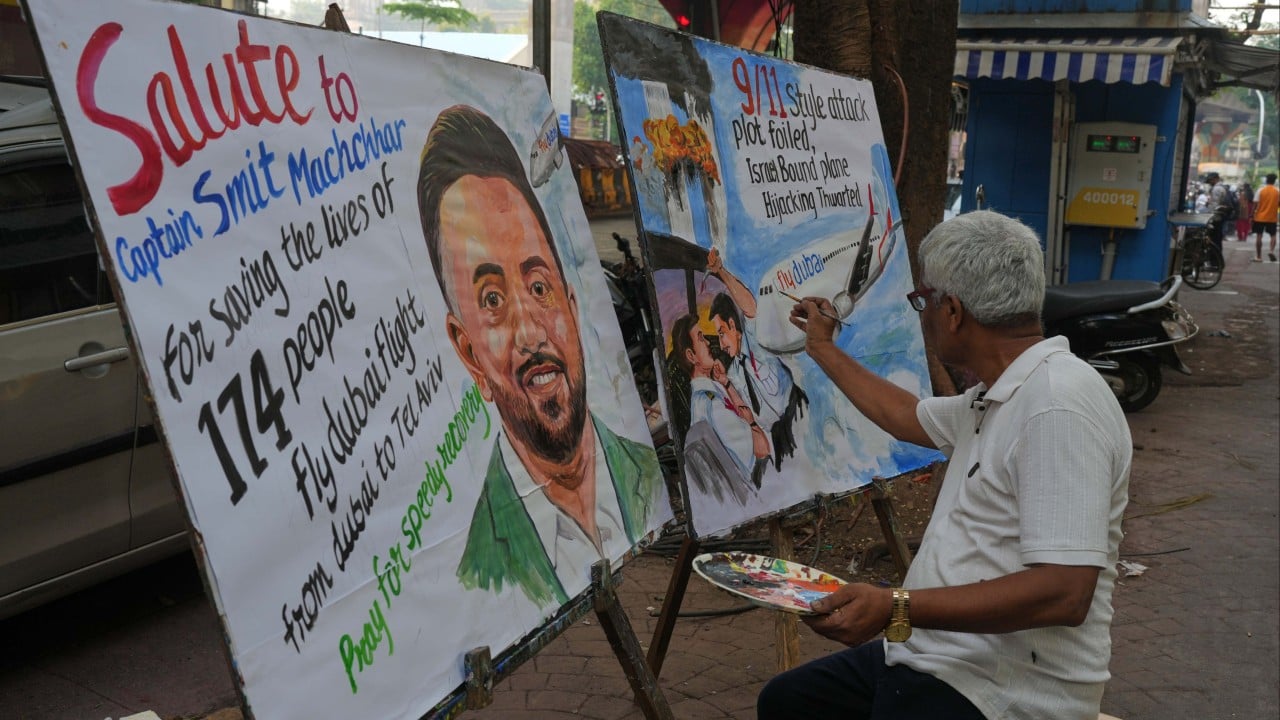
Imagine sitting in a commercial flight cockpit at 34,000 feet when your co-pilot suddenly turns on you with a crash axe. Most people can't fathom that level of sudden terror. Yet that is precisely what Captain Smit Machchhar faced aboard Flydubai Flight 1073.
The incident transformed a standard Dubai-to-Tel Aviv route into a harrowing fight for survival. When first officer Hamam al-Hammami launched his sudden assault, Machchhar took brutal blows to the head and arms. Bleeding heavily and temporarily losing consciousness after collapsing, the Indian captain woke up to an absolute nightmare: the aircraft's nose was pointing straight down, plunging thousands of feet in seconds.
What happened next defines true grit. Machchhar knew aviation handbooks cover engine failures and severe weather, but they don't prepare you for a colleague trying to murder you and crash the plane.
The Plunge and the Desperate Defense
Flight 1073 dropped from 34,000 feet to 17,000 feet in under a minute. The speed crossed maximum design limits, eventually tearing off most of the aircraft's rudder. Inside the flight deck, Machchhar was bleeding out from multiple stab wounds.
Instead of giving up, he fought back against the instinct to stay down. In a video call with Indian Prime Minister Narendra Modi shortly after the ordeal, Machchhar recalled that exact moment of clarity. He realized that if he stayed on the floor, everyone on board was dead.
Using his remaining strength, he crawled toward the door knob, screaming for help while blocking subsequent blows. That scream saved the flight. Passengers, including a plumber and a dentist traveling on board, heard the commotion, forced their way into the cockpit, and restrained the attacker. Deadheading Flydubai pilots stepping up from the cabin took over the controls and safely diverted the Boeing 737 MAX to Tabuk, Saudi Arabia.
Why This Changes Aviation Security Forever
This event shattered the baseline assumptions of commercial flight deck security. For decades, the industry focused on keeping unauthorized outsiders out of the cockpit. Heavy reinforced doors and strict entry codes became the global standard after past tragedies.
Nobody built a protocol for an insider threat originating from the left or right seat. Flight decks rely on absolute trust between two people locked behind a secure barrier. When that trust shatters violently, the safety mechanisms designed to protect passengers suddenly become a trap.
Investigators later uncovered extremist material associated with the attacker, pointing toward a calculated plan. Aviation authorities worldwide now face uncomfortable questions. How do you screen for ideological radicalization among active flight crew members? Psychological evaluations catch some warning signs, but determined actors can mask intent for months.
Recovery and Recognition
Captain Machchhar spent weeks recovering in the hospital, wrapped in bandages but remarkably resilient. He refused to view his severe
How an Indian Pilot Kept His Cool During a Cockpit Attack
news
Skies are supposed to be safe. You buckle your seatbelt, tune out the drone of the engines, and maybe scroll through a movie while thousands of feet in the air. You trust the flight deck. You trust the steel tube hurtling through the stratosphere. But what happens when the absolute last place you expect danger turns into a battlefield?
That exact nightmare scenario hit the crew of a Flydubai flight, and the response from the Indian pilot at the controls changed everything. People love to throw around the word hero. Most of the time, it's cheap hyperbole used for clickbait. In this case, though, staying calm under physical assault stopped a routine commercial journey from turning into absolute catastrophe.
The Reality of Cockpit Vulnerabilities
Commercial aviation changed forever after security protocols were rewritten in the early 2000s. Reinforced flight deck doors became the standard. They were designed to keep external threats locked out. But what happens when the threat is already inside the room? Or what happens when a breach occurs through sheer force or unexpected chaos?
Most passengers assume pilots are basically bus drivers with extra buttons. They don't think about the physical strain, the split-second decision-making, or the fact that an aviation professional might suddenly have to fight for physical survival while simultaneously keeping an aircraft stable.
When a violent altercation erupts in a cramped workspace filled with critical instrumentation, the margin for error shrinks to zero. You aren't just dealing with an aggressive individual. You are dealing with throttles, flight management computers, and altimeters. One stray elbow can disengage an autopilot or pitch the nose down into a fatal dive.
What Actually Happened Up Front
Details emerging from cockpit security reviews and crew accounts paint a terrifying picture. An attacker managed to breach the flight deck boundary, initiating a physical struggle during a high-altitude cruise.
Think about that environment for a second. You are enclosed in a space barely larger than a walk-in closet, surrounded by switches that control a multi-ton jetliner carrying hundreds of passengers.
The Indian pilot involved didn't panic. Panic kills in aviation. Training kicks in, sure, but raw temperament dictates whether a human being freezes or fights back effectively. While managing the physical confrontation, the priority list remained brutally simple. Fly the plane first. Subdue the threat second. Communicate with air traffic control third.
Many people fail to realize how quickly spatial disorientation can happen when you're physically scuffling in a pilot seat. Your eyes are off the primary flight display. Your hands are off the yoke or side-stick. The autopilot might be handling the basic trajectory, but the moment a body slams into the console, things get unpredictable.
Why Pilot Training Goes Far Beyond Flying
People always ask why pilots spend so much time in simulators practicing engine failures and bad weather. They rarely think about hand-to-hand defense or crew resource management during an active security threat.
Airlines have quietly ramped up situational awareness training and physical defense strategies for flight crews. You have to lock down the airspace above the cabin, but you also have to manage human unpredictability. When a passenger loses touch with reality mid-flight, the crew becomes the first line of defense, law enforcement, and crisis management all at once.
The captain and first officer have to communicate without speaking. A glance, a shift in body weight, a subtle nod—these become tactical cues. The Indian pilot at the center of this incident relied on that exact split-second coordination to neutralize the threat without compromising the safety envelope of the aircraft.
The Aftermath and Aviation Security
Landing a plane safely after an in-air assault is only half the battle. The psychological toll on flight crews remains an unspoken crisis in modern aviation. You don't just walk off a plane after a life-or-death struggle, sleep it off, and fly a routine trip the next morning. Adrenaline crashes are brutal. The mental replay of what could have gone wrong stays with you.
Airlines need to look hard at psychological support systems for flight crews who experience trauma in the line of duty. Too often, the industry treats pilots like machines. They fly the metal, fix the problem, file the report, and get back on the roster. That mindset is outdated and dangerous.
If you fly frequently, remember what is happening behind that reinforced door while you sleep or read. The next time you board a commercial flight, spare a thought for the people up front. They aren't just managing weather patterns and fuel burns. They are standing guard against the completely unexpected, ready to handle a crisis before you even realize anything is wrong.
Check your flight safety cards, respect the cabin crew, and appreciate that the calm flight you just experienced often relies on absolute quiet heroism behind a locked door.