The redirection of global maritime trade from the Suez Canal to the Cape of Good Hope is not a temporary logistical detour; it is a fundamental reassessment of the global supply chain’s tolerance for "Choke Point Risk." When Houthi rebel activity in the Red Sea rendered the Bab el-Mandeb strait a high-risk zone, the resulting shift in vessel traffic toward South Africa’s coast triggered a massive recalibration of transit economics, port capacity requirements, and energy consumption models. This analysis deconstructs the structural drivers of this shift and the subsequent bottlenecks emerging in South African maritime infrastructure.
The Suez-Cape Trade-Off: A Dual-Variable Cost Function
The decision to bypass the Suez Canal for the Cape of Good Hope is governed by a tension between two primary variables: Insurance Risk Premiums and Incremental Operational Expenditure (OPEX).
Under normal operating conditions, the Suez Canal offers the shortest route between Asia and Europe. However, the introduction of kinetic threats in the Red Sea creates a "Risk Surcharge" that, for many shipowners, now exceeds the cost of the additional 3,500 nautical miles required to circumnavigate Africa.
1. The Geometry of the Detour
A standard voyage from Singapore to Rotterdam via Suez covers approximately 8,400 nautical miles. The Cape route extends this to 11,700 nautical miles. This 40% increase in distance translates directly into a 10 to 14-day increase in transit time, depending on vessel speed. For a fleet manager, this delay is not merely a scheduling inconvenience; it represents a decrease in effective global vessel capacity. If 10% of the world's fleet is spending 40% more time at sea, the global supply of available "ton-miles" shrinks, leading to a spike in freight rates across the board.
2. The Bunker Fuel Paradox
Fuel (bunker) accounts for approximately 50% to 60% of a vessel's total operating cost. To mitigate the 10-day delay, many carriers "speed up" their vessels. Since fuel consumption increases cubically with speed—modeled by the relationship $P \propto v^3$ where $P$ is power and $v$ is velocity—the cost of recovering lost time is exponentially more expensive than slow-steaming. Carriers are forced to choose between absorbing the cost of higher fuel consumption or the cost of "inventory in transit" for their customers.
South Africa as a Strategic Service Hub: The Infrastructure Gap
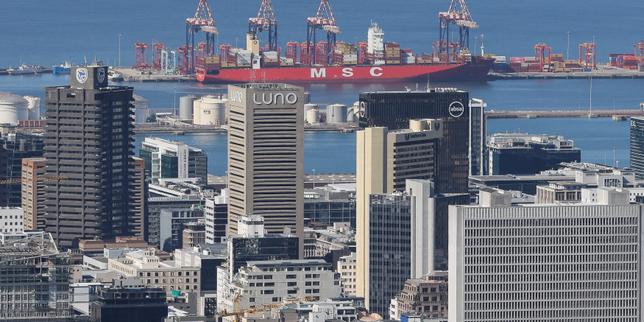
The surge in traffic around the Cape of Good Hope has turned South Africa’s ports—specifically Durban, Ngqura, and Cape Town—into critical infrastructure for the global economy. However, these ports were not designed for a sudden, massive influx of "ad hoc" calls from ultra-large container vessels (ULCVs) that would typically have refueled in Salalah or Jeddah.
The Transshipment Bottleneck
South Africa's port efficiency has historically lagged behind global benchmarks. The World Bank’s Container Port Performance Index frequently ranks South African terminals in the lower quartiles. The sudden "Cape Pivot" exposes three specific structural weaknesses:
- Equipment Reliability: A lack of investment in ship-to-shore (STS) cranes and straddle carriers results in high "dwell times." Vessels diverted from Suez often require rapid refueling and crew changes, but if the berths are occupied by domestic imports/exports, these diverted ships are forced to wait in "offshore bunkers," increasing their total voyage cost.
- Draft and Berth Constraints: Many of the vessels diverted are the "megamax" class, carrying over 20,000 TEUs (Twenty-foot Equivalent Units). Not all South African berths can accommodate the depth or the crane reach required for these giants, limiting the "Serviceable Addressable Market" of the Cape detour to smaller vessels or forcing larger ones to bypass South African ports entirely for refueling in Mauritius or Walvis Bay.
- Bunker Fuel Availability: The demand for Very Low Sulfur Fuel Oil (VLSFO) in South African waters has spiked. Since South Africa is a net importer of refined products following the closure of several domestic refineries, the supply chain for marine fuel is fragile. High demand leads to price premiums at the pipe, further eroding the margins of the shipping lines.
The Macroeconomic Ripple: From Maritime to Shoreline
The increased traffic is a double-edged sword for the South African economy. While the South African Maritime Safety Authority (SAMSA) and the Transnet National Ports Authority (TNPA) see increased revenue from light dues, pilotage, and towage, the broader economy faces inflationary pressure.
The "End-of-Pipe" Inflationary Effect
South Africa is itself a major importer of manufactured goods from Asia and an exporter of raw materials to Europe. The congestion caused by diverted traffic (ships that have no business in South Africa other than passing by) slows down the processing of domestic cargo. This creates a "congestion surcharge" for South African businesses.
- Export Delays: Deciduous fruit and citrus exporters in the Western Cape rely on "Just-In-Time" logistics. Vessel delays at the Port of Cape Town lead to spoiled inventory and breached contracts.
- Import Costs: Component parts for the automotive sector in the Eastern Cape (Gqeberha/East London) are subject to the same global freight rate hikes triggered by the Suez crisis, despite South Africa being geographically "closer" to the diverted route.
The Geopolitical Leverage of the Cape
For the first time since the 1967-1975 Suez closure, the Cape of Good Hope has regained its status as a primary global strategic artery. This grants South Africa significant "Diplomatic Rent." The ability to provide a safe, efficient alternative to the Red Sea gives the South African government leverage in international maritime forums. However, this leverage is contingent on the ability to provide security and services. If the "Cape route" becomes synonymous with delays and high costs, shipping lines will invest in more fuel-efficient "Direct-to-Destination" models that bypass South African stops entirely.
Operational Realities: The Shift in Logistics Strategy
Shipping companies are no longer treating the Cape route as an emergency measure. We are seeing a shift toward "Resilient Routing," where the Cape is baked into the annual operating plan. This involves:
- Vessel Cascading: Moving larger, more fuel-efficient ships to the Cape route to offset the longer distance, while keeping smaller vessels for regional feeder routes.
- Buffer Stock Indexing: European retailers are increasing their safety stock levels by 15% to 20% to account for the volatility in arrival times associated with the longer journey around Africa.
- South African "Off-Port" Services: A growth in helicopter and launch boat services to deliver spare parts and personnel to vessels while they are moving (Oasis-style service), allowing ships to avoid the time-sink of docking in a congested port.
The Emissions Accounting Conflict
One of the most significant, yet overlooked, consequences of the Cape of Good Hope surge is the impact on corporate ESG (Environmental, Social, and Governance) targets. The International Maritime Organization (IMO) has set strict targets for carbon intensity.
A vessel traveling from Shanghai to Hamburg via the Cape emits roughly 30% to 35% more $CO_2$ than it would via Suez. For multinational corporations committed to "Net Zero" supply chains, the Red Sea crisis is a catastrophic setback. This creates a market for "Green Corridors" along the African coast. There is a clear opportunity for South Africa to lead in the provision of "Green Ammonia" or "e-Methanol" refueling, but the capital expenditure required for such infrastructure is currently absent.
Strategic Play: Optimizing the South African Transit Corridor
To transform a temporary traffic surge into a permanent economic advantage, the following structural adjustments are required:
1. The Privatization of Terminal Operations
The state-owned monopoly model for port management is failing under the pressure of global diverted traffic. The introduction of private terminal operators—as seen in the partial privatization of Durban Pier 2—must be accelerated to bring in the capital required for high-speed STS cranes and automated yard management systems.
2. Strategic Bunker Reserves
South Africa must establish a strategic marine fuel reserve. By stabilizing the price and availability of VLSFO, the country can position itself as the "Gas Station of the Southern Ocean." This requires a policy shift to allow more offshore ship-to-ship (STS) bunkering in sheltered bays (like Algoa Bay), despite environmental opposition, provided that world-class oil spill response protocols are enforced.
3. Integrated Digital Customs and Clearance
The "Administrative Friction" of calling at a South African port must be reduced. Implementing a "Single Window" digital system for maritime clearance would allow diverted vessels to handle all paperwork (crew manifests, health clearances, bunkering permits) 48 hours before they reach the 12-nautical-mile limit, minimizing time at anchor.
The Cape of Good Hope has returned to the center of the global trade map, not by choice, but by necessity. The longevity of this trend depends on whether South African infrastructure can evolve from a passive observer of passing ships into an active, high-efficiency node in the global maritime network. The current "wait and see" approach will lead to a loss of market share to more agile regional competitors like Mauritius or Namibia, who are already positioning themselves to capture the "Red Sea Risk" overflow.