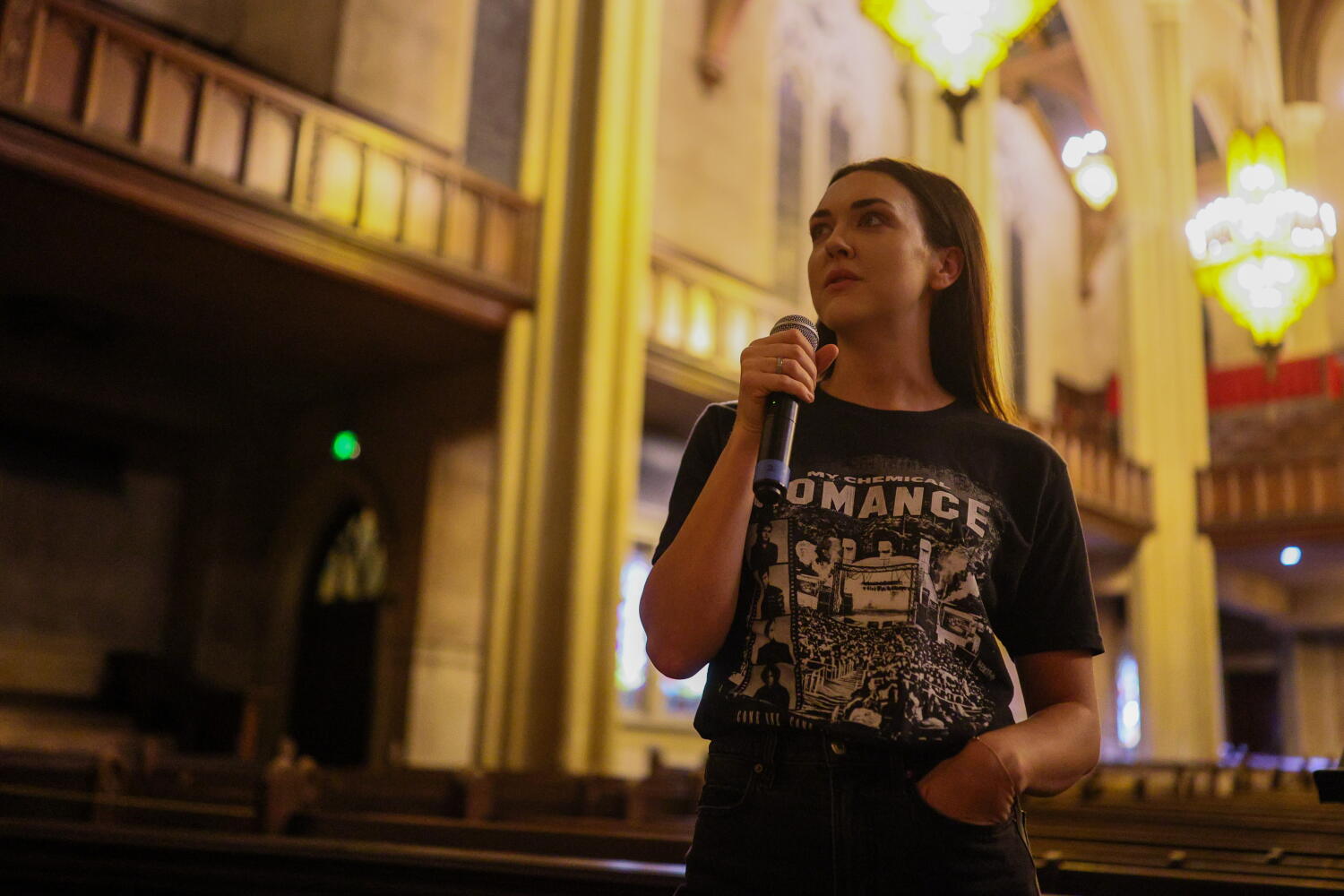
Watching grown adults sit on church pews in Los Angeles, holding tea lights while someone reads My Chemical Romance lyrics like scripture, is peak aesthetic cosplay. It looks moving. It sounds poetic. It is mostly an excuse to feel profound without doing the actual work of reading a line of poetry critically.
The standard media coverage of these gatherings treats them like a sacred subculture rebirth. The lazy consensus says that emo kids grew up, found community, and turned a messy teenage soundtrack into high-minded literary analysis. Cute story. Wrong diagnosis.
I have spent years watching live events, fan communities, and cultural trends chase whatever feels emotionally resonant in the moment. I have seen organizers pour serious money and hours into staging "intimate" experiences that confuse mood lighting with substance. When you strip away the wax drippings and the nostalgia, a lot of these candlelit nights are just karaoke with a sermon voice.
The Church Setting Is a Shortcut, Not an Insight
Put words inside a historic sanctuary, dim the overhead lights, and hand people a flame. Your nervous system does half the heavy lifting before a single verse is spoken. Humans are wired to treat quiet rooms, solemn acoustics, and warm flickering light as signals of reverence.
That is a production trick, not a literary breakthrough.
If you read the exact same lines from The Black Parade or Three Cheers for Sweet Revenge under harsh fluorescent lights in a folding chair, the room suddenly has to earn its seriousness. A candlelit L.A. church borrows authority from architecture and ritual. It borrows the gravity of a place built for confession and mourning, then drapes it over pop-punk and post-hardcore songwriting.
There is nothing illegal about borrowing a vibe. Plenty of theater directors, DJs, and event promoters do it every weekend. The problem starts when everyone in the room mistakes the setting for depth of analysis.
Close Reading Requires Friction, Not Comfort
Real literary analysis feels like friction. You stop at a metaphor because it contradicts itself, or because a historical reference clashes with the narrator's tone, or because the rhythm trips you up. You argue about ambiguity. You sit with discomfort instead of nodding along to a comforting narrative.
Candlelit lyric nights usually aim for the opposite effect. They want catharsis. They want everyone nodding in unison as a familiar chorus lands on a heavy word like "bleed," "ghost," "parade," or "death."
Shared catharsis feels great. I love screaming along to a bridge as much as anyone who survived 2006 with bad eyeliner and an overdrawn debit card. Still, feeling a lump in your throat is not the same thing as understanding how a text works. Comfort smooths out the sharp edges of a song; analysis looks for where the edges cut.
Why People Ask the Wrong Questions About Emo Lyrics
Whenever a viral clip or local feature pops up about these events, the surrounding search queries follow a predictable script. People ask whether My Chemical Romance lyrics are "secretly deep," what a specific song "really means," or why emo music still connects with adults today.
Every one of those questions is slightly tilted off-axis.
"Are My Chemical Romance lyrics secretly deep?"
Nothing about Gerard Way's best writing is a secret. The Black Parade is an openly theatrical concept album built around mortality, illness, institutional dread, and performance. Danger Days wears its sci-fi comic book influences right on its sleeve. Bullets is raw, jagged, desperate, and loud.
Calling those lyrics "secretly deep" implies they were hiding inside a vault until someone brought a votive candle into a chapel. In reality, the craft has always been right there in plain sight: dramatic irony, gallows humor, gothic melodrama, and sharp shifts between earnest vulnerability and camp.
If you missed the craft when you were fifteen, that is normal. Fifteen-year-olds usually listen for survival and identity, not prosody. Acting like the depth was hidden until a curated L.A. event unlocked it sells the band's actual songwriting short.
"What does this song really mean?"
"Real meaning" is a trap word in pop culture. Songs do not have one locked meaning waiting to be found like a key under a doormat. A song is a set of choices—words, melody, tempo, vocal strain, instrumentation—that creates a range of possible readings.
Consider a thought experiment. Imagine a scenario where two listeners sit side by side in that candlelit sanctuary hearing "Helena" or "Famous Last Words." Listener A went through a brutal family loss last year and hears a survival anthem. Listener B was raised in a strict religious household and hears theatrical defiance against guilt and control. Neither person is hallucinating. Both readings live inside the material because the songwriting leaves room for tension rather than spelling out a single moral.
When a host stands at a mic and declares what a lyric "really" means, they are usually offering one persuasive interpretation—or one personal story—and calling it gospel. That can be moving. It is also just one voice in the room.
"Why do adults still care about emo music?"
Because growing up does not erase the parts of you that felt alienated, anxious, or obsessed with mortality. You just get better at paying rent while feeling them.
Adults are not returning to emo because they suddenly discovered hidden academic brilliance in warpped-tour staples. They return because the emotional stakes in those songs match the messy, unpolished reality of adulthood better than polite, curated playlists do. Life does not always come with neat resolutions. Neither does a good post-hardcore bridge.
The Nuance the Competitor Missed
The competitor article treats the candlelit L.A. church gathering as proof that emo has matured into a thoughtful, community-driven art form. That view misses two things happening at once: genuine hunger for slower, more attentive spaces, and a booming market for stylized nostalgia.
People in big cities are starved for places where they are not scrolling, networking, or yelling over a club bassline. Sitting quietly with other fans for an hour or two meets a real social need. In that narrow sense, these nights solve a loneliness problem.
At the same time, nostalgia is a business model. Aestheticized grief, moody lighting, and reverent framing turn personal history into a ticketed experience. There is nothing wrong with paying for a well-run night out. Just do not confuse buying a ticket to a candlelit room with joining a serious critical circle.
Where Contrarian Critique Can Go Too Far
Let me be honest about the downside of taking this hardline view. If you mock every earnest lyric reading or roll your eyes every time someone calls a pop-punk line "poetic," you can end up sounding like a joyless gatekeeper.
I do not want emo culture to turn into a dusty seminar where nobody is allowed to cry or feel dramatic. Melodrama is part of the DNA. Anyone who demands clinical detachment from a band that named a track "It's Not a Fashion Statement, It's a Fucking Deathwish" missed the point of the genre's energy.
The real standard should not be academic snobbery. The real standard should be honesty. If you are there for community, nostalgia, and a quiet room, say that. Do not pretend a tea light makes you T.S. Eliot.
How to Actually Engage With Lyrics Without Faking Depth
If you care about My Chemical Romance—or any band whose words have stuck with you for twenty years—you do not need a church pew or a box of matches to take the writing seriously. You need habits that force you to pay attention.
- Read the lyrics cold before listening. Strip away Gerard Way's vocal delivery and the drum hits for five minutes. Look at which nouns repeat, which verbs carry the weight, and where the point of view shifts. You will spot structural tricks you miss when the chorus sweeps you away.
- Compare eras side by side. Put a track from I Brought You My Bullets, You Brought Me Your Love next to one from The Black Parade or Danger Days. Notice how the anger, humor, and theatricality change when the production budget and narrative ambition grow.
- Track the speaker, not just the singer. A lot of listeners assume every lyric is a direct diary entry. Pay attention to when the narrator is playing a character, exaggerating for effect, or mocking their own melodrama.
- Argue a counter-reading out loud. Pick your favorite line and ask what it means if the narrator is lying, being sarcastic, or losing the plot. If an interpretation cannot survive a five-minute pushback, it probably needs more work.
- Host a messy living-room breakdown instead of a solemn service. Gather four or five friends, print out the lyric sheets, grab markers, and underline lines you disagree on. No candles required. No fake reverence. Just people arguing in good faith about words that matter to them.
What This Says About Subculture Right Now
Subcultures rarely die from outside attacks; they go soft from inside when everyone agrees on the script. When every article, event, and social post frames a niche scene as "healing," "sacred," and "deep," the scene loses its teeth.
Good art can handle rough handling. My Chemical Romance built a catalog out of extremes—grief, absurdity, rage, tenderness, theatrics—without asking permission to be messy. Treating their lyrics like fragile stained glass is actually a smaller way to love them.
Light a candle if you like the smell and the quiet. Sing until your voice cracks if you need the release. Just keep your brain turned on while you listen.


