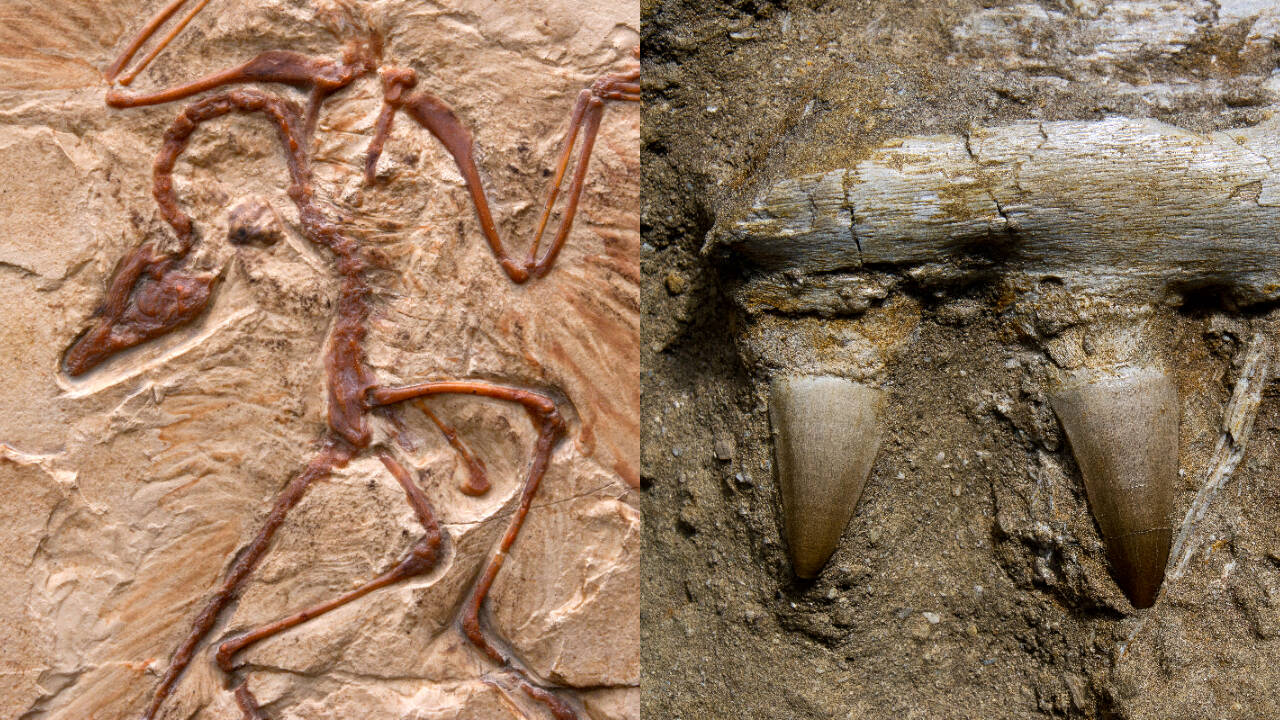
"Bird" is the wrong label. "Dinosaur-like teeth" is lazy shorthand.
Every time a fossil headline frames a Late Jurassic feathered theropod as a clumsy bird stuck with reptile leftovers, it gets the evolutionary arrow backward. The creature wasn't a bird trying to shed its dinosaur past. It was a small maniraptoran theropod wearing plumage that predated true avian flight by tens of millions of years.
Calling a 150-million-year-old fossil a "bird with dinosaur-like teeth" sounds snappy on a screen. Biologically, it is a category error wrapped in nostalgia.
The Lazy Consensus Around "First Birds" and Reptile Teeth
Popular science loves a neat transition story. Show a creature with feathers and a wishbone, call it the "first bird," and treat its sharp teeth as an awkward leftover from Tyrannosaurus or Velociraptor. That framing flatters our intuition because modern birds have beaks and big wings, so anything with feathers and teeth looks like a half-finished prototype.
Here is the problem. Feathers did not start as flight gear, and teeth on a Late Jurassic theropod were not an anomaly.
In paleontology, avialans are theropod dinosaurs on the branch leading to modern birds (Neornithes). A classic Late Jurassic benchmark like Archaeopteryx—alongside feathered paravians and basal avialans from the Solnhofen limestone of Bavaria and the younger Tiaojishan and Yixian formations of China—sits right near that boundary. Treating those animals as "birds" with "dinosaur teeth" implies that beaklessness was a defect waiting to be cured.
It wasn't. Beaks evolved repeatedly across theropods as a specialization—a way to shed dental weight, crop seeds or insects, and process food without heavy jaws—long after feathered forelimbs were already doing work that had nothing to do with soaring across continents.
Look at the anatomy of these Late Jurassic flyers and gliders. You don't see a modern pigeon with a mouthful of fangs. You see a small, agile theropod with:
- Socketed, serrated or recurved teeth suited to seizing small vertebrates, insects, or other prey—standard theropod dentition, not a weird throwback.
- Three clawed digits on each forelimb, distinct from the fused wing bones of modern birds.
- A bony tail rather than a shortened pygostyle, which anchors the tail feathers of living birds.
- Asymmetrical flight feathers on the wings and hindlimbs, showing aerodynamic structure existed before full powered flapping mechanics matured.
When writers reduce that anatomy to "tiny wings and dinosaur-like teeth," they measure a Late Jurassic theropod against a modern gull or eagle. A hawk is a specialized survivor of one lineage. Judging a 150-million-year-old theropod by how closely it mimics a modern hawk is like judging a 1990s flip phone by whether it runs modern mobile apps.
Why "Tiny Wings" Misses How Early Flight Actually Worked
The second half of that headline is just as misleading. "Tiny wings" makes a creature like Archaeopteryx sound under-equipped, as if evolution handed it half a wing and told it to flap harder.
Wing size only looks "tiny" if you assume early aerial locomotion required long-distance, high-aspect-ratio soaring. Different flight modes favor completely different wing proportions. Short, rounded, or broad wings excel at tight maneuverability, bursts of lift, or getting off the ground in cluttered environments—the exact reason many modern forest birds have shorter, broader wings than open-ocean albatrosses.
Even more importantly, early flight research has moved past the old binary of "ground-up" (running and leaping) versus "trees-down" (gliding from branches). Researchers studying Archaeopteryx and related feathered dinosaurs—from classic biomechanical work by John Ostrom and Kevin Padian to modern aerodynamic and bone-histology studies by figures like Luis Chiappe, Xing Xu, and Michael Benton—have shown that early aerial ability was messy, partial, and multi-factorial.
Wing-assisted incline running offers a concrete example. Some ground-dwelling birds with short or developing wings flap them while running up steep slopes to increase traction and get upward boost. You don't need modern breast muscles or a deep sternum to gain real mechanical advantage from feathered forelimbs.
Bone histology adds another layer. Unlike living birds that grow rapidly to adult size in a matter of weeks or months, Archaeopteryx grew more slowly, closer to non-avian dinosaurs, with lines of arrested growth in its bones. That means its flight apparatus—whatever exact bursts, glides, or short hops it managed—operated inside a physiology that was still bridging dinosaurian growth rates and avian metabolism.
Calling early feathered theropods "birds with dinosaur teeth" treats modern birds as the finish line rather than one surviving branch on a sprawling tree.
Imagine a scenario where you are designing a lightweight, agile predator for a wooded or island-dotted Jurassic landscape. Carrying heavy, toothless keratinous sheaths or long, delicate soaring wings might actually work against quick strikes, tight turns, or scrambling over rocky terrain. What looks like "tiny wings and dinosaur-like teeth" from a modern armchair looks like a coherent, integrated body plan once you stop forcing it into a modern bird mold.
What We Get Wrong When We Read Fossils Backward
I've watched media outlets and even corporate innovation teams make the exact same mistake with new technologies: they look at an early stage through the lens of the mature endpoint and call the early stage "incomplete." In science communication, that habit turns complex evolutionary experiments into cartoon caricatures.
When you call a 150-million-year-old theropod a bird with dinosaur teeth, you create three distortions:
- False teleology: You imply evolution had a predetermined goal—making a modern bird—and was marching toward it on schedule. In reality, dozens of feathered dinosaur lineages experimented with different feather arrangements, limb proportions, and diets, and only one lineage (crown birds) survived past the end-Cretaceous mass extinction.
- Misplaced surprise: Teeth on a theropod aren't shocking. A beak on a theropod is the evolutionary twist. Flipping the baseline makes ordinary anatomy sound bizarre.
- Flattened diversity: Grouping every feathered, toothed Jurassic or Cretaceous theropod under casual "proto-bird" labels hides how diverse non-avian paravians and early avialans actually were. Some had four "wings" (feathered hindlimbs as well as forelimbs, as seen in Microraptor); some had long bony tails; some had clawed fingers still useful for grasping.
To be fair to my own contrarian pushback, there is a real trade-off in being overly pedantic about clades. If you insist on strict phylogenetic precision in every sentence—distinguishing Paraves, Avialae, Pygostylia, and Neornithes—casual readers tune out before they hit the good part. Headlines exist to hook curiosity, and "bird" is an instant mental anchor.
The catch is that a hook doesn't have to lie about how evolution works. You can keep the punch without importing a broken premise.
A Quick Reality Check on Common Questions
| Common Question | Why the Premise Is Flawed | What Actually Happened |
|---|---|---|
| Why did early birds still have teeth? | Assumes teeth are a leftover from "dinosaurs" rather than standard equipment on theropod dinosaurs. | Teeth were the default for theropods; toothless beaks evolved later in specific lineages as a specialized adaptation. |
| Were their wings too small to fly properly? | Judges ancient wing proportions by modern long-distance flyers instead of short-range maneuvering or assisted climbing. | Short or broad feathered limbs can aid bursts, glides, and incline running even without modern flight muscles. |
| Was Archaeopteryx the very first bird? | Treats a single famous fossil as the sole origin point of avian traits. | Feathers and flight-related traits emerged across multiple theropods over time, with Archaeopteryx sitting right near the avian transition. |
How to Read Paleontology Headlines Without Getting Played
You don't need a PhD in vertebrate paleontology to spot a weak fossil take. Look at how the story treats homology (shared ancestry) versus analogy (similar function or appearance), and watch out for stories that treat a single fossil specimen as a complete verdict on an entire era.
When a new study drops on feathered dinosaurs or early avialans, ask three sharp questions before repeating the headline:
- What exact specimen or clade is this about? Check whether the finding comes from Archaeopteryx, a dromaeosaurid, an enantiornithine, or another theropod, and what time period it lived in.
- What trait was actually measured? Bone cross-sections, feather microstructure, claw curvature, and aerodynamic modeling all answer very different questions. A study on feather color or bone growth does not automatically settle flight capability.
- Is the comparison fair? Comparing a Jurassic theropod's forelimb to a modern falcon is useful for testing mechanics, not for declaring the Jurassic animal "bad at being a bird."
The fossil record doesn't owe us neat categories or modern-looking birds 150 million years ahead of schedule. The real story isn't a bird stuck with dinosaur teeth—it's a theropod world full of feathered experiments that were already doing plenty without waiting to become modern birds.