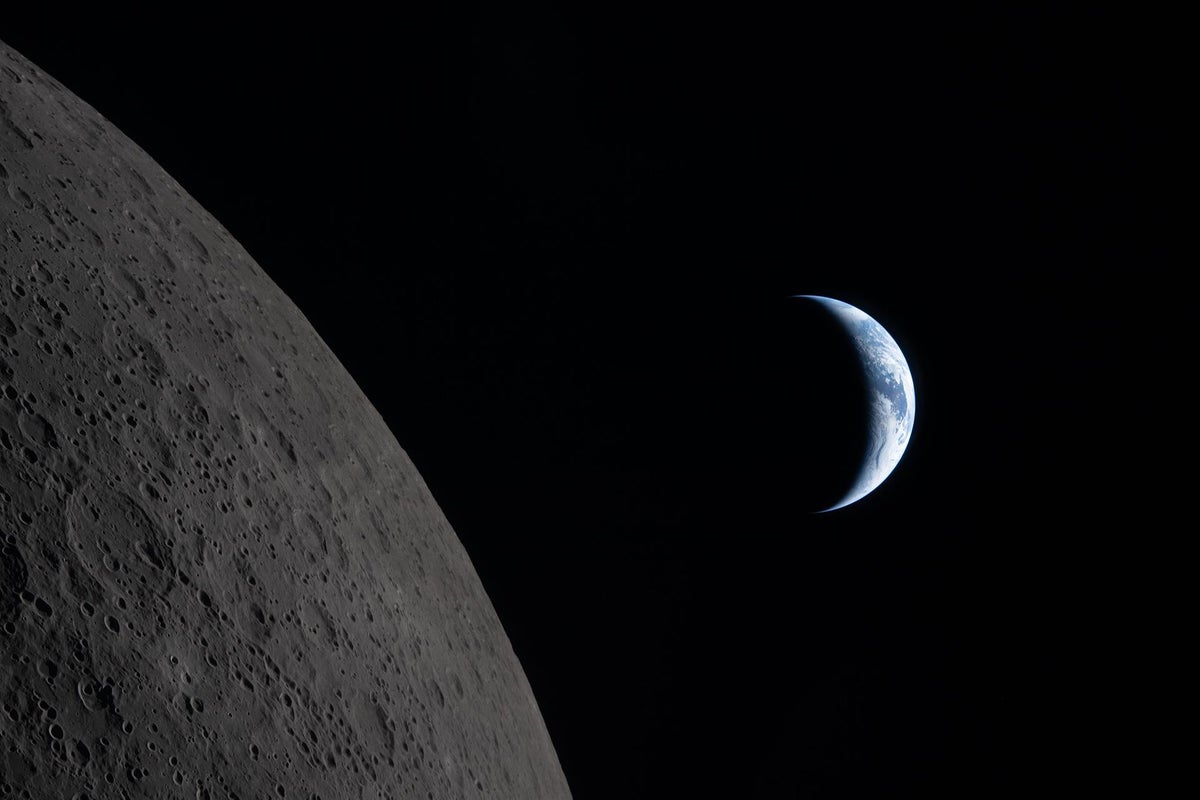
The moon is a cold, dead graveyard for solar panels. As the Artemis missions move from brief flags-and-footprints visits to permanent habitation, NASA and the Department of Energy are facing a physical reality that no amount of battery storage can solve. The lunar night lasts 14 Earth days. Temperatures plummet to $-208^\circ\text{F}$. Relying on the sun to keep astronauts alive in these conditions is a logistical death sentence. To stay on the moon—and eventually reach Mars—the United States is betting its entire deep-space future on the smallest, most controversial engine in existence: the fission reactor.
This isn't about the clunky, massive cooling towers of the 20th century. Washington is pouring hundreds of millions into Fission Surface Power (FSP), specifically compact 40-kilowatt reactors designed to be shoved into a rocket fairing and operated autonomously for a decade. The pivot from solar to nuclear is not just a preference. It is a mandatory shift in physics. If we do not master nuclear thermal propulsion and surface power within the next decade, the Artemis program will stall at the orbital stage, and the American presence on the lunar south pole will remain a series of expensive, short-term camping trips.
Why Solar Power Fails the Mars Test
Public relations footage often shows glittering solar arrays unfurling in the void. They look clean, efficient, and modern. But space agencies are hitting a wall. On the lunar surface, the weight of the batteries required to store enough energy for a two-week night exceeds the lifting capacity of current heavy-lift rockets.
Mars is even worse. The Red Planet receives less than half the sunlight of Earth. When the global dust storms arrive—choking the atmosphere for months—solar-powered rovers become expensive lawn ornaments. We saw this with the Opportunity rover, which went silent in 2018 after a storm covered its panels in silt. A nuclear reactor doesn't care about dust. It doesn't care about the 354-hour lunar night. It provides a steady, unrelenting heartbeat of electricity regardless of the environment.
The Power Density Math
To understand the scale of the challenge, consider the energy requirements for a modest lunar base. Life support, oxygen generation, and habitat heating require massive amounts of constant energy.
- Solar Setup: Requires acres of panels and tons of lithium-ion storage.
- Nuclear Setup: A single reactor the size of a household refrigerator can provide $40\text{ kW}$ of power, enough to run several homes or a specialized research facility.
The math favors the atom.
The DARPA Connection and the DRACO Program
While NASA focuses on keeping people warm on the moon, the Pentagon is looking at the transit problem. The current chemical rockets we use are essentially refined versions of the V-2 technology from the 1940s. They are slow. A trip to Mars takes seven to nine months, exposing astronauts to debilitating radiation and muscle atrophy.
The DRACO (Demonstration Rocket for Agile Cislunar Operations) program is the military’s attempt to change the propulsion game. By using a nuclear reactor to heat liquid hydrogen to extreme temperatures, the gas is expelled at high velocity, creating a high-thrust, high-efficiency engine. This isn't science fiction. This is Nuclear Thermal Propulsion (NTP).
Faster Transit Means Safer Crews
The primary benefit of NTP isn't just "going fast." It is the reduction of risk. Every day spent in deep space is a day spent dodging solar flares and cosmic rays. A nuclear-powered ship could cut the travel time to Mars by a third. This isn't just about efficiency; it's about the biological survival of the crew. When you move faster, you carry less food, less water, and less shielding. The mass savings alone justify the immense R&D costs.
The Safety Elephant in the Room
Mention "nuclear" and "launch" in the same sentence, and the ghost of the 1986 Challenger disaster looms over the conversation. The fear is a launch failure that scatters radioactive material across the Florida coast. This is a valid concern, but the engineering response is sophisticated.
The reactors being developed for Artemis and DRACO are designed to be "cold" during launch. They contain High-Assay Low-Enriched Uranium (HALEU), which is not significantly radioactive until the reactor is actually started. If a rocket explodes on the pad, the fuel is contained in reinforced ceramic and metal casings designed to survive reentry and impact without leaking. The reactor only becomes "hot" once it is safely in a high-earth orbit or on the lunar surface, far from the biosphere.
Public Perception vs. Physical Reality
The biggest hurdle isn't the shielding or the coolant. It is the regulatory gridlock. For decades, the U.S. government effectively banned nuclear power in space due to political optics. That changed in 2019 with a presidential memorandum that streamlined the approval process for launching nuclear systems. We are now seeing a gold rush of private companies—BWXT, Lockheed Martin, and X-energy—vying for contracts that were previously non-existent.
The Geopolitical Stakes of Lunar Energy
We are not the only ones looking at the poles of the moon. China and Russia have already announced plans for a joint International Lunar Research Station. They are not planning to rely on solar.
The moon’s south pole is home to "permanently shadowed regions" where water ice exists. This ice is the "oil" of the solar system; it can be broken down into oxygen for breathing and hydrogen for rocket fuel. However, mining that ice requires immense amounts of energy in a place where the sun never shines. Whoever brings the first reliable nuclear power plant to the moon will control the fuel supply for the rest of the solar system.
Sovereignty Through Megawatts
Energy is the ultimate form of sovereignty. If an American base has a surplus of nuclear power, it becomes the hub for all other international activity. Conversely, if we arrive with insufficient power, we will be dependent on whoever got there first with a working reactor. The race for space nuclear power is a race for the strategic high ground of the next century.
The Engineering Bottlenecks
Building a reactor for Earth is easy. You have an atmosphere to dissipate heat and plenty of water for cooling. In the vacuum of space, heat is your greatest enemy. You cannot "vent" heat into a vacuum. You have to radiate it away.
This requires massive radiator wings that use liquid metal coolants to move heat from the reactor core to the cold of space. The materials science required to keep these systems running for 10 years without maintenance is staggering. We are talking about components that must survive extreme vibration, radiation, and thermal cycling from $-200^\circ\text{C}$ to $800^\circ\text{C}$ on a daily basis.
Low-Enriched Uranium and the Supply Chain
Another overlooked factor is the fuel itself. The U.S. currently has a limited domestic capacity to produce HALEU. Most of the world's supply traditionally came from Russia. Relying on a geopolitical rival for the fuel that will power our lunar bases is a strategic nightmare. The Department of Energy is currently scrambling to subsidize domestic enrichment facilities to ensure the Artemis program isn't dead on arrival due to fuel shortages.
The Private Sector’s New Role
In the 1960s, nuclear space power was purely the domain of the government. Today, the landscape is shifting toward a "power-as-a-service" model. NASA doesn't want to own and operate the reactors; they want to buy the electricity from private contractors.
This creates a market for micro-reactors that have terrestrial applications as well. The technology being developed for a lunar base could eventually power remote military outposts or disaster zones on Earth. This cross-pollination of space and terrestrial tech is what is driving private investment. Venture capital is flowing into nuclear startups because they see a dual-use case that didn't exist during the Cold War.
Redefining the "Final Frontier"
The transition to space-based nuclear power is the most significant shift in aerospace since the invention of the jet engine. We are moving away from the era of "disposable" space travel—where we burn everything we have just to get there—into an era of sustained presence.
Without nuclear power, Mars remains a dream for the distant future. With it, the solar system becomes an accessible backyard. The challenges are not just technical; they are psychological. We have to move past the 20th-century fear of the atom and recognize it as the only viable tool for survival in the most hostile environment known to man.
The first reactor to go critical on another world will mark the true beginning of the space age. Everything before that was just a trial run. The infrastructure we build now will determine if the moon is a destination or just another place we visited once and never returned. There is no middle ground. You either bring the power with you, or you stay home in the dark.
Take the gamble on the atom now or concede the lunar surface to those who will.