The verdict is in, and the legal ambiguity is dead. The International Court of Justice (ICJ) has officially ruled that Myanmar committed genocide against the Rohingya Muslim minority, confirming that the 2017 military crackdown was driven by a specific intent to destroy a people in whole or in part. This landmark ruling marks the first time the United Nations' highest court has found a state directly responsible for violating the 1948 Genocide Convention since the Bosnia and Herzegovina case decades ago. For the over one million Rohingya survivors languishing in sprawling refugee camps in Bangladesh, the decision provides long-awaited judicial validation, even as the actual enforcement of justice remains trapped in the machinery of global geopolitics.
Most mainstream coverage stops at the gavel drop. They treat a courtroom victory in The Hague as the finish line, ignoring the cold reality of international law. A ruling from the ICJ is binding, yes, but the court has no police force, no army, and no mechanism to kick down the doors of the military junta in Naypyidaw. To understand what this ruling actually does—and where it fails—you have to look past the headlines and examine the legal architecture, the decades of state-sponsored erasure that preceded the 2017 fires, and the geopolitical shield that keeps Myanmar's generals insulated from real consequences.
Inside the Legal Standard That Proved Intent
Proving genocide in an international court is notoriously difficult. Prosecutors cannot simply point to mass graves, burned villages, or hundreds of thousands of displaced people. Under Article II of the 1948 Genocide Convention, the legal threshold requires proving dolus specialis—the specific intent to destroy, in whole or in part, a national, ethnical, racial, or religious group. Without proof of that specific state of mind, mass atrocities get downgraded to crimes against humanity or war crimes.
For years, Myanmar’s defense team, once famously led in person by Aung San Suu Kyi before the 2021 military coup, argued that the 2017 "clearance operations" were legitimate counter-insurgency measures against the Arakan Rohingya Salvation Army (ARSA). They claimed the massive displacement of over 700,000 people was an unfortunate byproduct of fighting militants, not a coordinated campaign of extermination.
The ICJ dismantled that defense by looking at the pattern of conduct. When a military force systematically burns hundreds of villages while leaving neighboring ethnic Rakhine settlements untouched, that is not counter-insurgency. When soldiers execute infants, commit mass sexual violence, and deploy hate speech coordinated through state-backed media, the pattern becomes undeniable. The court inferred specific intent from the sheer scale, coordination, and uniformity of the violence across Rakhine State.
Gambia, the small West African nation that brought the case forward in 2019 on behalf of the Organization of Islamic Cooperation, utilized a crucial legal mechanism known as erga omnes partes. Because the Genocide Convention is a treaty designed to protect universal human rights, any signatory state has the legal standing to sue another signatory, even if none of its own citizens were harmed. Gambia’s legal team weaponized this principle, bypassing the usual jurisdictional roadblocks that prevent international courts from intervening in domestic atrocities.
How the State Engineered a Slow-Motion Erasure
The 2017 military crackdown did not happen in a vacuum. It was the violent climax of a bureaucratic and legal dismantling of Rohingya identity that stretched back more than half a century. Long before the Tatmadaw—Myanmar's military—lit the matches in Rakhine State, the government used ink and paper to strip the Rohingya of their right to exist.
Consider the 1982 Citizenship Law. Enacted under General Ne Win’s military regime, this legislation created a tiered system of citizenship tied to 135 officially recognized "national races" (taingyintha). The Rohingya were deliberately excluded from that list, instantly rendering an entire population stateless in the land where their families had lived for generations.
Once you erase a group's legal status, every subsequent abuse becomes administratively routine. Over the next three decades, the state systematically tightened the noose through a web of discriminatory policies:
- Movement Restrictions: Rohingya were barred from traveling outside their townships without expensive, hard-to-obtain government permits, effectively turning northern Rakhine State into an open-air prison.
- Marriage and Birth Controls: Local authorities enforced strict regulations requiring Rohingya couples to apply for permission to marry, often accompanied by years-long delays and exorbitant bribes, alongside two-child limits in specific townships.
- Economic Strangulation: Arbitrary taxation, land confiscations, and exclusion from civil service and higher education systematically impoverished the community, eroding their capacity to resist or recover.
- Dehumanization Campaigns: State media and ultra-nationalist Buddhist monks, such as the Ma Ba Tha movement, spent years framing the Rohingya as existential threats and illegal "Bengali" invaders.
When the military launched its sweep in August 2017, the psychological and logistical groundwork had already been laid. The general population had been conditioned to view the Rohingya not as neighbors, but as an infestation. The soldiers on the ground were merely executing the final physical phase of a bureaucratic erasure that had been running for decades.
The Enforcement Paradox and Geopolitical Reality
Here is the uncomfortable truth that human rights advocates rarely emphasize on broadcast news. Winning at the ICJ does not put a single general in handcuffs. The ICJ settles disputes between states; it does not prosecute individuals. Even though the court ordered Myanmar to pay reparations, cease all genocidal acts, and preserve evidence, the entity currently running Myanmar—the State Administration Council—is the very same military junta that orchestrated the atrocities.
Enforcement of ICJ rulings falls to the United Nations Security Council. If a state refuses to comply with an ICJ judgment, the other party can ask the Security Council to impose sanctions, authorize peacekeeping forces, or take other coercive measures under Article 94 of the UN Charter.
That is where the legal momentum hits a brick wall. China and Russia hold permanent veto power on the Security Council. Beijing views Myanmar as a critical strategic corridor to the Indian Ocean, pouring billions into infrastructure projects like the China-Myanmar Economic Corridor. Moscow, isolated by Western sanctions, has become the junta’s primary arms supplier, selling fighter jets and armored vehicles to the regime in exchange for diplomatic backing. Neither Beijing nor Moscow has any interest in allowing the Security Council to enforce an ICJ ruling against Naypyidaw.
Furthermore, the political situation inside Myanmar has fractured completely since the February 2021 coup. The military junta is currently fighting for its survival against a nationwide coalition of ethnic armed organizations and pro-democracy People’s Defense Forces. Remarkably, the junta has recently resorted to forcibly conscripting Rohingya men from the remaining camps in Rakhine State to fight as human shields against the Arakan Army, an ethnic Rakhine rebel group that now controls vast swaths of the state. The perpetrators of the 2017 genocide are actively forcing their victims to die on the front lines of a civil war.
Why This Verdict Still Matters Beyond The Hague
If the junta ignores the court and the Security Council remains paralyzed, it is fair to ask whether the ruling is purely symbolic. Dismissing it as mere symbolism, however, misunderstands how international pressure actually erodes rogue regimes over time. The ICJ verdict creates concrete, long-term liabilities that neither the junta nor its foreign backers can easily scrub away.
First, the ruling fundamentally alters the diplomatic and financial risk profile for any nation or corporation doing business with Myanmar. When the world’s highest court formally labels a state’s actions as genocide, foreign banks, insurers, and state-owned enterprises face immense legal and reputational exposure if they continue facilitating transactions with the regime. It gives Western governments airtight legal justification to expand targeted sanctions against Myanmar's state-owned oil and gas enterprises, cutting off the junta's remaining foreign currency lifelines.
Second, the ICJ's evidentiary record serves as a direct feeder into parallel criminal prosecutions. While the ICJ handles state responsibility, the International Criminal Court (ICC) prosecutes individual leaders. The ICC has already opened an investigation into the deportation of the Rohingya from Myanmar to Bangladesh, and the ICJ’s definitive finding of genocidal intent provides massive legal ammunition for ICC prosecutors seeking arrest warrants for Senior General Min Aung Hlaing and his top commanders.
Third, the decision triggers universal jurisdiction cases around the globe. Under the principle of universal jurisdiction, national courts in countries like Argentina, Germany, or the United Kingdom can prosecute individuals for genocide regardless of where the crimes occurred or the nationality of the perpetrators. An active case in Argentina is already pursuing Myanmar’s military leadership under this exact doctrine. The ICJ verdict eliminates any remaining legal doubt in those domestic courts about whether the threshold of genocide was met.
The Forgotten Crisis in Cox's Bazar
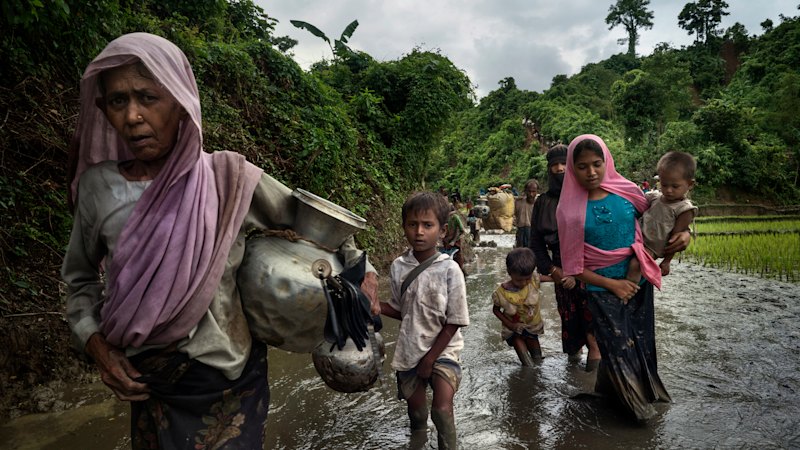
While diplomats and lawyers dissect the legal nuances in Europe, the human cost continues to compound in southeastern Bangladesh. Over one million Rohingya live in the Kutupalong and Nayapara refugee camps in Cox’s Bazar, the largest and most densely populated refugee settlement on earth.
The conditions there are deteriorating rapidly. International donor fatigue, driven by competing global crises in Ukraine, Gaza, and Sudan, has severely starved the UN’s Joint Response Plan for the Rohingya humanitarian crisis. The World Food Programme was forced to slash food rations multiple times, dropping monthly allowances to levels that leave families chronically malnourished.
Without legal status in Bangladesh, refugees are barred from formal employment and higher education. An entire generation of Rohingya children is growing up behind barbed-wire fences with almost no prospects for a future. Criminal gangs and militant factions have filled the security vacuum inside the camps, leading to daily extortion, kidnappings, and turf wars.
Repatriation—the stated goal of both Bangladesh and the international community—is a fantasy under current conditions. Sending the Rohingya back to Rakhine State without guaranteed citizenship, freedom of movement, and international security monitors would simply be handing them back to the exact military apparatus the ICJ just found guilty of trying to wipe them out. Even if the junta were to collapse tomorrow, the National Unity Government (NUG)—Myanmar’s shadow pro-democracy administration—and the Arakan Army must still reckon with decades of deeply ingrained anti-Rohingya prejudice among the broader population.
The ICJ ruling strips away the world's last excuse for inaction. For years, cautious diplomats hid behind the word "alleged" when describing the atrocities in Rakhine State, waiting for the judicial process to play out before committing to decisive political measures. That shield is gone. The court has established the historical and legal truth in permanent ink, leaving global powers with a stark choice between enforcing the law they wrote or admitting that the Genocide Convention is only worth the paper it is printed on when the victims lack geopolitical value.