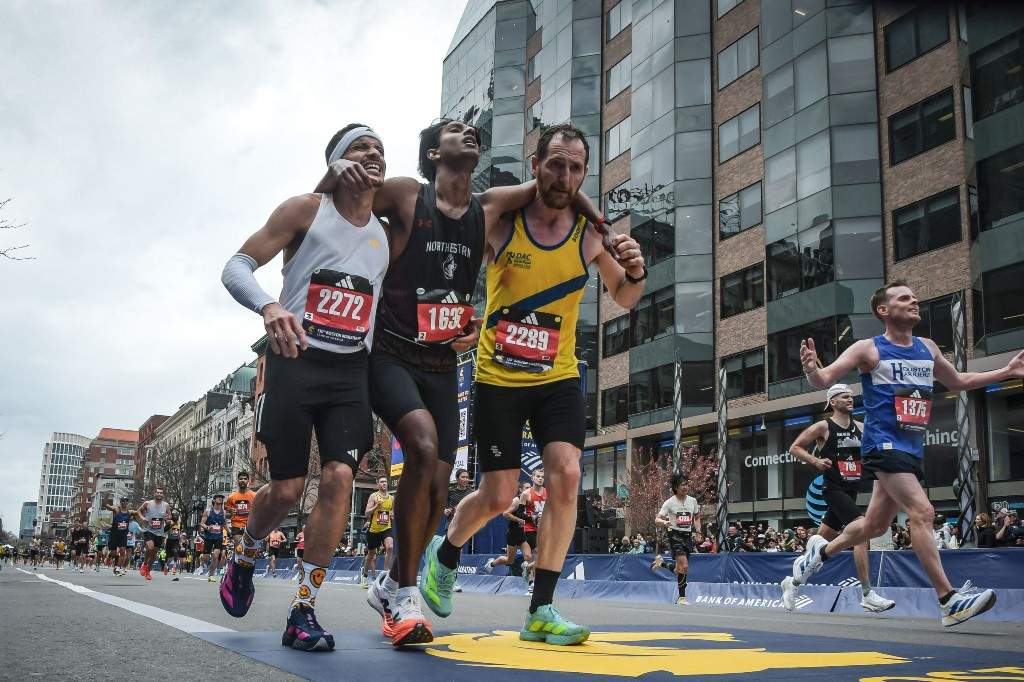
The sight of a collapsing runner being hauled across the blue-and-yellow paint of Boylston Street has become the quintessential image of the Boston Marathon. It surfaces every April, reliably filling social media feeds with a specific brand of tear-jerking content. This year was no different, as a group of exhausted participants abandoned their own personal records to physically carry a struggling man over the final yards. While the public celebrates these moments as triumphs of the human spirit, they actually mask a grueling physiological reality and a controversial debate regarding the ethics of assistance in elite endurance sports.
To understand why a runner’s body shuts down within sight of the grandstands, you have to look past the "heartwarming" narrative and into the chemistry of total systemic failure. These athletes are not just tired. They are experiencing a cascading biological breakdown where the brain and the muscles enter a desperate conflict over survival.
The Chemistry of the Wall
Most amateur runners talk about hitting "the wall" at mile 20. By the time someone reaches mile 26.2 and loses the ability to stand, they have moved beyond a wall and into a basement of metabolic crisis. The body typically stores about 2,000 calories of glycogen in the muscles and liver. For a marathoner, that fuel tank hits empty somewhere around the two-hour mark for pros, or the four-hour mark for the middle of the pack.
When glycogen vanishes, the body attempts to switch to fat oxidation, which is a far less efficient process for maintaining a competitive pace. The brain, sensing that the heart and lungs are pushing toward a redline that could result in permanent damage, begins to dial back the electrical signals sent to the legs. This is the central governor theory in action. It is a protective mechanism. When you see a runner's legs turn to "jelly," you are witnessing the brain literally cutting power to the house to prevent the circuits from melting.
The man carried across the line this year was likely suffering from a combination of severe hypoglycemia and exercise-associated muscle cramping. His nervous system had effectively disconnected from his motor units. While the imagery of fellow runners grabbing his arms is poignant, it represents a moment where the athlete is no longer in control of his own physical narrative.
The Cost of the Finish Line Photo
There is a tension in the world of long-distance running that most casual observers ignore. Most major marathons, including Boston, operate under strict rules regarding "outside assistance." Technically, if a spectator or a medical professional touches a runner, that runner is subject to immediate disqualification.
However, "participant-to-participant" assistance occupies a murky gray area. The Boston Athletic Association (BAA) generally looks the other way when runners help one another, choosing the optics of sportsmanship over the rigidity of the rulebook. But veteran coaches often view these moments with a more cynical eye.
When three people stop to carry a fourth, they are not just helping a friend; they are potentially endangering a person who needs immediate, professional medical intervention. A runner who cannot support their own weight is often in the throes of heatstroke or severe hyponatremia—a dangerous drop in blood sodium levels. Dragging that person across a finish line to get a "finisher" medal delays the cooling tubs and IV fluids that could save their life. The quest for the "heartwarming moment" can sometimes bypass the basic safety protocols that keep these races from turning fatal.
The Spectacle of Suffering
We have become addicted to the aesthetics of the struggle. The more a runner suffers, the more "authentic" the race feels to the watching public. This creates a strange incentive structure. In the era of the "Main Character" on social media, stopping to help a falling runner is the fastest way to go viral. It guarantees local news coverage and thousands of shares.
This isn't to say the impulse to help isn't genuine. It usually is. But the industry surrounding these races has leaned into this imagery because it sells the idea that marathons are about something deeper than aerobic capacity. They sell the idea of a secular pilgrimage where the finish line acts as a site of total absolution.
The Evolution of the Boylston Street Gauntlet
The final 0.2 miles of the Boston Marathon is perhaps the most scrutinized stretch of pavement in the sporting world. It is flat, lined with thousands of screaming fans, and framed by the architecture of a city that views this race as its primary cultural export.
Since the 2013 bombing, the finish line has taken on an even heavier weight. It is no longer just a timing mat; it is a symbol of resilience. This explains why the "heartwarming" stories from Boston carry more weight than those from London, Tokyo, or Chicago. Every person who crosses that line is seen as a participant in a collective act of defiance.
When a runner falls and is lifted by strangers, it mirrors the way the city itself was lifted in the aftermath of tragedy. This emotional baggage makes it almost impossible to critique the act of helping. To suggest that the runner should have been left for the medics is seen as heartless, even if it is the medically sound perspective.
The Physiological Point of No Return
What does it feel like when the legs quit? Experienced marathoners describe a sensation of "neurological flickering." You tell your foot to lift, and nothing happens. Your vision narrows. The sound of the crowd becomes a dull hum.
In these moments, the "helpers" are often acting on adrenaline. They aren't thinking about the mechanics of the carry or the potential for dropping the person. They are reacting to a primal urge to not leave a member of the tribe behind.
The Mechanics of the Carry:
- The Under-Arm Hook: Most common, but puts immense pressure on the ribcage and can restrict breathing for the struggling runner.
- The Drag: Used when the runner is too heavy for a full lift; this often results in abrasions on the knees and shins.
- The Human Crutch: Two runners act as pillars. This is the safest method but requires perfect synchronization.
The Professional Divide
You rarely see this in the elite field. If a pro runner collapses, they are usually whisked away by medical staff within seconds. The stakes are too high, and the disqualification rules are too strictly enforced. The "heartwarming" collapse is a phenomenon almost exclusively reserved for the "charity" or "time-qualified" amateur brackets.
This suggests a fundamental difference in how we perceive the sport. For professionals, the marathon is a job, and failure is a professional setback. For the amateur, the marathon is a metaphor for life. In a life-metaphor, failing at the very end is unacceptable. You must finish, by any means necessary, even if you have to be dragged.
The Long-Term Impact on the Sport
The glorification of the "carry" creates a dangerous precedent for novice runners. It reinforces the idea that you should push yourself until your body literally fails, because someone will be there to catch you. This "push past the pain" mentality is responsible for a significant percentage of the injuries seen in the medical tents.
While the story of the man helped across the line is framed as a win, we rarely see the aftermath. We don't see the hours in the hospital, the kidney stress caused by rhabdomyolysis, or the months of physical therapy required to recover from a systemic shutdown. We only see the 15-second clip of the finish.
The truth is that the most successful marathon is the one where you finish on your own two feet, having managed your pace and nutrition with surgical precision. The "heartwarming" collapse isn't a success of training; it is a failure of preparation or a betrayal of biology.
We need to stop celebrating the collapse and start respecting the limit. The finish line is a destination, not a divine right. If the body says no, the most courageous thing a runner can do is listen, step off the course, and acknowledge that the race won.
The man who was carried across the line in Boston will have a medal on his wall. He will have a story for his grandchildren. But the blue-and-yellow paint of Boylston Street doesn't care about stories. It only cares about the physical reality of the 26.2 miles that lead up to it. The "spirit of Boston" is a powerful thing, but it cannot override the laws of human physiology, no matter how many cameras are rolling.