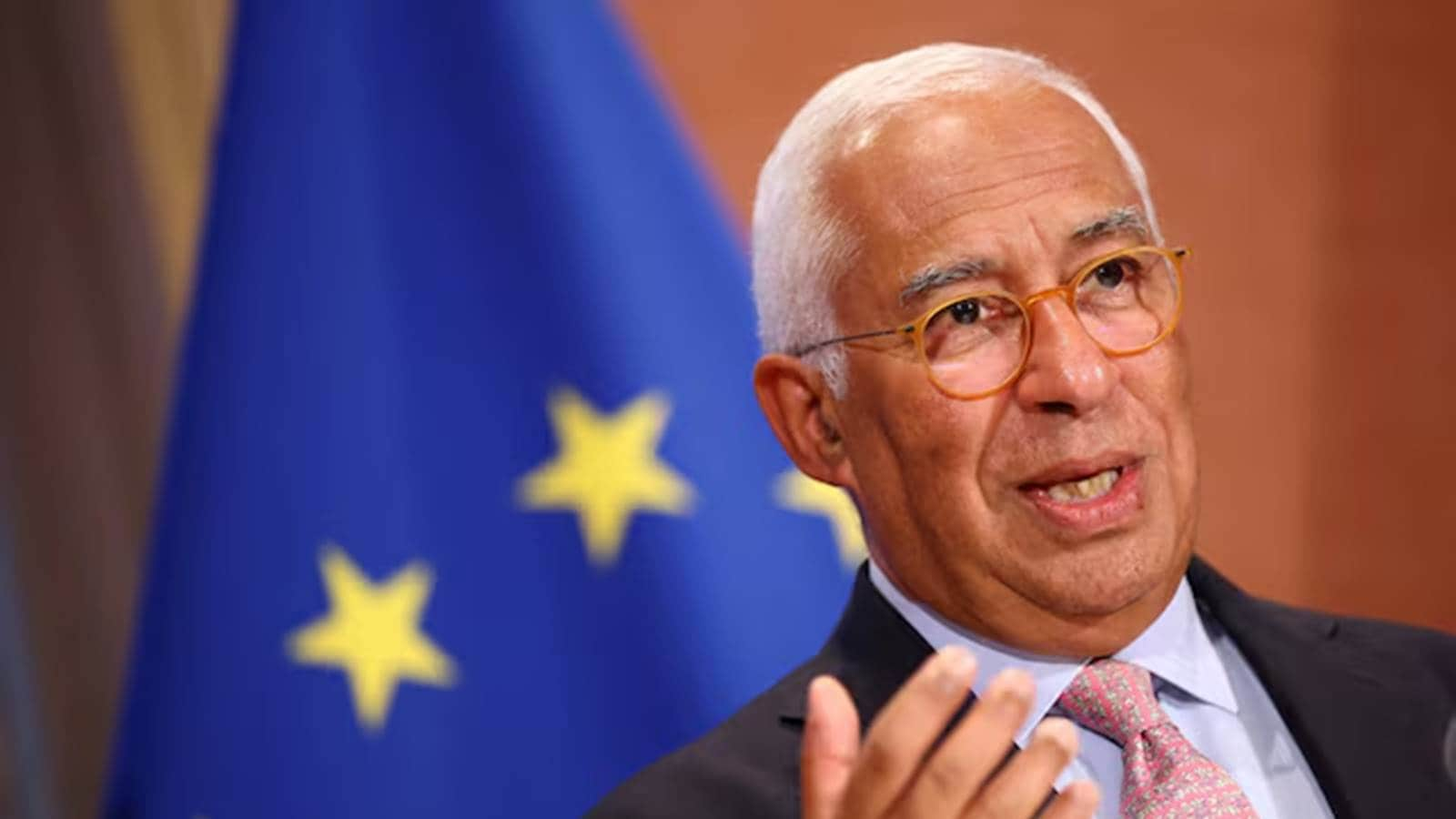
Every seven years, Brussels stages the exact same kabuki theater. A European Council president floats painful cuts to the Multiannual Financial Framework, tosses a shiny new "own resource" tax onto the negotiating table, and the financial press dutifully reports it as a hard-nosed fiscal reckoning.
They are missing the entire plot. You might also find this similar article interesting: Inside the High-Stakes India and Canada CEPA Trade Negotiations Nobody is Explaining.
When the EU leaders' chair proposes slicing into the 2028–2034 budget draft while dangling a fresh digital tax to plug the hole, the lazy consensus frames this as a standard tug-of-war between frugal net contributors and ambitious spenders. Economists in Brussels will tell you it is about balancing debt repayments for the NextGenerationEU recovery fund against new defense and competitiveness priorities. Tech lobbyists will scream that a digital levy violates international tax consensus and invites American tariffs.
Both sides are arguing over the furniture while the house is sinking into the mud. The real story is not the size of the 2028–2034 budget or the mechanics of a digital services levy. The real story is that the European Union is trying to tax its way out of an innovation deficit while refusing to touch the bloated, twentieth-century entitlement structures that consume the vast majority of its cash. As reported in latest coverage by Harvard Business Review, the implications are worth noting.
The Accounting Trick Behind "New Own Resources"
Let us get our definitions straight before the policy wonks muddy the waters. In EU parlance, the seven-year spending plan is the Multiannual Financial Framework, or MFF. Historically, it has been funded primarily by Gross National Income (GNI) contributions from member states—essentially membership dues based on the size of each country’s economy.
When the EU borrowed hundreds of billions of euros on capital markets to fund its post-pandemic recovery instrument, NextGenerationEU, it created a ticking fiscal time bomb. Starting in 2028, those bonds come due. Interest and principal repayments will eat roughly €25 billion to €30 billion every single year out of the MFF.
Faced with that math, national capitals had three choices:
- Increase their direct GNI contributions (political suicide for finance ministers in Berlin, The Hague, and Stockholm).
- Gut legacy spending programs like the Common Agricultural Policy (CAP) and Cohesion Policy (political suicide in Paris, Warsaw, and Madrid).
- Invent "new own resources"—taxes collected directly at the EU level so national governments can pretend they aren't the ones raising taxes.
Enter the digital tax proposal. By pitching a levy on digital revenues alongside modest trims to the draft budget, the Council leadership is executing a classic political sleight of hand. They get to posture as fiscal hawks by proposing cuts, while simultaneously building a direct fiscal pipeline from the tech sector straight to Brussels.
It is brilliant politics and terrible economics.
Why a Digital Tax Is an Own-Goal for European Competitiveness
I have sat in rooms with European tech founders and venture capital partners who spent years trying to scale enterprise software across fragmented national borders. Ask them what holds Europe back, and not a single one will say, "We just don't have enough tax compliance hurdles."
Yet every time Brussels needs cash, it reaches for the digital tax hammer. The logic is seductively simple for politicians: big American tech platforms generate massive revenues from European users while booking profits in low-tax jurisdictions like Ireland or Luxembourg. Taxing gross digital revenues—rather than corporate profits—bypasses profit-shifting tricks and guarantees immediate cash flow.
Here is the problem. Gross revenue taxes do not care about margins.
If you are a mature monopoly sitting on 40 percent net margins, a 3 percent tax on top-line revenue is an annoying haircut. You absorb it, or you pass it directly onto European businesses buying your cloud credits and ad inventory. In fact, we already know how this plays out. When France and the UK introduced unilateral Digital Services Taxes, major platforms simply added a surcharge to invoices for local advertisers and merchants. The tax meant to punish Silicon Valley became a consumption tax paid by European small businesses.
Worse, if you are a high-growth European scale-up operating at a loss to capture market share, a revenue tax is poison. Even when legislators include high revenue thresholds—like the €750 million global turnover mark used in the OECD Pillar One discussions—they create a hard growth ceiling. Companies approaching the threshold deliberately throttle expansion, split entities, or relocate their headquarters to Delaware before they ever hit the trigger.
Mario Draghi spent hundreds of pages in his landmark report on European competitiveness warning that the EU is falling dangerously behind the United States and China precisely because it fails to scale high-tech firms. You cannot publish white papers begging for European tech champions on Monday and propose punitive revenue taxes on digital business models on Tuesday.
The Sacred Cows Nobody Dares to Slaughter
To understand why the 2028–2034 budget negotiations are fundamentally dishonest, you have to look at where the money actually goes.
Even with the proposed cuts from the Council chair, the structural bones of the EU budget remain trapped in the 1980s. Roughly two-thirds of the entire MFF is still swallowed by two massive buckets: agricultural subsidies and regional cohesion funds.
- The Common Agricultural Policy (CAP): Originally designed to ensure food security in post-war Europe, it now functions largely as an acreage-based wealth transfer where the largest 20 percent of industrial farms capture roughly 80 percent of the direct payments.
- Cohesion Policy: Intended to help poorer regions catch up to the EU average, it has morphed into a bureaucratic slush fund where net-contributor countries demand their own "just return" slice of regional grants just to justify their membership fees to voters back home.
Imagine a scenario where a legacy manufacturing conglomerate realizes its core product line is obsolete, its debt service is spiking, and its R&D department is starved of cash. Instead of shutting down unprofitable factories, the board of directors leaves the legacy plants untouched, trims 5 percent off office supplies, and slaps a surcharge on its fastest-growing digital distribution channel.
That is the exact blueprint currently circulating in Brussels.
The Council chair’s proposed cuts do not represent a structural overhaul of EU spending. They are across-the-board haircuts designed to appease the "Frugal Four" coalition without triggering a veto from agricultural lobbies or eastern European governments dependent on cohesion transfers. When you trim budgets with a butter knife instead of a scalpel, you do not eliminate waste; you just starve the forward-looking programs—like Horizon Europe research grants, cross-border energy grids, and joint defense procurement—that lack entrenched national lobbies to defend them.
Dismantling the Myths Around the 2028–2034 MFF
Whenever these budget drafts leak, the same tired talking points flood the zone. Let us strip away the diplomatic jargon and look at what is actually happening.
"Isn't an EU digital tax necessary to make Big Tech pay its fair share?"
This question confuses two completely different issues: corporate tax avoidance and EU budget financing. For years, the OECD worked on Pillar One—a global framework to reallocate taxing rights over the world's largest multinationals to the countries where their users and consumers are located. That deal stalled largely because of political gridlock in Washington and disputes over unilateral taxes.
If the EU resurrects a standalone digital levy specifically to fund its own budget, it is no longer about global tax fairness. It is about protectionism disguised as fiscal policy. Furthermore, it guarantees retaliatory tariffs from the United States on European exports—meaning German automakers, French winemakers, and Italian luxury brands will end up paying the bill for Brussels' budget shortfall.
"Won't cutting the draft budget force Brussels to become more efficient?"
No. In EU institutional politics, budget cuts almost never target administrative bloat or ineffective legacy subsidies because those line items are protected by fierce national vetoes. When member states demand a smaller headline figure—say, capping the MFF at 1 percent of EU GNI—the European Commission protects the politically untouchable funds first. The cuts fall disproportionately on flexible instruments, external border management, digital infrastructure, and scientific research. You end up with the exact same bureaucracy, the exact same farm subsidies, and zero capacity to respond to geopolitical shocks.
"How else can the EU pay back its pandemic debt without raising national taxes?"
This is the uncomfortable truth no European leader wants to say out loud: you cannot. Debt is simply deferred taxation. When EU leaders agreed to issue joint bonds in 2020, they kicked the repayment can down the road to 2028, hoping economic growth or magical new revenue streams would materialize. Neither happened at the scale required. Pretending that a niche tax on digital platforms—or revenues from the Emissions Trading System and the Carbon Border Adjustment Mechanism—will painlessly erase €30 billion a year in debt service is fiscal fantasy. Either national budgets absorb the cost, or existing EU programs get gutted.
The Uncomfortable Downside of Scrapping the Status Quo
If I were advising a European finance minister today, I would tell them to reject the digital tax outright, accept a painful restructuring of agricultural and cohesion spending, and pivot the entire 2028–2034 MFF toward hard infrastructure, defense, and deep capital markets.
Let me be completely honest about the political cost of that stance: it could break the European Council.
The MFF requires unanimous approval from all 27 member states, plus the consent of the European Parliament. The reason CAP and Cohesion funds survive every single seven-year cycle is that they are the political glue holding the bloc together. If you strip away regional transfers from central and eastern Europe while simultaneously telling French farmers their direct payments are gone, you do not get a sleek, modern EU budget. You get vetoes, paralyzed summits, and a surge in anti-EU populism across half the continent.
That is the trap Brussels has built for itself. The unanimity rule turns the EU budget into a hostage negotiation where every country protects its favorite subsidy, leaving no room for strategic investment.
What Smart Operators Should Do Right Now
If you run a business, manage capital, or lead policy strategy in Europe, do not wait around for the 2028–2034 negotiations to produce a miracle. Watch the incentives, ignore the press releases, and position yourself accordingly.
- Price in digital pass-through costs now. Do not assume a digital tax will be blocked by Washington or killed in the Council. Even if an EU-wide levy stalls, desperate finance ministries will expand unilateral national digital taxes to plug domestic deficits. If your business relies heavily on enterprise cloud services, programmatic advertising, or third-party marketplaces in Europe, model a 3 to 5 percent cost increase across your vendor stack by 2028.
- Stop chasing Brussels grant money for core R&D. Every time the MFF gets squeezed, research and innovation programs become the piggy bank raided to pay for emergencies. If your startup's survival depends on Horizon grants or EU innovation subsidies, your business model is fragile. Build for commercial unit economics first, and treat EU funding as non-dilutive gravy—never as runway.
- Watch the regulatory arbitrage. As Brussels tightens fiscal and regulatory screws on digital business models, look for the member states quietly offering tax credits, R&D deductions, and regulatory sandboxes to attract technical talent. Capital will always flow to where it is treated best, regardless of what the Council chair writes in a budget draft.
Brussels wants you to believe that trimming a few billion off a seven-year spreadsheet and taxing tech platforms equals bold leadership. It is not. It is the sound of a continent mortgaging its digital future to pay for its agricultural past.



