The bricks arrived on Clover Way long before the crowds did.
They came in the form of quiet anxieties, whispered conversations over garden fences, and a mounting sense of abandonment that had been quietly pooling in this Norfolk market town for months. When the summer heat finally broke into open unrest, the targets were not abstract political policies or distant government offices. The targets were ordinary front doors, smashed windows, and the lives trembling behind them.
For three consecutive nights, Thetford became a flashpoint. More than a hundred people gathered on the streets, drawn together by circulating online lists of properties used by government contractors to house asylum seekers. What began as bitter frustration over plans to convert the nearby former RAF Barnham barracks into accommodation for hundreds of migrants quickly metastasized into something darker.
Mobs formed in the twilight. Shouts of hostility echoed against brick facades. Fences splintered under pressure, and eggs smeared across windowpanes left sticky yellow trails like weeping sores.
Consider what happens when a community feels entirely unheard. Former police detective Chris Phillips noted that unrest of this nature often brews when ordinary people believe politicians are profoundly ignoring their warnings. In Thetford, that structural disconnect curdled into vigilantism. Local residents watched as a quiet, tight-knit town transformed into an arena of confrontation, caught between a government machinery operating behind closed doors and the volatile energy of outside agitators whipping up local fears.
The cost was paid by bodies and bonds.
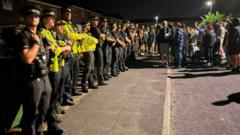
Officers stepping in to form human shields around men forced to flee their accommodation found themselves under siege. Rocks flew through the air. A male officer was struck. A female officer suffered a severe bite that broke her skin. Others were spat upon, pushed, and vilified while trying to maintain a thinning line between absolute chaos and civic order. Two officers ended up hospitalized, while emergency public safety powers and dispersal orders had to be slammed down across the town.
Yet behind the flying debris and the screech of police sirens lies a deeper fracture.
On one side stand residents like Angela Milton, a fifty-year resident watching her familiar streets change overnight, wrestling with a genuine, deep-seated unease about rapid demographic shifts and infrastructural strain without local consent. On the other side stand human beings who arrived seeking sanctuary, only to find themselves dragged from their homes in the dead of night, their possessions targeted, their safety shattered by strangers who knew nothing of their stories save for their status.
Local MP Terry Jermy called the scenes deeply concerning, condemning the descent into mob rule that yanked vulnerable people from designated places of safety. He acknowledged that while legitimate worries about local planning and transparency at the ex-RAF site exist, the outbreak of violence actively sabotages any honest community dialogue.
When the sun rises over Thetford, the broken glass is swept from the pavement. The spray-marked walls are scrubbed. But the underlying fever does not break so easily.
Trust, once broken, leaves jagged edges that no emergency police powers can smooth away. The crowds have dispersed for now, retreating behind closed doors and darkened windows, leaving a once-quiet market town to reckon with the heavy silence of what happens when fear is left unchecked in the dark.
The quiet Norfolk street remains under watch, its pavement clean of debris, yet heavy with the enduring shadow of a community at war with itself.
Police officers bitten, spat at in anti-migrant protests in UK town
This video coverage outlines the frontline clashes and law enforcement response during the height of the disturbances in Thetford.