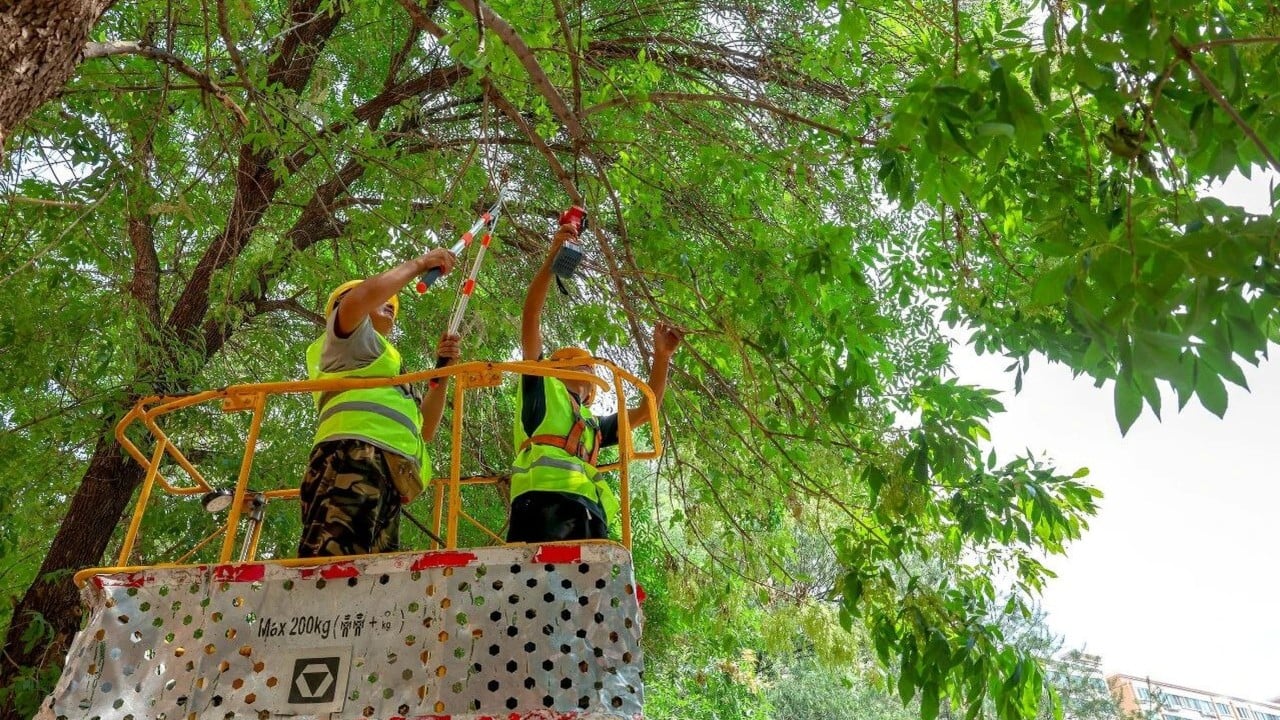
Municipal panic theater looks remarkably green from a distance. If you read the standard reports, Beijing is currently executing a masterclass in ecological stewardship. The narrative is pristine: millions of micro-wasps released into municipal canopies, hand-to-hand combat against invasive moths, and children turning in squirming caterpillars for cash prizes in a quaint civic partnership. It plays like a modern fairy tale where modern science meets grassroots heroism.
It is also an expensive, sentimental distraction from a failing ecosystem.
I have spent years watching urban planners throw capital at symptoms while ignoring the structural decay rotting the host. When a metropolis of twenty-two million people resorts to biological hand-to-hand combat against a defoliating insect, you are not witnessing advanced environmental management. You are watching a desperate holding action by a system that has engineered resilience completely out of its own soil.
The lazy consensus holds that invasive pests are an external enemy to be repelled by deploying counter-species and schoolyard brigades. This misses the mechanical reality of urban forestry. Moths do not invade healthy habitats; they exploit vacant niches left behind by sterile, mono-culture landscaping.
The Illusion of Biological Control
Let us dismantle the parasite narrative first. Trichogramma wasps and similar parasitoids are heavily romanticized by municipal PR departments. They sound organic. They sound sophisticated. In a controlled agricultural greenhouse with a single crop line, targeted biological release has a mathematical logic.
In a hyper-fragmented, polluted, heat-island urban center like Beijing, releasing tiny predatory wasps is like throwing water balloons at a forest fire.
The fundamental error lies in treating the urban canopy as a static artifact rather than a dynamic, stressed network. Beijing’s urban greening over the past three decades prioritized speed and visual uniformity over biological depth. Acres of poplars and monotonous rows of single-species trees were planted to anchor dust and paint the city green for international summits. These monocultures act as all-you-can-eat buffets for opportunistic insects.
When you plant a highway-length corridor of identical hosts, you remove the chemical diversity that confuses pests and feeds native predators. You create an ecological desert disguised as a park. Then, when the inevitable population explosion of caterpillars occurs, you do not fix the structural flaw. You ship in millions of wasps to eat the symptoms, creating a perpetual dependency cycle where the municipal budget becomes the sole guarantor of tree survival.
It is chemical pest control without the sprayers, substituting biological intervention for genuine ecological health.
The Caterpillar Bounty Fallacy
Then we have the community engagement angle. Turning children into bounty hunters collecting bagworms and moth larvae in jars for cash is a brilliant PR stunt. It generates heartwarming human-interest stories, fills local news broadcasts with smiling youths, and fosters a sense of civic duty.
It is also macroscopically useless.
Imagine a scenario where a leak in a massive industrial dam is plugged with chewing gum by school children. Does it slow the flood? Technically, for about four minutes. Does it solve the structural engineering failure behind the leak? Not even slightly.
Manual collection of caterpillars by citizens removes a microscopic fraction of a breeding population that reproduces exponentially. A single female moth can lay hundreds of eggs. A child filling a jar of fifty caterpillars is making zero statistical impact on an infestation spanning thousands of hectares of municipal greenery.
Worse, it trains the public to misunderstand the nature of the crisis. It teaches citizens that urban nature is fragile, dirty, and requires constant human babysitting to prevent collapse. True urban ecology is self-regulating. If your trees require children with mason jars to survive the summer, your urban planning has already failed.
Why We Refuse to Look at the Soil
The real crisis is not the moth. The moth is merely an auditor pointing out bad accounting.
Urban trees in Beijing suffer from chronic root compaction, hydro-stress, severe air pollution, and nutrient-depleted soil sealed beneath concrete and impermeable pavers. A stressed tree emits specific volatile organic compounds that act like a dinner bell for herbivores. Insects are evolutionarily programmed to cull the weak. They are the garbage collectors of the biological world.
When you spray pesticides or release wasps without fixing the soil microbiome or diversifying the tree species, you are treating a patient with advanced organ failure by painting their skin with makeup.
The data from successful urban forestry initiatives globally shows a starkly different playbook. Cities that successfully resist invasive pests do not rely on cute biological warfare or schoolyard bounties. They engage in radical diversification. They tear out mono-culture corridors and interplant native undergrowth. They build permeable infrastructure that allows water and oxygen to reach root zones. They foster populations of resident insectivorous birds, bats, and spiders by preserving structural complexity—leaving dead wood, varied canopy heights, and untamed brush patches where predators can actually nest and thrive.
Beijing’s current approach is downstream thinking at its finest. It addresses the pest after it hatches, in the tree after it is planted, in the neighborhood after the concrete is poured.
The Cost of Sentimentality
Sentimentality is a dangerous baseline for municipal policy. We love the imagery of tiny wasps hunting pests. We love the charm of kids collecting bugs. It makes us feel like we are participating in a harmonious, localized ecosystem.
Meanwhile, the underlying infrastructure continues to decay under a regime of aesthetic band-aids.
If Beijing wants to stop fighting the same seasonal war against moths year after year, the leadership has to swallow a bitter pill: stop treating nature like a manicured garden that needs constant human correction, and start treating it like a living system that requires structural liberation.
That means ripping out vulnerable monocultures. It means unsealing the concrete around root systems. It means accepting a wilder, messier, biologically complex urban landscape that can defend itself.
Until then, keep the wasp shipments coming and hand the kids their jars. You are going to need them next spring.