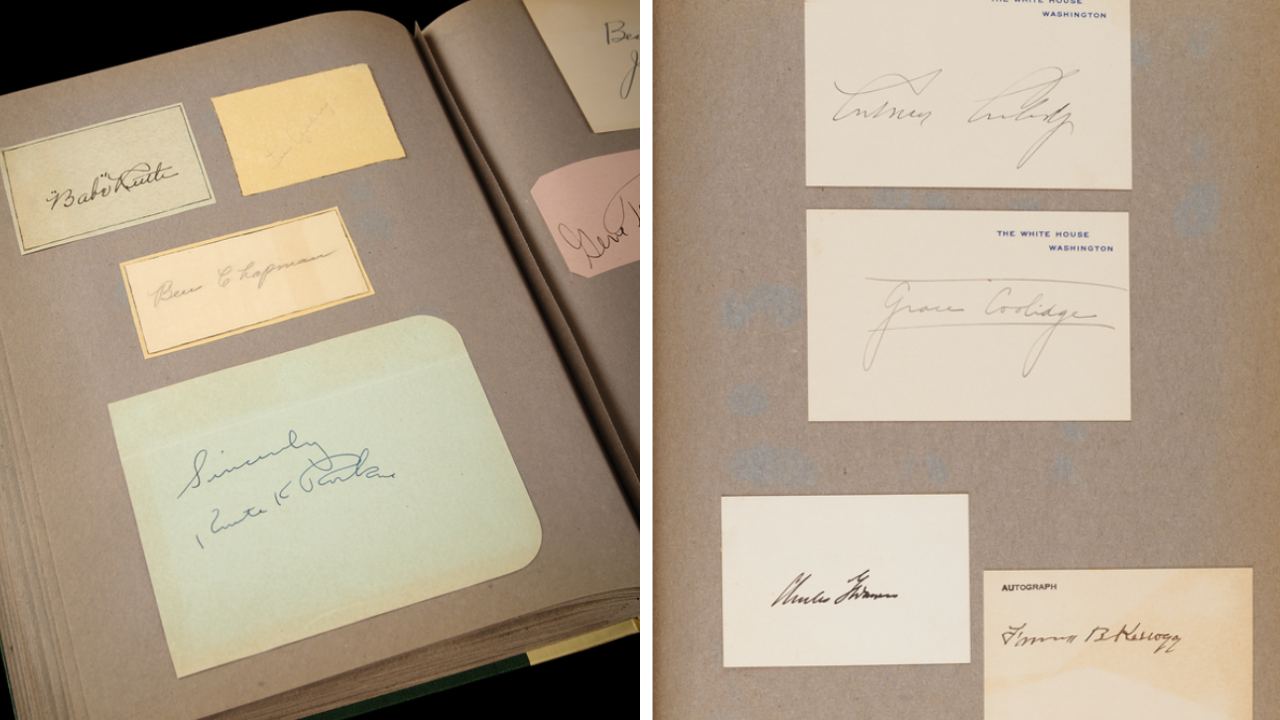
The sale of Hilda Payin’s archive of over 200 autographs for $28,759 illustrates a structural pricing anomaly in the alternative asset market, where a single bulk transaction yields an average unit price of approximately $143.79 despite containing Tier-1 historical signatures from Babe Ruth and Amelia Earhart. When collectors or estate executors liquidate large, uncertified accumulations as single lots or rapid-fire estate bundles rather than disaggregating high-beta assets for third-party authentication, they transfer the arbitrage margin directly to institutional dealers. This valuation gap is governed by three economic mechanisms: the authentication liquidity premium, the bundling discount curve, and provenance decay.
The Architecture of the Hilda Payin Archive
To evaluate the $28,759 hammer price, analysts must first separate the known parameters of the transaction from the structural variables of the memorabilia market. The empirical baseline consists of two data points: a collection volume exceeding 200 distinct signatures and the inclusion of blue-chip historical figures—specifically baseball icon Babe Ruth and aviation pioneer Amelia Earhart—collected by a single individual, Hilda Payin.
In standard collectibles underwriting, a collection of this composition exhibits extreme Pareto distribution characteristics. Roughly 2% to 5% of the line items generate 80% to 90% of the total intrinsic value. Under current market conditions for authenticated historical ephemera, a single verified Babe Ruth signature on a clean medium (such as an index card, album page, or baseball) routinely clears between $3,000 and $15,000 depending on ink contrast, medium condition, and date of execution. Similarly, a verified Amelia Earhart signature on a standard album leaf or correspondence typically commands between $1,500 and $4,500.
If those two primary assets alone account for $4,500 to $19,500 of the theoretical retail value, the remaining 198-plus signatures in the Payin collection absorbed the rest of the $28,759 realization, or were heavily discounted due to auction structure. Understanding why a portfolio containing globally recognized historical figures settles at an aggregate figure under $30,000 requires analyzing the friction points between raw estate discovery and institutional secondary markets.
Mechanism 1: The Bundling Discount Curve
Auction houses and estate liquidators face a fundamental optimization problem when bringing a multi-hundred-item collection to market: maximizing gross merchandise value (GMV) versus minimizing cataloging and fulfillment overhead.
When an auctioneer groups 200+ autographs into a single lot—or a tightly compressed series of ungraded estate lots—they trigger the Bundling Discount Curve. Institutional buyers and professional dealers step in to absorb the inventory, applying a strict underwriting formula to protect their operating margins:
$$\text{Bid}{\max} = \sum{i=1}^{n} (V_i \cdot P_{\text{auth}, i}) - (C_{\text{grading}} + C_{\text{holding}} + M_{\text{target}})$$
Where:
- $V_i$ represents the estimated retail value of item $i$ post-certification.
- $P_{\text{auth}, i}$ represents the probability that item $i$ passes third-party authentication.
- $C_{\text{grading}}$ represents the capital expenditure required to encapsulate and certify the items.
- $C_{\text{holding}}$ represents the cost of capital tied up during the grading turnaround window (often 30 to 90 days) and subsequent resale cycle.
- $M_{\text{target}}$ represents the dealer’s required gross profit margin (typically 40% to 60% on raw estate acquisitions).
Because the buyer assumes 100% of the authenticity risk ($1 - P_{\text{auth}, i}$) and the operational labor of processing 200 individual items, the hammer price compresses sharply. A retail collector looking only for an Amelia Earhart signature will rarely bid on a 200-piece lot because they have no infrastructure to liquidate the remaining 199 items. By bundling the assets, the seller eliminates retail end-user competition, leaving the bidding floor exclusively to wholesale arbitragers who price in maximum downside protection.
Mechanism 2: Authentication Friction and Asymmetric Information
In the secondary collectibles market, unauthenticated autographs suffer from severe information asymmetry, a classic economic failure described by George Akerlof in The Market for Lemons. Without verification from recognized third-party authenticators—such as Professional Sports Authenticator (PSA/DNA), James Spence Authentication (JSA), or Beckett Authentication Services (BAS)—a signature exists in a state of Schrödinger’s value: simultaneously genuine and potentially secretarial, stamped, or forged.
Period autograph albums from the 1920s through the 1940s, the exact era during which Hilda Payin would have assembled signatures from Ruth (died 1948) and Earhart (disappeared 1937), carry specific historical risks that suppress raw hammer prices:
- Secretarial Signatures: Both Babe Ruth and Amelia Earhart employed assistants and club secretaries who routinely signed fan mail and autograph requests on their behalf during peak fame. To an untrained eye, a 1930s secretarial Ruth signature exhibits period-correct fountain pen ink and vintage paper toning, yet holds less than 5% of the value of a genuine exemplar.
- Autopen and Pre-Printed Ephemera: While mechanical autopens were not commercially prevalent until the 1950s, rubber stamps and facsimile signatures were widely distributed by publicity departments during the interwar period.
- Medium Degradation: Autograph books from the early twentieth century frequently utilized acidic wood-pulp paper. Over an 80-to-90-year storage cycle, acid migration causes paper embrittlement and ink fading. If a signature is executed on a fragile album page alongside a lower-tier celebrity on the reverse side (a "back-to-back" conflict), the physical extraction and encapsulation process becomes technically hazardous.
When an estate sells a collection raw, bidders discount the Babe Ruth and Amelia Earhart signatures by 50% to 75% to hedge against the statistical probability of secretarial execution or physical damage during encapsulation. Had the estate submitted the top ten signatures for pre-auction authentication—at a total capital outlay of roughly $1,000 to $1,500—the removal of information asymmetry would have unlocked retail bidding capital, likely driving the aggregate realization significantly higher.
Mechanism 3: Provenance Decay vs. Primary Source Chains
A critical distinction in high-end auction theory separates chain-of-custody provenance from documented interaction provenance. The Hilda Payin collection benefits from single-owner continuity, which signals to experienced dealers that the material has not been "cherry-picked"—meaning the highest-value items have not already been stripped out by prior dealers, leaving only dead inventory.
However, single-owner provenance alone does not substitute for empirical proof of acquisition. In the upper echelons of historical collectibles, provenance adds a 20% to 50% valuation multiplier only when accompanied by corroborating primary artifacts:
- Contemporary photographs showing the collector with the subject.
- Dated ticket stubs, flight manifests, or event programs matching the ink and pen used for the signature.
- Original mailing envelopes bearing period postmarks from the subject's known itinerary.
- Contemporaneous diary entries detailing the exact date and location of the encounter.
Without these physical anchors, "Hilda Payin’s collection" functions merely as a descriptive label rather than a verifiable forensic shield. Auction buyers treat the name as neutral background context, relying entirely on handwriting morphology—stroke velocity, letter slant, pressure shading, and terminal flourishes—to underwrite their bids.
The Long-Tail Asset Drag
Beyond the marquee names of Ruth and Earhart, a 200-piece vintage collection inevitably contains a vast long tail of secondary and tertiary figures: mid-century politicians, stage actors, radio personalities, regional athletes, and forgotten executives. In quantitative portfolio management, these assets represent negative-yield inventory when sold individually, yet they create logistical drag when sold in bulk.
Consider the unit economics of liquidating 180 long-tail autographs:
- Listing and Cataloging Cost: Photographing, researching, writing descriptions, and listing a $25 autograph consumes approximately 20 to 30 minutes of skilled labor. At a modest operational cost of $30 per hour, the labor expense alone consumes 40% to 60% of the gross sale price.
- Platform and Payment Fees: Online marketplaces and auction platforms extract 13% to 20% in final value fees.
- Authenticity Ceiling: A $25 autograph cannot absorb a $25 authentication fee. Consequently, long-tail items must be sold raw, limiting their buyer pool to low-budget niche collectors and extending the inventory turnover timeline from weeks to years.
When the $28,759 final price is analyzed through this operational lens, the math becomes transparent. The winning bidder did not pay $143.79 per autograph. Instead, the buyer allocated roughly $22,000 to $25,000 of their capital toward the top 5 to 10 Tier-1 and Tier-2 signatures (Ruth, Earhart, and any unpublicized Hall of Famers or historical leaders buried in the lot), while valuing the remaining 190 signatures at $15 to $30 per unit—a bulk liquidation basis designed to recoup capital slowly over a multi-year retail cycle.
Structural Limitations of Auction Liquidation Models
Executors and private collectors frequently assume that public auctions automatically discover the true market value of rare assets through competitive bidding. This assumption fails under three specific structural conditions:
- Catalog Visibility Bottlenecks: Regional or general estate auction houses lack the specialized mailing lists of premier sports and historical auctioneers (such as Heritage Auctions, Robert Edward Auctions, or RR Auction). If a Babe Ruth signature is buried in a general estate catalog without targeted digital marketing to dedicated baseball collectors, the auction fails to reach the marginal buyer willing to pay peak retail prices.
- Seller’s Commission and Buyer’s Premium Spread: Standard auction structures impose a buyer’s premium of 20% to 25% on top of the hammer price, alongside a seller’s commission of 10% to 15%. In a $28,759 transaction (assuming that figure includes the buyer's premium, which is standard reporting practice for auction houses), the actual hammer price was approximately $23,000 to $24,000, and the net payout to the consignor after seller fees likely settled between $19,500 and $21,500. Nearly 25% to 30% of the total capital deployed by the buyer was absorbed by the intermediary platform rather than the asset owner.
- Temporal Compression: Live auctions force price discovery within a 60-to-90-second window. If two key retail bidders experience technical latency, fail to notice the lot due to poor indexing, or hit their daily credit limits earlier in the session, the asset clears at the wholesale reserve floor.
Tactical Protocol for Maximizing Estate Ephemera Realizations
To prevent the value leakage observed in bulk estate sales, asset managers and executors handling historical autograph portfolios must execute a four-stage disaggregation and certification protocol prior to consignment:
- Triage and Pareto Isolation: Audit the entire archive to separate the top 5% of signatures by historical significance and market liquidity (e.g., Babe Ruth, Amelia Earhart, U.S. Presidents, Nobel Laureates, Hall of Fame athletes) from the long-tail inventory. Never allow Tier-1 assets to be lotted alongside low-tier ephemera.
- Targeted Third-Party Encapsulation: Submit the isolated Tier-1 items to the dominant authentication authority for each specific vertical—PSA/DNA for sports figures like Ruth, and JSA or Beckett for historical and aviation figures like Earhart. Ensure vintage album pages are kept intact unless professional paper conservationists confirm that extraction will not sever adjacent signatures or tear brittle fibers.
- Channel-Specific Routing: Consign the authenticated Tier-1 items to specialized vertical auction houses with demonstrated liquidity in those exact categories, negotiating a 0% seller’s commission (or a rebate of a portion of the buyer's premium) based on the high-profile nature of the consignments.
- Bulk Wholesale Offloading of the Long Tail: Group the remaining 180+ uncertified, low-value signatures into regional or thematic lots (e.g., "1930s Broadway Performers," "Mid-Century Political Figures") and liquidate them through a general estate auctioneer to eliminate internal labor drag while capturing immediate cash flow.