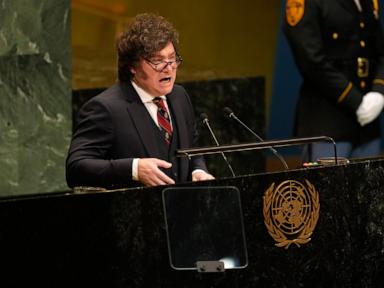
Javier Milei stood before the United Nations General Assembly and breathed new life into Argentina’s historic sovereignty claim over the Falkland Islands, known locally as the Islas Malvinas, while insisting on a peaceful pathway to recovery. The self-described anarcho-capitalist president delivered a speech that startled observers who expected a complete departure from traditional Argentine foreign policy. For months, Milei had signaled a desire to align his administration entirely with Washington and London, treating economic deregulation as his singular gospel. Yet, statecraft rarely permits absolute ideological purity. By invoking the Malvinas at the global podium, Milei executed a textbook maneuver of domestic political self-preservation wrapped in international diplomacy. He wants British investment and Western validation, but he cannot afford to look weak on the most sacred nationalist altar in Argentine politics.
This contradiction defines the current phase of the dispute. The immediate question is not whether London will suddenly hand over sovereignty, because they certainly will not. The question is why a radical free-market reformer who routinely denounces state-driven nationalism chose to lean heavily into a territorial claim that yields zero immediate fiscal dividends. To understand this move, one must examine the intersection of Buenos Aires domestic desperation and the unyielding geopolitical realities of the South Atlantic.
The Ideological Fracture in Buenos Aires
Milei came to power promising a chainsaw revolution. He dismantled ministries, devalued the peso, and promised to sever ties with authoritarian regimes while cozying up to Western democracies. Foreign policy was supposed to be simple. Trade with everyone who pays cash, follow the rules of international capital markets, and abandon the ideological posturing of his Peronist predecessors.
The Malvinas dispute complicates that clean slate. In Argentina, the islands are more than a geographic dispute. They represent a collective historical trauma, an unhealed wound dating back to the military junta’s catastrophic 1982 war. Every politician who attempts to downplay the issue is immediately branded a traitor by a public that remains fiercely protective of the sovereignty narrative. Milei realized early in his term that while he could rewrite tax codes and fire bureaucrats, ignoring the Malvinas would hand his domestic political enemies a lethal weapon.
So, he pivoted. His UN address did not sound like the firebrand who brandished a chainsaw on campaign stages. It sounded measured. It sounded conventional. He spoke of dialogue, international law, and peaceful solutions. This rhetorical shift was designed for two distinct audiences simultaneously. Domestically, it proved he had not surrendered Argentine dignity to foreign powers. Internationally, it signaled that he would not pursue military adventures or aggressive economic blockades like those attempted by past administrations.
Beneath the Waves and Across the Tundra
Beyond the emotional rhetoric of national honor lies a hard economic calculation. The waters surrounding the Falklands are rich. Fisheries generate substantial licensing revenues for the local government, while offshore oil and gas reserves remain a persistent temptation for an Argentine economy chronically starved of hard currency.
For decades, Buenos Aires has watched British-licensed trawlers sweep the South Atlantic while Argentine ports miss out on the economic windfall. The local population on the islands, numbering fewer than four thousand residents, overwhelmingly identifies as British and rejects any association with mainland Argentina. They hold self-determination as an absolute right, backed by successive referendums where over ninety-nine percent of voters chose to remain a British Overseas Territory.
Milei’s administration understands these demographic and legal walls. When British Foreign Secretary David Cameron visited the islands earlier, he made it explicitly clear that the issue of sovereignty was settled permanently. Cameron’s visit provoked predictable outrage in Buenos Aires, yet Milei’s response was notably muted compared to the fierce denunciations of previous governments. This restraint exposed the core tension of his administration. He is willing to endure diplomatic slights if it keeps open the channels of international finance and prevents a total breakdown of relations with the United Kingdom.
Furthermore, successive British governments have tightened the administrative and logistical knots around the territory. The islands operate with a high degree of internal self-governance, relying on the British military umbrella for total security. Any commercial overture from Buenos Aires that bypasses the core question of sovereignty is routinely dismissed in Stanley and London alike.
The Military and Strategic Reality
The military balance in the South Atlantic leaves no room for illusion. Mount Pleasant Complex, the British military base on East Falkland, houses a formidable garrison of Royal Air Force jets, rapid reaction troops, and modern air defense systems. Argentina’s armed forces, starved of modern equipment and crippled by decades of economic crisis, possess no capability to project power across the water, let alone challenge a permanent member of the United Nations Security Council.
Any serious analyst in Buenos Aires knows this. The generals know it. The foreign ministry knows it. Therefore, the dispute exists almost entirely in the sphere of discourse and international theater. When Milei urges a peaceful solution at the UN, he is acknowledging this military asymmetry without explicitly admitting defeat. Diplomacy becomes the only game available, even if the board is heavily tilted against him.
The United Nations Special Committee on Decolonization passes routine resolutions urging both nations to resume negotiations. Great Britain routinely ignores them, citing the principle of self-determination enshrined in the UN Charter. This creates a perpetual diplomatic loop where Argentina registers its protest, Britain reiterates its refusal to negotiate, and nothing fundamentally changes on the ground. Milei has simply plugged himself into this historic routine, recognizing that the ritual itself holds domestic utility.
The Trap of Bipartisan Consensus
In Argentine politics, the Malvinas claim functions as a constitutional article of faith. It is written into the foundational text of the 1994 constitutional reform. No president, regardless of economic philosophy, can legally or politically abandon it.
This creates a trap for reformers. If Milei focuses exclusively on inflation, fiscal deficits, and deregulation, critics accuse him of abandoning national identity. By making this UN speech, he inoculates himself against those charges. He demonstrates that a libertarian can wear the mantle of national sovereignty just as comfortably as a leftist populist.
Yet, this strategy carries hidden costs. By keeping the issue alive on the global stage, Milei validates the very nationalist framework he spends the rest of his time trying to dismantle. If sovereignty and state-led territorial integrity matter so much in the South Atlantic, why should market forces dictate every other aspect of Argentine life? Ideological consistency fractures under the weight of historical grievances.
The Limits of Pragmatic Appeasement
Milei hopes to achieve what previous leaders could not. He wants to engage in commercial cooperation, improve trade ties, and build subtle bridges with London while keeping the sovereignty claim ticking along in the background. He envisions a future where economic integration makes the border question less abrasive, echoing the way European nations managed historic disputes through mutual market dependence.
The flaw in this calculation is the British position. London has consistently refused to separate economic cooperation from the core question of sovereignty. British officials maintain that as long as the islanders wish to remain British, there is nothing to discuss regarding the ownership of the land. They view Milei’s soft-spoken diplomacy as a rhetorical change of tone rather than a substantive shift in intent.
As economic pressure mounts at home and international creditors watch his reform package wind through a hostile legislature, Milei will find less and less room for foreign policy nuance. The Malvinas will remain a convenient distraction when inflation spikes or protests paralyze the streets of Buenos Aires.
The flag will continue to fly over government buildings in the southern hemisphere. Speeches will be delivered in glass chambers in New York. And the freezing waters of the South Atlantic will continue to roll against distant shores, unmoved by the shifting political winds of a restless continent.