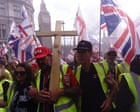
Cultural politics in the United Kingdom are undergoing a structural shift characterized by the decoupling of theological adherence from nationalist posturing. Empirical findings published by research institutes examining public attitudes toward British identity demonstrate that modern iterations of Christian nationalism derive their primary momentum not from active congregants, but from individuals who exhibit minimal engagement with institutional worship. This phenomenon points to an operational conversion of religious symbols from markers of spiritual devotion into proxies for ethnic and cultural boundary-maintenance.
To map this dynamic, analysis must separate theological Christianity from civil religion. Practicing churchgoers—those attending services weekly—typically operate within a framework defined by institutional liturgies, pastoral community structures, and globalized theological doctrines. Conversely, secular or nominal nationalists utilize the signifiers of historic Christianity to construct an exclusionary definition of native identity. The mechanics of this movement rely on three distinct operational drivers.
First, the instrumentalization of heritage functions as a defensive mechanism against perceived demographic and cultural dilution. Nominal identifiers view historical ecclesiastical architecture, calendar markers, and public symbols as finite assets of an indigenous group rather than expressions of universal faith. This logic transforms the church from a house of worship into a tribal clubhouse. Individuals who have not entered a pew in decades readily mobilize around the preservation of Christian aesthetics when those aesthetics can be juxtaposed against external cultural influences, particularly Islam or non-Western immigration patterns.
Second, theological vacancy enables ideological projection. Because nominal adherents lack deep formation in orthodox doctrine, religious terminology is easily emptied of its original ethical constraints—such as mandates regarding hospitality to strangers or universal human dignity—and refilled with grievances concerning systemic disenfranchisement. The resulting hybrid identity requires zero institutional accountability. A person can maintain zero spiritual discipline while claiming ownership of religious heritage to assert social dominance or establish clear political in-groups and out-groups.
Third, political entrepreneurship accelerates this divergence. Far-right factions and populist political entities actively leverage the language of faith to legitimize nationalist grievances under a respectable banner. By framing political polarization as a defense of traditional civilization, these actors provide an intellectual shortcut for frustrated demographics seeking a cohesive narrative. The appeal rests on simplicity: societal friction is attributed to the erosion of traditional identity, and the remedy is sought through the assertion of nominal cultural supremacy.
The systemic consequence of this trend is a profound distortion of civic discourse. Actual religious institutions find their public witness complicated by association with political extremisms they frequently reject. Meanwhile, secular nationalist movements secure a veneer of moral legitimacy without bearing the operational or spiritual costs of religious discipleship.
Future trajectories indicate that as institutional church attendance continues its secular decline, the utilization of cultural Christianity as a political instrument will likely intensify rather than abate. As religious literacy fades entirely from the public square, remaining religious symbols will function with increasing frequency as pure tribal markers, detached entirely from both theology and history.