Switzerland produces zero agricultural yield of Coffea arabica or Coffea canephora. Yet, measured by export value, the landlocked European nation consistently tracks as the world’s second-largest exporter of coffee, occasionally outstripping global giants like Colombia, Vietnam, and Ethiopia, and sitting immediately behind Brazil. The architecture of this economic anomaly relies on an aggressive value-add industrial framework rather than primary resource extraction.
Data from the Swiss Trade Monitor at the University of St. Gallen reveals a massive spread in unit economics: Switzerland imports raw unroasted green coffee at an average cost of $5.00 per kilogram. Following domestic processing, the structural output commands an export value of $26.80 per kilogram. This represents an approximate 436% expansion in product value. Coffee processing has eclipsed traditional sectors, comprising roughly one-third of all Swiss agricultural export value—rendering it structurally more vital to the nation's trade balance than cheese or chocolate. This dominance is sustained by three distinct structural vectors: global commodity trading localization, physical transformation margins via automated portioned systems, and industrial hardware integration.
The Three Vectors of Swiss Coffee Dominance
[Upstream Supply] ---> [60-70% Global Green Trade Managed in CH] ---> [Advanced Processing] ---> [Premium Single-Serve Export]
  (Raw: $5.00/kg)          (Geneva/Zurich Desk Arbitrage)                (Nespresso/Capsules)          (Processed: $26.80/kg)
1. Upstream Commidty Trade Localization
The foundation of Switzerland's dominance does not begin at the roasting oven, but on the trading desks of Geneva and Zurich. Between 60% and 70% of the world's green coffee trade is contractually, financially, and logistically managed by entities operating within Swiss borders. The Swiss Coffee Trade Association (SCTA) maintains a membership that dictates over half of the planet's physical coffee distribution.
This centralization is a function of corporate clustering. Decades of specialized merchant banking, predictable regulatory frameworks, and favorable corporate tax structures established Switzerland as the default destination for maritime and agricultural commodity transit trading. By controlling the financing, hedging, and allocation of raw beans before they are ever shipped from Santos or Ho Chi Minh City, Swiss firms secure structural transparency over the entire global supply chain. This transparency allows domestic roasters to optimize procurement costs and select premium-grade inputs with high efficiency.
2. High-Margin Physical Transformation Models
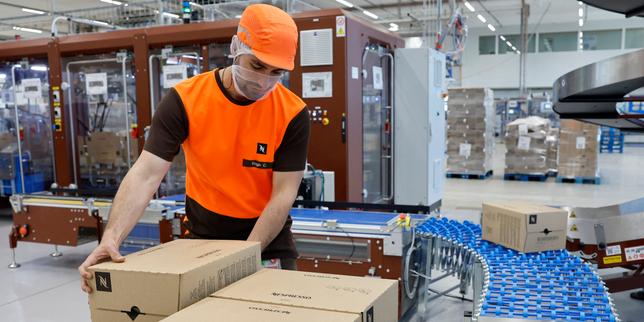
The core driver of the $5.00 to $26.80 price expansion is the domestic industrialization of the roasting and portioning process. The historical growth trajectory shifted radically in the early 2000s, aligning directly with the global consumer migration toward single-serve capsule ecosystems.
Raw Material Input (Green Coffee):     $5.00 / kg
Export Material Output (Processed):    $26.80 / kg
Net Value-Add Margin:                 +$21.80 / kg
Nestlé localized the entirety of its Nespresso capsule production within three specialized production facilities in Switzerland. By transitioning coffee from a bulk agricultural commodity sold by the sack into a high-precision, packaged consumer technology asset sold by the gram, the industrial process alters the underlying economics. The capsule model locks consumers into a proprietary closed-loop system, allowing the exporter to charge a significant premium per unit of weight. This high concentration of processed, high-margin goods explains why Switzerland trails larger European neighbors like Germany and Italy in gross export volume, yet systematically outperforms them in realized fiscal value.
3. Vertical Hardware Monopolization
An analysis of the Swiss ecosystem reveals that value extraction extends beyond the consumable product into the mechanical infrastructure that processes it. Switzerland commands approximately 70% of the global market share for high-end, fully automatic commercial coffee machinery.
Industrial manufacturers such as Thermoplan, Schaerer, and Jura form an infrastructure cluster often referred to as "Coffee Valley," stretching around Lake Geneva and into Eastern Switzerland. Thermoplan, for example, operates as the exclusive global hardware supplier for multinational retail chains like Starbucks. This creates a powerful industrial feedback loop: Swiss engineering dictates the technical standards of extraction—such as bar pressure, thermal stability, and grind consistency—which in turn normalizes the precise grind profiles and packaging formats produced by Swiss roasters.
Supply Chain Realities and Macroeconomic Vulnerabilities
The structural integrity of this economic engine faces critical headwinds. The reliance on a vast pricing spread exposes the Swiss model to distinct external shocks that cannot be mitigated by domestic policy alone.
- Geographical Concentration of Demand: The European Union consumes approximately 44% of Swiss roasted coffee exports. This hyper-concentration leaves the domestic industry highly exposed to regulatory adjustments within the Eurozone, particularly shifting environmental frameworks and cross-border packaging mandates.
- Input Cost Volatility: Because the domestic industry relies entirely on re-exportation, any systemic compression of supply in originating markets directly threatens the processing margin. Climate shifts, extreme weather patterns, and crop diseases in primary growing bands drive raw green coffee costs upward. As input costs rise, maintaining a 436% value-add margin requires escalating consumer prices, testing the upper limits of premium price elasticity.
- The Regulatory Compliance Burden: The implementation of stringent global deforestation-free supply chain mandates demands comprehensive traceability asset tracking from the exact point of harvest to the retail shelf. For a country handling over 60% of global trade via third-party transactions, the administrative and operational costs of ensuring absolute compliance across fragmented smallholder farms in South America and Africa present an immediate operational bottleneck.
To insulate this infrastructure against margin compression, the industry has altered its governance model. The establishment of multi-stakeholder frameworks, such as the Swiss Sustainable Coffee Platform, represents a defensive strategy to standardize compliance across private corporations, non-governmental organizations, and state secretariats. The objective is to construct an verified, lower-risk supply corridor that preserves the premium status of the re-exported product, ensuring that the structural spread between raw imports and technical exports remains economically viable.