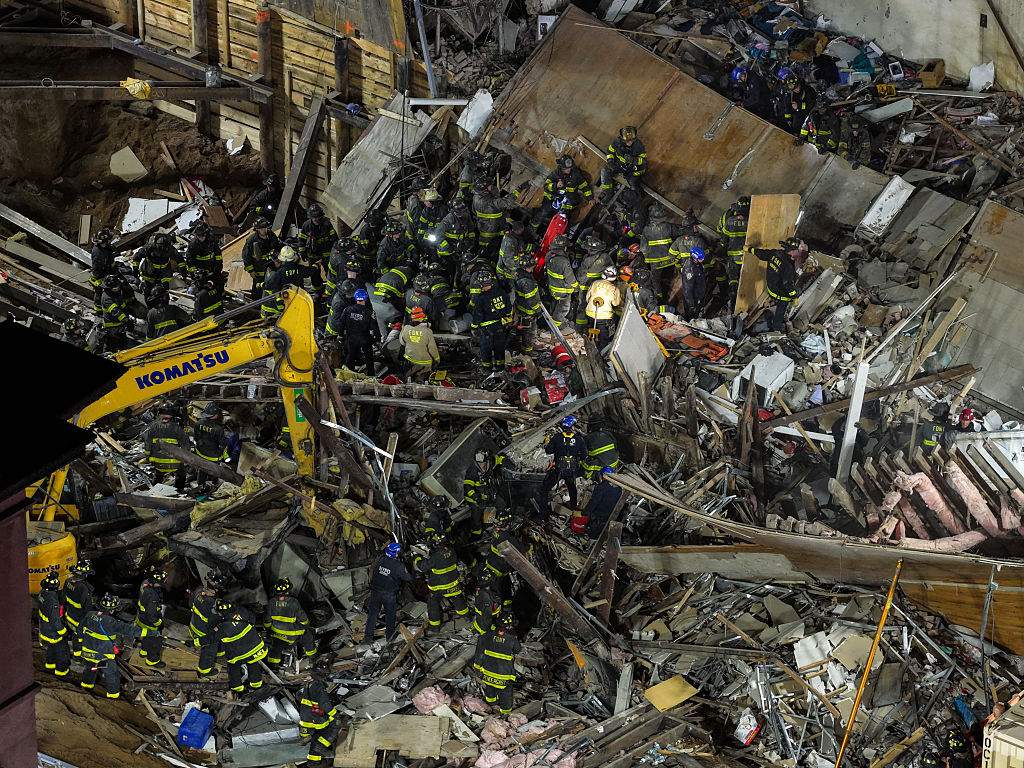
An urban building collapse resulting in eight fatalities and over a dozen severe injuries represents a catastrophic failure of load-bearing equilibrium, regulatory enforcement, and municipal emergency response. Standard reporting treats these incidents as isolated tragedies measured solely by casualty counts. That framing obscures the engineering mechanics, inspection bottlenecks, and systemic risk factors that allow aging masonry and steel structures in dense metropolitan environments to fail without immediate public warning.
Understanding how a multi-story structure transitions from stable occupancy to sudden progressive failure requires analyzing three distinct operational phases: the pre-collapse structural degradation cycle, the kinetic mechanics of the failure event, and the post-collapse urban search and rescue (USAR) triage framework.
The Structural Degradation Cycle and Load-Path Failure
Buildings do not fail instantaneously without preceding mechanical stress; they fail when cumulative degradation exceeds the safety margins engineered into their primary load paths. In high-density jurisdictions like New York City, the building stock spans multiple regulatory eras, creating distinct vulnerability profiles across pre-war unreinforced masonry structures, mid-century steel-frame buildings, and modern reinforced concrete towers.
Every vertical structure relies on a continuous load path to transfer dead loads (the weight of the structure itself) and live loads (occupants, equipment, environmental forces) down to the foundation. Collapse occurs when a critical vertical support—such as a load-bearing masonry wall, a steel column, or a foundation pier—loses compressive or shear capacity.
Three primary mechanisms drive this loss of capacity in dense urban environments:
- Unpermitted Structural Alteration and Load Redistribution
The removal of interior partition walls or the addition of heavy rooftop mechanical equipment alters the distribution of gravity loads. When contractors remove a wall perceived to be non-structural without engineering verification, adjacent columns absorb unintended eccentric loads. Over months or years, this induces localized buckling or shear cracking in masonry joints. - Moisture Intrusion and Material Fatigue
Water infiltration behind facade cladding triggers freeze-thaw cycles in brick and mortar while accelerating corrosion in embedded structural steel. As steel oxidizes, rust expands up to six times the volume of the original metal—a process known as oxide jacking. This internal expansion fractures surrounding concrete and displaces exterior brickwork, severing the connection between the facade and the primary structural frame. - Adjacent Excavation and Subsurface Vibrations
Deep foundation work on neighboring parcels alters soil lateral pressure and water table levels. If underpinning or sheeting fails to stabilize the shared soil mass, differential settlement occurs. Even a fraction of an inch of uneven foundation settlement introduces severe bending moments into rigid masonry walls, which possess high compressive strength but near-zero tensile capacity.
Regulatory frameworks attempt to intercept these failures through periodic facade inspections (such as New York City’s Local Law 11) and complaint-driven Department of Buildings (DOB) audits. A critical bottleneck exists between violation issuance and physical remediation. Property owners frequently absorb administrative fines as an operational expense rather than executing capital-intensive structural repairs, leaving compromised buildings occupied while hazardous conditions compound.
Kinetic Mechanics of Progressive Collapse
When a primary structural element fails, the building undergoes progressive collapse—a chain reaction where the failure of one component triggers the sequential failure of adjacent components. The lethality of an eight-fatality event stems directly from the speed and geometry of this collapse mechanism.
Structural engineers categorize progressive collapse into distinct kinetic patterns, each dictating survival probabilities for occupants inside the footprint:
- Pancake Collapse: Horizontal floor slabs lose vertical support simultaneously or sequentially, stacking directly on top of one another. Because the slabs compress tightly, void spaces capable of sustaining human life are virtually eliminated. This mechanism produces the highest fatality-to-injury ratios.
- V-Shape Collapse: A central support fails while perimeter walls remain temporarily intact. The floor slabs fracture in the middle and fold downward, creating triangular void spaces along the exterior walls where trapped occupants can survive.
- Lean-To Collapse: One exterior load-bearing wall gives way while the opposite wall holds. The floor slabs pivot downward at an angle, resting on the failed debris pile on one side and the intact wall on the other. This forms a single large wedge-shaped void.
In an event yielding eight deaths and more than twelve injuries, the casualty distribution indicates a localized or partial collapse rather than a total pancake failure of a high-rise structure. Survivors extracted with injuries typically occupy perimeter zones, stairwells reinforced with independent shear walls, or structural voids created by heavy furniture and steel beams deflecting falling masonry.
Secondary hazards immediately compound the initial kinetic trauma. Fractured natural gas risers ignite upon contact with electrical arcs, while pulverized concrete, silica, and asbestos create an immediate respiratory hazard that incapacitates trapped individuals before thermal or crushing injuries turn fatal.
The Urban Search and Rescue Triage Equation
Once a collapse occurs, the operational focus shifts from structural engineering to rapid casualty extraction under conditions of extreme instability. Municipal fire departments and specialized USAR task forces operate under a strict inverse relationship between time and survivability: survival rates for trapped victims drop precipitously after the first 24 hours due to crush syndrome, dehydration, and hypoxia.
Emergency commanders execute response operations through a four-stage tactical sequence:
- Perimeter Stabilization and Utility Isolation
First responders establish a collapse zone equal to at least 1.5 times the height of the remaining standing walls to protect personnel from secondary facade failures. Utility crews simultaneously shut off gas mains and electrical feeds at the street level to eliminate explosion risks. - Surface Triage and Rapid Extraction
Rescue teams sweep the debris pile perimeter to extract walking wounded and visible victims trapped near the surface. Removing the dozen-plus injured individuals typically occurs within the first two hours, utilizing hydraulic spreaders and pneumatic chisels before heavy machinery is introduced. - Void Search and Acoustic/Thermal Detection
Because heavy cranes can shift unstable debris and collapse surviving void spaces, teams deploy fiber-optic snake cameras, seismic acoustic sensors, and search canines to locate non-responsive victims deep within the rubble. - Deliberate Shoring and De-layering
Engineers design temporary timber or hydraulic shoring systems to stabilize hanging floor slabs before rescuers tunnel into interior voids. Only after electronic and canine searches confirm no remaining acoustic signatures does the operation transition from rescue to recovery, allowing heavy excavators to clear the remaining debris.
Systemic Limitations in Municipal Risk Mitigation
Preventing multi-fatality collapses in aging cities faces structural and economic friction that cannot be resolved solely by increasing inspection frequency.
First, visual inspections cannot detect concealed internal degradation. Inspectors assessing exterior facades or accessible basements cannot observe corroded steel connections hidden behind drywall or encased in concrete without destructive testing or expensive non-destructive evaluation (NDE) technologies like ground-penetrating radar and ultrasonic testing.
Second, enforcement mechanisms suffer from jurisdictional fragmentation. Building departments track structural permits, fire departments track occupancy and egress hazards, and environmental agencies monitor subsurface work. When data silos prevent cross-referencing—such as flagging an active excavation permit adjacent to a pre-war building with unresolved facade violations—compound risks go unnoticed until mechanical failure occurs.
Third, the economic reality of urban real estate creates perverse incentives. For older, rent-regulated, or under-capitalized commercial properties, the cost of comprehensive structural underpinning or steel remediation can exceed the building's net operating income. Owners delay structural interventions until distress manifests visibly as bowing walls or cracked lintels, at which point the structure is already operating near its ultimate limit state.
Tactical Protocol for High-Density Structural Risk Management
To eliminate preventable fatalities from urban building failures, municipal agencies and commercial asset managers must shift from reactive violation enforcement to predictive structural monitoring:
- Mandate Proximity Risk Scoring: Municipal permitting systems must automatically trigger mandatory third-party structural engineering monitoring whenever deep excavation or demolition permits are issued within 50 feet of any unreinforced masonry structure or building with open Class 1 (immediately hazardous) structural violations.
- Deploy Continuous Tilt and Vibration Telemetry: Require property owners with unresolved structural violations to install wireless MEMS (Micro-Electro-Mechanical Systems) tiltmeters and accelerometers on load-bearing walls. Automated alerts triggered by micro-movements exceeding 0.5 millimeters allow for preemptive evacuation hours or days before catastrophic load-path failure occurs.
- Enforce Escrow-Backed Remediation: Replace repetitive administrative fines with mandatory municipal repair interventions funded via direct tax liens on the property whenever structural violations remain unaddressed beyond 90 days, removing the financial incentive for owners to delay critical stabilization work.