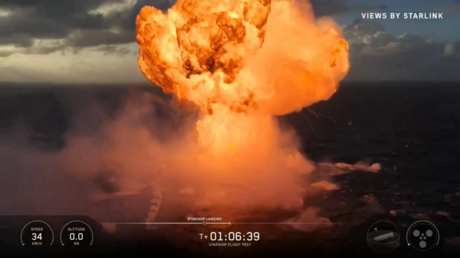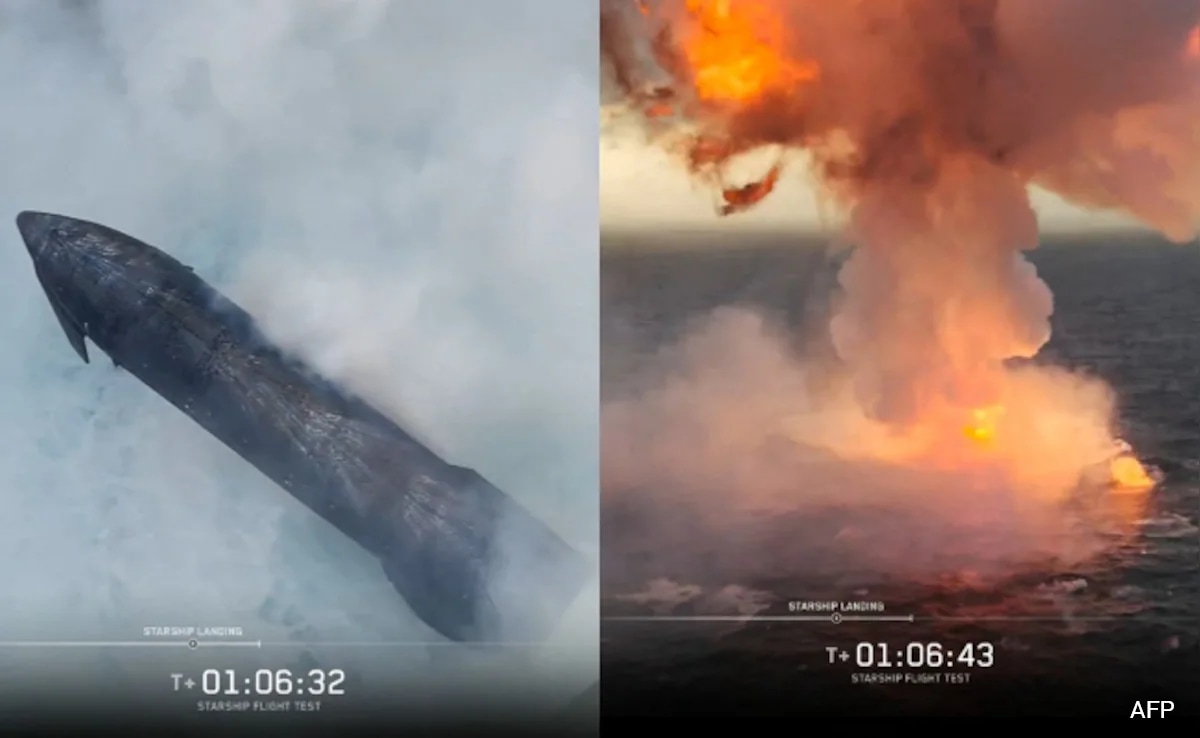
Mass-media coverage of aerospace milestones routinely conflates an expected mechanical structural failure with a systemic operational defeat. When SpaceX’s Starship Version 3 (V3) upper stage completed its terminal descent over the Indian Ocean during Flight 12, tipped over, and erupted into a fireball, non-technical headlines blared that the vehicle had "exploded during splashdown." This framing misses the fundamental mechanical engineering and economic logic of the flight. The destruction of the uncrewed hull upon ocean contact was a predetermined boundary condition of the test, not an unforced error.
To evaluate Flight 12 accurately requires shifting focus away from the superficial spectacle of a post-splashdown explosion and analyzing the structural, propulsive, and strategic data points demonstrated by this inaugural flight of the upgraded V3 platform. The true performance metrics of the mission lie in how the vehicle managed subsystem degradation, executed complex aerodynamic maneuvers, and advanced the economic calculus underpinning SpaceX's impending initial public offering.
The Core Flight Mechanics: Managing Subsystem Degradation
The primary objective of a developmental aerospace test flight is to map the margins of the vehicle’s operating envelope under real-world conditions. Flight 12 subjected the newly designed V3 architecture to severe real-time stressors, validating the vehicle's automated redundancy and fault-tolerance algorithms.
The structural and propulsive behavior of the vehicle during its distinct flight phases reveals a clear hierarchy of cause-and-effect relationships:
1. Ascent Phase and Propulsive Redundancy
The stacked V3 vehicle—standing 407 feet tall—lifted off from a newly commissioned second launch pad at Starbase, Texas, powered by upgraded Raptor 3 engines. Early in the atmospheric ascent, one of the Super Heavy booster's 33 methane-fueled engines suffered an early shutdown. Shortly thereafter, during the upper stage's climb, one of its six Raptor engines failed as well.
In legacy, non-redundant launch vehicle architectures, a primary engine loss frequently results in mission termination. Here, the flight computer adapted by extending the burn duration of the remaining five functional upper-stage engines, successfully driving the ship to its targeted suborbital trajectory. This verified that the V3 platform possess a resilient thrust-to-weight margin capable of absorbing individual engine dropouts without compromising structural insertion limits.
2. Booster Separation and Dynamics
Following hot-staging—where the upper stage ignites its engines while still attached to the booster—the Super Heavy first stage attempted a return-to-launch-site trajectory. The vehicle was scheduled to execute a "boost-back burn" to position itself for a controlled Gulf of Mexico splashdown.
However, multiple Raptor engines failed to relight or sustain pressure during this phase. The loss of propulsive control caused the booster to drop short of its designated recovery zone, plunging into the Gulf of Mexico in an uncontrolled state. While hardware recovery was not a requirement for this specific booster asset, the engine relight failure points to a persistent bottleneck in fluid dynamics or plumbing reliability during rapid pressure transitions.
3. Payload Deployment and In-Space Testing
Once in suborbital space, Starship V3 tested its redesigned internal payload mechanism. Previous test flights suffered from mechanical failures in the narrow, slit-like "Pez dispenser" door designed for satellite deployment.
Flight 12 achieved a clean mechanical victory by successfully dispensing 22 mock Starlink satellites into space at an accelerated rate. This design modification resolves a critical operational bottleneck, proving that the V3 hull can physically support rapid orbital deployment cycles.
Thermal Protection and Aerodynamic Boundary Conditions
The most technically demanding phase of the mission was the hypersonic atmospheric re-entry over the Indian Ocean. Prior Starship iterations suffered from severe plasma burn-through, particularly around the hinges of the steering flaps where thermal protection tile gaps are most vulnerable.
[Hypersonic Entry at Mach 25] ──> [Peak Thermal & Dynamic Pressure] ──> [Mach 7 Flap Load Test] ──> [Two-Engine Landing Burn & Flip] ──> [Planned Structural Failure at Splashdown]
The V3 architecture introduced altered structural geometries and optimized thermal protection tile configurations to mitigate this specific vulnerability.
- Thermal Protection System Resilience: Onboard camera feeds confirmed that the V3 hull transited peak heating with negligible thermal tile shedding. The structural integrity of the aft and forward flaps remained completely intact throughout the peak plasma phase, marking a major iterative improvement over the heavily eroded surfaces seen in Flights 4 and 5.
- Aerodynamic Load Inquiries: At approximately Mach 7, the flight computer executed an intentional load test, aggressively flexing the rear flaps to gauge the structural limits of the hydraulic and mechanical actuation systems under high dynamic pressure. The components sustained the aerodynamic forces without structural tearing or lock-ups.
- The Terminal Guidance Maneuver: Upon entering the lower atmosphere, the vehicle executed a complex banking and pitching maneuver to transition from a horizontal, skydiver-like belly flop to a vertical landing orientation. This flip requires precise center-of-mass calculations and instantaneous thrust vector control.
Despite operating with a degraded propulsive layout due to earlier engine issues, the ship successfully restarted two of its available engines, completed the vertical flip, and slowed itself to a controlled, zero-velocity splashdown directly on target in the Indian Ocean.
The Thermodynamics of the Post-Splashdown Fireball
The post-splashdown explosion that dominated mainstream media reports is easily explained by fundamental thermodynamics and mechanical engineering constraints. Starship is constructed out of AISI 304L stainless steel. It is designed to withstand extreme internal pressures from cryogenic liquid methane and liquid oxygen propellants, as well as external aerodynamic loads. However, it is not an aquatic vessel.
When the 165-foot-tall upper stage hit the surface of the Indian Ocean, it did so vertically under the power of its landing engines. Upon contact with the water, the structural forces immediately shifted from axial compression to asymmetric lateral loads as the vehicle tipped over. This caused the thin-walled stainless steel tanks to breach.
Once the structural integrity of the bulkheads failed, the remaining unspent cryogenic liquid methane and liquid oxygen mixed instantly in the open air. Ignited by the still-hot nozzle surfaces of the recently firing Raptor engines, an immediate, high-energy deflagration occurred.
Because SpaceX had zero intention of recovering this specific developmental hull, no marine recovery assets were deployed to stabilize the tank pressures post-impact. The explosion was the mathematical certainty of introducing a hot, pressurized, fuel-laden steel structure to an unyielding body of water.
Strategic Microeconomics: The V3 Unit Cost Function
To look at Flight 12 purely as an engineering exercise ignores the intense financial forcing functions driving the Starship program. SpaceX is currently operating under a dual-track strategic mandate: satisfying its multi-billion-dollar NASA Artemis lunar lander contract commitments and preparing for a highly anticipated initial public offering (IPO).
The transition from the V2 architecture to the V3 architecture directly alters SpaceX's long-term cost function. The V3 design optimizes the path to structural profitability via distinct operational levers:
| Variable / Lifecycle Phase | V1/V2 Legacy Performance | V3 Architecture Performance |
|---|---|---|
| Payload Delivery Capacity | Low-volume, unverified mechanism | Verified 22-satellite rapid deployment |
| Engine Configuration | Variable reliability, legacy Raptor plumbing | Raptor 3 integration, improved internal fuel transfer tubes |
| Thermal Protection Wear | High tile loss, flap erosion | Negligible tile shedding, survived Mach 7 load test |
| Structural Reusability | Total vehicle loss during descent | Successful controlled splashdown, verified flip maneuver |
By demonstrating that the V3 platform can successfully deploy payloads even while absorbing an in-flight engine failure, SpaceX has substantially de-risked its core operational thesis: achieving high-frequency, low-cost access to low Earth orbit. The company’s stated objective to commence active orbital payload delivery using Starship in the second half of this year depends entirely on these V3 modifications working under real-world stress.
The Strategic Play
The data yielded by Flight 12 establishes a definitive development path for the next phase of the Starship program. Engineers must prioritize fixing the booster's Raptor relight vulnerabilities during high-velocity return maneuvers, as perfecting the "Mechazilla" catch mechanism is essential for true vehicle reusability.
However, the upper stage has cleared its most critical technical hurdles. The V3 hull has proven it can survive hypersonic re-entry, execute complex terminal aerodynamic maneuvers with a degraded propulsion system, and operate its payload delivery doors smoothly.
SpaceX should immediately phase out any remaining V2 components and shift all manufacturing capital exclusively to the V3 asset line. With the basic aerodynamic and thermal protection challenges resolved, the strategic focus must now pivot from basic survival to manufacturing scaling and launch-cadence acceleration to solidify market dominance ahead of its public market debut.