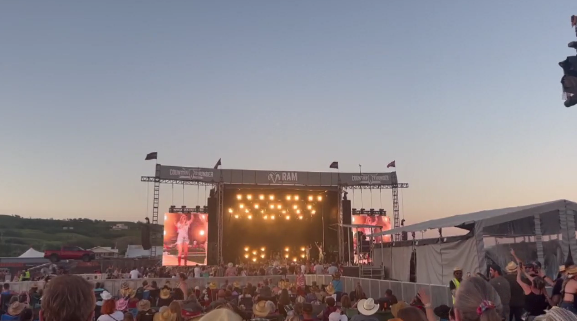
When a rural municipality with a permanent population of fewer than a thousand people suddenly swells to accommodate tens of thousands of temporary residents for a four-day weekend, it ceases to function as a rural district. It becomes a dense, high-risk municipal center. The Craven Country Thunder music festival in Saskatchewan represents a recurring logistical challenge: the rapid deployment of an ephemeral public safety infrastructure capable of managing intense crowds, high-volume substance consumption, and massive traffic flows.
Analyzing the Saskatchewan RCMP's operational data from the July 9 to July 13, 2026 festival weekend reveals the structural mechanics of pop-up city policing. Rather than viewing the 177 recorded calls for service as a random collection of misbehavior, emergency planners must analyze these figures through a structured operational lens. Public safety at scale is determined by a clear cost function, where resource allocation must balance proactive deterrence against reactive containment.
The Operational Division of Service Calls
The 177 calls for service handled by the RCMP during the event are best understood when categorized by operational domains. Labeling every incident under a single umbrella of "festival crime" obscures the specific environmental factors that drive these occurrences.
The data maps directly into three distinct risk categories:
1. On-Site Behavioral and Property Management
On-site offenses are driven by high-density camping and prolonged alcohol intake. The primary friction points identified during the 2026 event include:
- Regulatory Violations (28 cases): Offenses prosecuted under the Alcohol and Gaming Regulation Act. These represent open consumption violations, underage drinking, and unauthorized alcohol distribution within the campground and venue limits.
- Peace Disruptions (23 cases): Incidents of disturbing the peace or causing a disturbance. These represent verbal altercations and escalating camp-site disputes before physical violence occurs.
- Mischief and Property Interference (11 cases): Acts involving property damage or obstructing the enjoyment of the venue. High-density camping environments inherently escalate minor spatial disputes into property-related complaints.
- Low-Velocity Property Crimes (5 cases): Thefts under $5,000, specifically targeting highly transportable, unsecured outdoor goods such as coolers, lawn chairs, and retail vendor merchandise.
- Interpersonal Violence (2 cases): Reports of assault, one of which escalated to a formal criminal charge. The low ratio of physical assaults relative to the size of the crowd points to an effective early-intervention threshold by on-site security and police.
2. Proactive Perimeter Interdiction
The largest single block of service calls did not occur inside the concert gates, but at the physical transition points where the temporary city meets the provincial highway network. The RCMP, in partnership with Saskatchewan Government Insurance (SGI), executed a targeted traffic safety initiative on Friday, Saturday, and Sunday mornings.
- Roadside Suspensions (54 cases): Administrative suspensions issued immediately at the roadside. 42 of these suspensions were issued for alcohol impairment, while 12 were issued for drug impairment.
- Criminal Impaired Driving (2 cases): Situations where the level of impairment or driver behavior crossed the threshold from administrative suspension to formal Criminal Code prosecution.
- Volume Screening Operations: Officers conducted two dedicated check-stops at primary event entrances, screening over 1,000 vehicles. This high-visibility presence yielded 460 Traffic Safety Act tickets and written warnings for non-impairment violations (such as speeding, vehicle defects, and licensing issues).
The Coordinated Security Cost Function
The operational success of large-scale event policing depends on a clear division of labor between public police forces and private event security. Misallocating these resources leads to critical bottlenecks.
[Public Safety Output] = f(Private Security Filtering + Proactive Police Deterrence + Rapid Response Capability)
In this system, private security acts as the primary filter. Contracted personnel manage low-risk access control, bag checks, metal detection, and localized crowd monitoring within licensed areas. This allows public law enforcement officers to remain highly mobile, focusing their efforts on high-risk criminal behavior and regional traffic safety.
When private security fails to act as an effective filter, police forces are forced to absorb low-level regulatory calls. This shifts their operational posture from proactive deterrence to reactive containment. The 2026 data indicates a balanced equilibrium: the RCMP responded to only two assaults and five minor thefts over four days, suggesting that private security successfully managed the vast majority of low-intensity camp-site friction.
Infrastructure Bottlenecks and Traffic Interdiction
The concentration of 54 roadside suspensions highlights a critical point in event management: the transition phase. The highest risk of impaired driving does not occur during the headlining performances, but during the morning migration windows when campers leave the grounds to seek supplies, or when day-pass holders depart.
The choice of morning enforcement times (Friday, Saturday, and Sunday mornings) targets the phenomenon of residual next-day impairment. Many drivers assume they are fit to drive after sleeping, unaware that their blood alcohol concentration or drug metabolization rates remain above legal limits.
[Residual Impairment Risk] = (Volume of Alcohol Consumed) / (Metabolic Time Window + Hydration Deficit)
By positioning check-stops directly at the gates during these exit windows, law enforcement creates a physical barrier that prevents impaired drivers from entering the public highway system. This strategic placement protects the broader public while containing the legal and physical liability strictly within the perimeter of the event.
Strategic Recommendations for Large-Scale Event Organizers
Organizers of high-density, multi-day outdoor events cannot rely solely on law enforcement to manage safety risks. They must actively design their environments to minimize friction points.
Optimize Site Design to Reduce Low-Velocity Theft
Because coolers, lawn chairs, and camping gear represent highly transportable targets, campsites should be organized into clearly defined, well-lit zones with designated pathways. Creating physical boundaries and encouraging peer-to-peer neighborhood watches within camping sectors reduces opportunistic theft.
Expand On-Site Transit Alternatives
The high volume of next-day roadside suspensions demonstrates a persistent demand for mobility during the event. Organizers can reduce the temptation of impaired driving by offering continuous, low-cost shuttle services between the festival grounds and nearby urban hubs. Removing the practical need to drive for basic supplies directly lowers the volume of morning traffic infractions.
Synchronize Communication Protocols
A formal, real-time communication loop between private security coordinators and the RCMP command post is necessary. This integration ensures that when camp-site arguments or regulatory infractions begin to escalate, private security can request a targeted police presence before the situation deteriorates into physical violence or mischief.