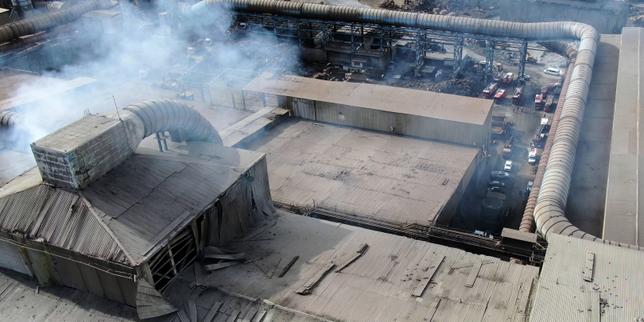
An explosion at a Turkish steel facility killed 16 workers and injured several others, exposing the lethal physics of high-temperature metallurgy when containment protocols fail. Standard news reporting treats industrial disasters as isolated, unpredictable tragedies, cataloging casualties without interrogating the thermodynamic and operational mechanisms that turn a routine smelting shift into a mass-casualty event. Understanding this failure requires separating verified operational realities from the systemic vulnerabilities inherent to electric arc furnace and blast furnace steel production.
The core physical reality of steelmaking rests on extreme thermal energy concentrated within finite containment vessels. When molten metal—typically maintained between 1,500°C and 1,650°C—makes unintended contact with water or trapped moisture, the resulting phase change is instantaneous. Water expands in volume by a factor of roughly 1,600 to 1,700 when flash-vaporized into steam. Inside the confined geometry of a furnace, ladle, or casting pit, this rapid volumetric expansion generates a shockwave indistinguishable from a high-explosive detonation.
The Physics of Metallurgical Containment Failure
To evaluate how a facility suffers 16 simultaneous fatalities, one must map the three primary failure vectors common to heavy steelworks. While investigators establish the exact ignition or rupture sequence at the Turkish site, metallurgical engineering narrows the mechanical causes to specific thermodynamic breakdowns.
- Molten Metal-Water Interactions (FCI): Fuel-coolant interactions represent the single most destructive mechanism in foundry and steel plant operations. A leaking water-cooled panel inside an electric arc furnace, wet scrap metal charged into a molten bath, or moisture pooled in a slag pot introduces liquid water beneath or within liquid steel. The superheated water vaporizes explosively, ejecting tons of molten slag and steel across the melt shop floor.
- Pressurized Gas Accumulation and Ignition: Steelmaking relies on volatile gas streams, including carbon monoxide, hydrogen, and natural gas used for auxiliary heating and reduction processes. If ventilation scrubbers stall or furnace seals degrade, carbon monoxide—an odorless, flammable byproduct of decarburization—accumulates in enclosed overhead bays. A single electrical arc or hot surface triggers a deflagration that collapses structural steelwork.
- Oxygen Lance and Valve Ruptures: High-purity oxygen is injected at supersonic speeds to oxidize impurities in the molten bath. At elevated pressures, pure oxygen reacts violently with hydrocarbons, grease, or even the carbon steel piping carrying it. A mechanical failure in a regulating valve creates an intense, self-sustaining metal fire that breaches adjacent containment lines within seconds.
The casualty count of 16 dead indicates that the event occurred during an active shift transition, a maintenance intervention near an active vessel, or a structural collapse of an occupied control pulpit. Modern melt shops isolate operators inside reinforced, blast-resistant control rooms precisely because primary containment vessels carry non-zero failure probabilities. High fatality clusters point directly to a breakdown in exclusion-zone enforcement, placing personnel within the blast radius during high-risk thermal operations.
The Economic Architecture of Turkish Steel Production
Turkey operates as one of the world's top ten steel producers and the largest steelmaker in Europe, occupying a critical node in global construction and manufacturing supply chains. Unlike traditional integrated producers that rely heavily on iron ore and coking coal in blast furnaces, roughly 70% to 75% of Turkish steel output relies on Electric Arc Furnaces (EAF) fed by imported ferrous scrap.
This structural reliance on EAF technology dictates the specific risk profile of the domestic sector. Scrap-based steelmaking offers high operational flexibility, allowing mills to ramp production up or down in response to volatile global rebar and billet prices. However, scrap inputs introduce severe feedstock variability. Sealed cylinders, unexploded ordnance from conflict zones, trapped moisture in dense scrap bundles, and volatile coatings routinely enter the scrap stream. Without rigorous multi-stage sorting, radiation detection, and pre-heating protocols, hazardous contaminants go straight into the furnace bath.
Macroeconomic pressures compound these operational risks. Turkish steelmakers operate within a tight margin squeeze defined by three external variables:
- Energy Cost Volatility: EAF steelmaking is intensely electricity-dependent. Fluctuations in domestic industrial power tariffs force operators to maximize furnace throughput during off-peak hours, compressing maintenance windows.
- Currency Depreciation: Imported scrap is priced in US dollars, while domestic construction sales occur in Turkish lira. Mills face relentless pressure to cut fixed overhead and stretch refractory lining lifespans to preserve working capital.
- Export Market Compression: Trade barriers, including European Union safeguard quotas and fluctuating demand in Middle Eastern construction markets, force producers to compete aggressively on unit cost.
When capital preservation supersedes preventative maintenance, the degradation of safety-critical infrastructure follows a predictable trajectory. Refractory bricks lining the furnace degrade thinner than specification, water-cooled roof panels operate past their fatigue limits, and acoustic or thermal leak-detection sensors remain uncalibrated.
Distinguishing Verified Facts from Analytical Hypotheses
Rigorous incident analysis requires strict boundaries between established evidence and structural inference. As of the initial emergency response, the verified facts remain narrow: an explosion occurred within an active Turkish steelmaking facility, resulting in 16 confirmed deaths and multiple severe injuries requiring trauma care. Emergency services secured the perimeter, and judicial authorities initiated standard criminal negligence inquiries alongside labor ministry inspections.
Everything beyond the casualty figures and facility classification remains a structured hypothesis awaiting metallurgical forensics:
- Hypothesis A (Feedstock Contamination): Wet or sealed hollow scrap introduced into a molten heel triggered a steam explosion, blowing off the furnace roof and showering the melt shop floor.
- Hypothesis B (Cooling System Breach): A compromised water-cooling circuit on the furnace sidewall or off-gas duct leaked into the molten bath, causing a delayed fuel-coolant detonation.
- Hypothesis C (Auxiliary Fuel/Gas Failure): A breach in the natural gas or oxygen supply manifold caused a primary blast, which subsequently ruptured adjacent molten metal vessels.
Determining which hypothesis holds true dictates where liability lands. Feedstock contamination points to failures in procurement quality control and scrap yard inspection. A cooling system breach indicts maintenance scheduling and sensor monitoring. A gas manifold failure highlights lapses in mechanical integrity testing and hazardous-area electrical compliance.
Operational Control Frameworks and Their Limitations
In high-hazard heavy industry, safety performance is governed by the Hierarchy of Controls, a framework that ranks risk mitigation from most effective to least effective: elimination, substitution, engineering controls, administrative controls, and personal protective equipment (PPE).
In a steel mill, elimination and substitution are physically impossible; you cannot make steel without extreme heat and reactive chemistry. Consequently, operational survival depends entirely on engineering controls. These include automated scrap-drying tunnels, infrared moisture scanners, automated slag-skimming robotics that remove humans from the furnace floor, and blast-proof control pulpits with independent air supplies.
When facilities lack the capital to deploy automated engineering controls, management invariably falls back on administrative controls—written procedures, safety checklists, verbal warnings, and shift briefings. This substitution is structurally flawed. Administrative controls rely on continuous human vigilance inside an environment characterized by deafening noise, radiant heat stress, and complex multi-team coordination. Under production pressure, workers routinely bypass administrative rules to clear jams or expedite tapping cycles.
Even advanced engineering controls carry hard operational limits:
- Sensor Blind Spots: Automated moisture detectors scan the surface of scrap buckets but cannot detect water trapped inside sealed pipes or dense crushed engine blocks.
- Maintenance Paradoxes: Installing complex automated leak-detection systems requires skilled instrumentation technicians. In facilities suffering high turnover or wage compression, unmaintained sensors generate false alarms, conditioning operators to mute or ignore critical warnings.
- PPE Irrelevance: Aluminized proximity suits protect workers against radiant heat and minor slag splashes, but they offer zero survivability against a supersonic steam pressure wave or structural collapse.
Supply Chain Ripples and Regulatory Enforcement Dynamics
An incident of this magnitude generates immediate operational friction across regional industrial supply chains. The affected plant faces an immediate judicial halt to operations, freezing tens of thousands of tons of monthly billet or rebar capacity. Downstream construction contractors and rolling mills reliant on just-in-time deliveries must scramble to secure alternative allocations, tightening regional spot availability.
Simultaneously, the Turkish Ministry of Labor and Social Security initiates sweeping compliance audits across competing mills within the same industrial zone. Historically, post-disaster regulatory crackdowns focus heavily on documentation compliance, subcontractor licensing, and fire-suppression certification. While these audits temporarily slow production rates across the sector as mills halt lines to remediate obvious infractions, they rarely alter the underlying economic incentives driving risk.
Criminal prosecutions in Turkish industrial disasters typically target site-level shift supervisors, occupational safety specialists, and mid-level plant managers rather than executive board members who control capital expenditure budgets. This legal asymmetry creates a persistent governance failure: the individuals held criminally liable for safety failures lack the financial authority to authorize furnace shutdowns for deep structural rebuilds, while the executives controlling capital allocation remain insulated from direct legal consequence.
Strategic Imperatives for Industrial Operators and Buyers
For heavy industrial operators, institutional investors, and global steel buyers sourcing from high-risk manufacturing jurisdictions, reactive compliance is an inadequate risk-management strategy. Mitigating catastrophic tail risk requires restructuring operational governance around physical engineering thresholds rather than administrative paperwork.
Industrial operators must enforce strict physical exclusion zones during scrap charging and furnace tapping, utilizing interlocked physical barriers that prevent crane movement or furnace tilting if personnel transponders register inside the red zone. Capital allocation models must treat refractory relining and cooling-panel replacement as non-negotiable fixed costs tied directly to heat-cycle counts, stripping plant managers of the discretion to extend campaign runs during margin squeezes.
Global procurement teams sourcing steel from volatile emerging markets must integrate forensic operational audits into their vendor qualification criteria. Standard ISO 45001 certificates verify the existence of safety paperwork, not physical containment integrity. Buyers should mandate third-party engineering inspections focused specifically on scrap-yard pre-heating infrastructure, automated furnace control isolation, and preventative maintenance backlogs—redirecting volume toward mills that invest in physical automation before a containment failure destroys both human life and supply continuity.