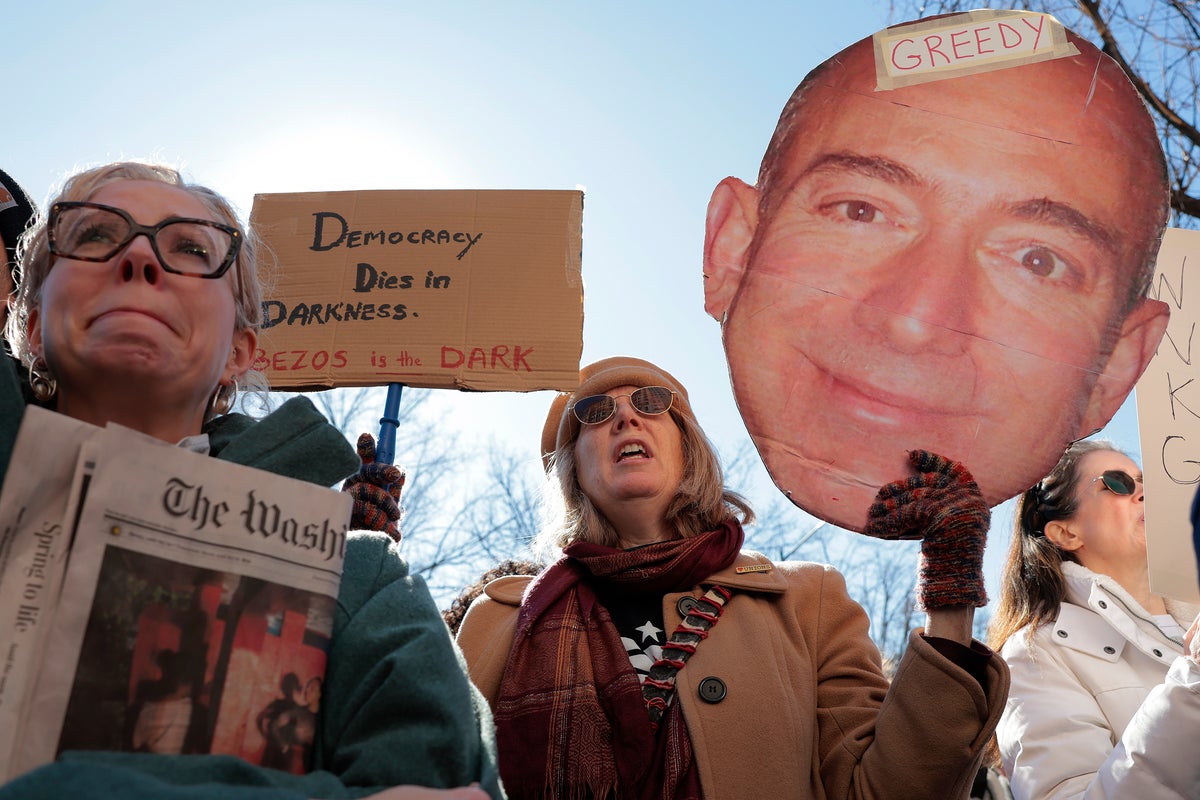
Corporate appeasement of political power is not an emotional surrender; it is a calculated capital allocation strategy. When Jeff Bezos publicly characterized Donald Trump as a "more mature, more disciplined version of himself" during a CNBC interview, the commentary was widely analyzed through a purely political lens. This analysis misses the underlying corporate mechanics. For a multi-billion-dollar enterprise operating at the intersection of logistics, cloud computing, aerospace, and national defense, public rhetoric is an inexpensive hedge against catastrophic regulatory intervention.
The strategy deployed by ultra-high-net-worth founders under populist administrations follows a precise matrix of risk mitigation. By deconstructing the operational moves of Amazon, Blue Origin, and The Washington Post, we can map the exact cost function of political exposure and identify the systematic framework used by corporate titans to protect enterprise value while quietly positioning their assets for a post-populist macroeconomic environment.
The Tri-Sector Exposure Matrix
To understand why a technology founder would reverse years of adversarial positioning to praise a sitting president, one must evaluate the enterprise's exposure across three distinct vectors. Each vector represents a highly vulnerable revenue stream dependent on executive branch discretion.
       [Federal Contract Vulnerability] ---> DoD / Intelligence Cloud Revenue
                      |
                      v
[Regulatory Arbitrage Optimization] ---> Antitrust, FTC, and Labor Oversight
                      |
                      v
   [Capital-Intensive Infrastructure] ---> Aerospace Licensing and Launch Approvals
1. Federal Contract Vulnerability
During Trump’s first term, Amazon Web Services (AWS) lost the $10 billion Joint Enterprise Defense Infrastructure (JEDI) cloud contract to Microsoft, an outcome Amazon formally challenged by alleging direct presidential interference. In the current administration, federal cloud infrastructure spend across the Department of Defense and intelligence agencies has scaled significantly.
The financial cost of public dissent is no longer a abstract reputational risk; it is a direct top-line penalty. Maintaining a non-adversarial posture ensures that AWS remains a friction-free contender for high-margin government cloud expenditures.
2. Regulatory Arbitrage Optimization
Large-scale commerce platforms operate under permanent antitrust scrutiny. The Federal Trade Commission (FTC) and the Department of Justice hold immense structural leverage over corporate mergers, labor policies, and marketplace structures.
Praising executive leadership serves as an operational lubricant. It signals a willingness to align with national economic goals, such as domestic manufacturing or supply-chain reshoring, in exchange for non-predatory regulatory oversight.
3. Capital-Intensive Infrastructure Licensing
Blue Origin’s business model depends on capital-intensive, long-horizon projects that require multi-agency federal approvals. The company’s New Glenn rocket systems, lunar lander contracts, and satellite megaconstellations require strict licensing from the Federal Communications Commission (FCC) and the Federal Aviation Administration (FAA).
A single delayed launch approval or a bureaucratic audit can burn hundreds of millions of dollars in capital. Welcoming defense officials to aerospace facilities and maintaining a public narrative of alignment protects the regulatory pipeline from politicized bottlenecks.
The Cost Function of Media Assets
The structural transformation of The Washington Post over the past two years provides a clear example of tactical de-risking. In October 2024, the publication unilaterally halted its tradition of presidential endorsements, a decision that triggered the immediate cancellation of over 250,000 subscriptions and deep internal friction. This was followed by the elimination of more than 300 newsroom positions.
From a pure portfolio perspective, a media property owned by a multi-sector billionaire operates under a severe structural mismatch:
$$\text{Systemic Risk Ratio} = \frac{\text{Media Revenue Realized}}{\text{Core Enterprise Value Exposed}}$$
For Bezos, The Washington Post represents a fraction of a percent of his total net worth, yet its editorial output exposes 100% of his primary capital vehicles—Amazon and Blue Origin—to retaliatory political actions. The decision to enforce a corporate mandate centered on "free markets and personal liberties" while downsizing the newsroom is a systematic reduction of structural liability.
The asset's core function was recalibrated from an aggressive, adversarial watchdog to a neutral, insulated entity, lowering the owner's total political surface area.
Hedging the Tariff Bottleneck
The operational reality of managing global supply chains requires rapid adaptation to executive trade policy. When rumors emerged that Amazon was considering a feature to explicitly display the localized cost of trade tariffs to consumers at checkout, the White House labeled the move a "hostile and political act." The friction was resolved through an immediate, direct conversation between the executive branch and corporate leadership.
This incident demonstrates the fragility of a purely compliant strategy. While public praise manages macro-level sentiment, micro-level operational decisions can still trigger executive frustration.
The corporate response to this volatility is binary:
- Public De-escalation: Immediate rhetorical alignment and operational concessions to preserve short-term stability.
- Private Diversification: The quiet restructuring of supply networks to bypass geopolitical flashpoints, preparing operations for a post-tariff trade environment.
The Parallel Playbook: Amazon MGM and Cultural Capital
Corporate hedging is not limited to newsrooms and logistical frameworks; it extends directly into cultural production. The decision by Amazon MGM Studios to finance and stream the documentary Melania for $75 million represents a sophisticated deployment of asymmetric cultural capital.
While media critics viewed the project as an unprofitable venture that yielded minimal theatrical returns, its true value must be measured as a strategic capital expenditure. The production serves two distinct purposes:
- Direct Relationship Insurance: It establishes a commercial relationship with the executive family, creating an internal buffer against abrupt policy shifts.
- Public Neutrality Signaling: It demonstrates to populist consumers and regulators that the platform is not structurally aligned against the administration.
Even if the direct return on investment is negative, the project functions as a highly effective risk-transfer mechanism, insulating broader commercial operations from ideological boycotts.
The Post-Volatility Blueprint
The ultimate limitation of corporate appeasement is its shelf life. Populist administrations are inherently volatile, driven by unpredictable shifts in executive sentiment rather than predictable institutional frameworks. Relying solely on rhetorical compliance creates a brittle foundation for long-term corporate strategy.
Sophisticated capital preservation requires a dual-track operational model. While the public-facing machinery maintains an attitude of compliance, the internal corporate apparatus must execute a systematic diversification strategy designed to outlast the current political cycle.
+-----------------------------------------------------------------+
|                    DUAL-TRACK REVENUE SHIELD                    |
+-----------------------------------------------------------------+
|  SHORT-TERM TRACK: RHETORICAL COMPLIANCE                        |
|  - High-profile public praise of administration discipline      |
|  - Strategic investments in politically favorable media         |
|  - Direct executive communication channels                      |
+-----------------------------------------------------------------+
|  LONG-TERM TRACK: STRUCTURAL INSULATION                         |
|  - Automate compliance protocols to remove human bias           |
|  - Diversify supply chains away from tariff-sensitive zones     |
|  - Scale non-governmental commercial revenue segments          |
+-----------------------------------------------------------------+
The primary operational priority for multi-sector enterprises is the automation of compliance and the aggressive expansion of non-governmental commercial revenue streams. By building decentralized supply networks and scaling international cloud infrastructure projects outside domestic jurisdiction, the enterprise reduces its vulnerability to any single sovereign authority.
The strategic play is unambiguous: treat political praise as an operational expense to secure short-term stability, while systematically building an unassailable commercial infrastructure that remains insulated from the eventual breakdown of the current political consensus.