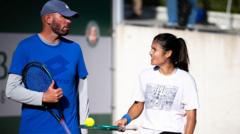
The efficiency of an elite athlete's support ecosystem is directly proportional to the alignment of two opposing vectors: technical optimization and psychological stability. When Emma Raducanu rehired Andrew Richardson—nearly five years after their historic 2021 US Open campaign—the tennis industry framed the reunion through the lens of sentimentality, translating the move as a simple quest for "trust and connection." This narrative oversimplifies the mechanics of elite athletic performance. The rehire is not an emotional retreat; it is a structural course correction responding to the quantifiable failure of a high-churn optimization strategy.
To analyze why a world-class athlete cycles through eight coaches in five years before returning to the architectural foundation of her initial success, one must discard abstract sportswriting tropes. Instead, the partnership must be deconstructed using operational frameworks: the optimization-stability trade-off, the cost function of technical friction, and the mitigation of external variances.
The Optimization-Stability Trade-Off
Every elite athlete operates under a resource allocation framework where coaching inputs are divided between tactical optimization (maximizing ceiling) and psychological stability (raising the floor).
   High |---------------------------------------------------
        |
        |   [Phase 2: Tactical Optimization]
        |   - High-churn specialist coaching
        |   - Increased technical friction
        |   - Volatile performance floors
C       |
E       |
I       |---------------------------------------------------
L   Low | [Phase 1: Foundation]    | [Phase 3: Stabilization]
I       | - High relational trust  | - Rehire of Richardson
N       | - Low friction base      | - Minimizing variance
G       | - Baseline stability     | - Structural equilibrium
        |---------------------------------------------------
          Low                       STABILITY           High
In the immediate aftermath of her 2021 US Open victory, Raducanu's strategic decision-making shifted entirely toward tactical optimization. The logic dictated that an unseeded qualifier who won a Grand Slam required specialized WTA-tour-level expertise to survive the rigorous, week-in, week-out demands of the main tour. This led to the sequential hiring of various specialists, including Torben Beltz, Dmitry Tursunov, and Francisco Roig.
Each iteration was designed to inject specific technical adjustments into Raducanu's game. However, this strategy ignored the compounding cost of relationship friction. The optimization-stability trade-off can be expressed through a fundamental performance equation:
$$P = f(T) - \phi(F)$$
Where:
- $P$ represents actual on-court performance.
- $T$ represents the athlete's raw technical and physical capacity.
- $\phi(F)$ is a non-linear cost function dictated by relational and communication friction.
When the coaching carousel accelerates, $\phi(F)$ escalates exponentially. New technical philosophies require conscious behavioral adaptation, which inherently delays reaction times and disrupts the fluid, sub-conscious execution required at the professional level. By shifting from coach to coach, the marginal gains sought in $T$ were consistently cannibalized by the soaring costs of $\phi(F)$. The return to Richardson represents a strategic pivot to drive $\phi(F)$ to zero, prioritizing baseline stability over marginal tactical gains.
The Cost Function of Technical Friction
The hypothesis that elite players simply require "the best tactical mind" ignores the operational reality of feedback loops. For a tennis player, information processing during a match relies on deep cognitive entrainment. When a coaching staff changes frequently, the athlete enters a state of perpetual cognitive restructuring.
- Information Overload: Every elite coach arrives with a distinct paradigm regarding court positioning, biomechanical execution, and tactical patterns. Introducing a new paradigm every six months forces the athlete to filter active instincts through a new analytical lens.
- The Validation Deficit: In high-stakes environments, an athlete requires immediate validation of their tactical execution. If a coach has only been in place for twelve weeks, the feedback loop lacks historical data. The athlete cannot distinguish whether a failed strategy is a flaw in execution or a flaw in the coach's philosophy.
- Biomechanical Volatility: Constant adjustments to core mechanics—such as serve presentation or backhand take-back—increase the probability of physical stress injuries, a variable that has severely disrupted Raducanu's career progression since 2022.
By re-engaging Richardson, Raducanu eliminates the onboarding period of tactical alignment. Richardson possesses a comprehensive baseline of her natural mechanics and psychological triggers established during her developmental years and solidified during the flawless ten-match run in New York. The operational benefit is immediate: communication is streamlined, behavioral expectations are pre-set, and the administrative drag of adjusting to a new personality is eradicated.
Mitigating External Variance
The modern WTA tour is characterized by extreme competitive parity and intense external scrutiny, particularly for British athletes. For a player operating under constant media observation, the player-coach dynamic serves as an insulated micro-environment. If this micro-environment is unstable, external variance penetrates the performance bubble.
Raducanu noted that the rapid transformation of her life post-2021 left her feeling "pulled left and right," admitting she lacked a firm handle on her immediate environment. In commercial and strategic terms, her coaching choices became reactive attempts to solve structural vulnerabilities.
+-------------------------------------------------------+
|                 EXTERNAL VARIANCE                     |
|    (Media Scrutiny, Commercial Demands, Ranking Pressures) |
+-------------------------------------------------------+
                           |
                           v
+-------------------------------------------------------+
|               INSULATED MICRO-ENVIRONMENT             |
+-------------------------------------------------------+
|  High-Churn Coaching    |     Andrew Richardson       |
|  - Low relational trust |     - Pre-success history   |
|  - Strategic volatility  |     - High relational trust |
|  - Permeable barrier    |     - Impermeable barrier   |
+-------------------------+-----------------------------+
                           |
                           v
+-------------------------------------------------------+
|                  PERFORMANCE OUTPUT                   |
|  (Volatile performance,  |     (Stabilized floor,      |
|   high cognitive drag)  |      minimized variance)     |
+-------------------------------------------------------+
When a coach's employment tenure is perceived as highly contingent on immediate outcomes, the coach's incentives misalign with the athlete's long-term development. A short-term coach prioritizes immediate ranking points to secure their position, potentially rushing injury rehabilitation or overplaying the athlete.
Conversely, Richardson’s historical equity with Raducanu—dating back over a decade to her junior development—creates an incentive structure aligned with long-term athletic sustainability. He is insulated from the volatility of short-term losses because his value proposition is built on structural knowledge, not instant validation. This asymmetric trust acts as an environmental buffer, dampening the impact of external pressures.
The Strategic Play: Minimizing Variance Over Maximizing Ceiling
The re-hiring of Andrew Richardson ahead of the grass-court swing marks a calculated transition from a high-risk optimization strategy to a variance-minimization strategy. At World No. 37, Raducanu does not need a revolutionary tactical blueprint; she requires physical durability and psychological continuity to rebuild her ranking baseline.
The primary limitation of this strategy is its inherent ceiling. While Richardson provides the ideal framework for stability, the modern game eventually demands tactical evolution to defeat elite counter-punchers and power hitters who adjust their strategies across a long season. For now, however, maximizing efficiency means reducing friction. By re-establishing a foundational partnership where communication is frictionless, Raducanu has chosen to optimize her operational environment rather than her technical mechanics.
The tactical alignment between an elite athlete and their coach dictates the efficiency of their training blocks. For insight into how top-tier tennis minds evaluate the technical adjustments required to compete against modern baseliners, analyzing specific court positioning drills offers clear context on the work Raducanu and Richardson face at the Ferrer Academy. WTA On-Court Tactical Patterns and Positioning Guide provides an excellent breakdown of the precise competitive frameworks elite players use to adjust their depth and court coverage during high-stakes transitions.


