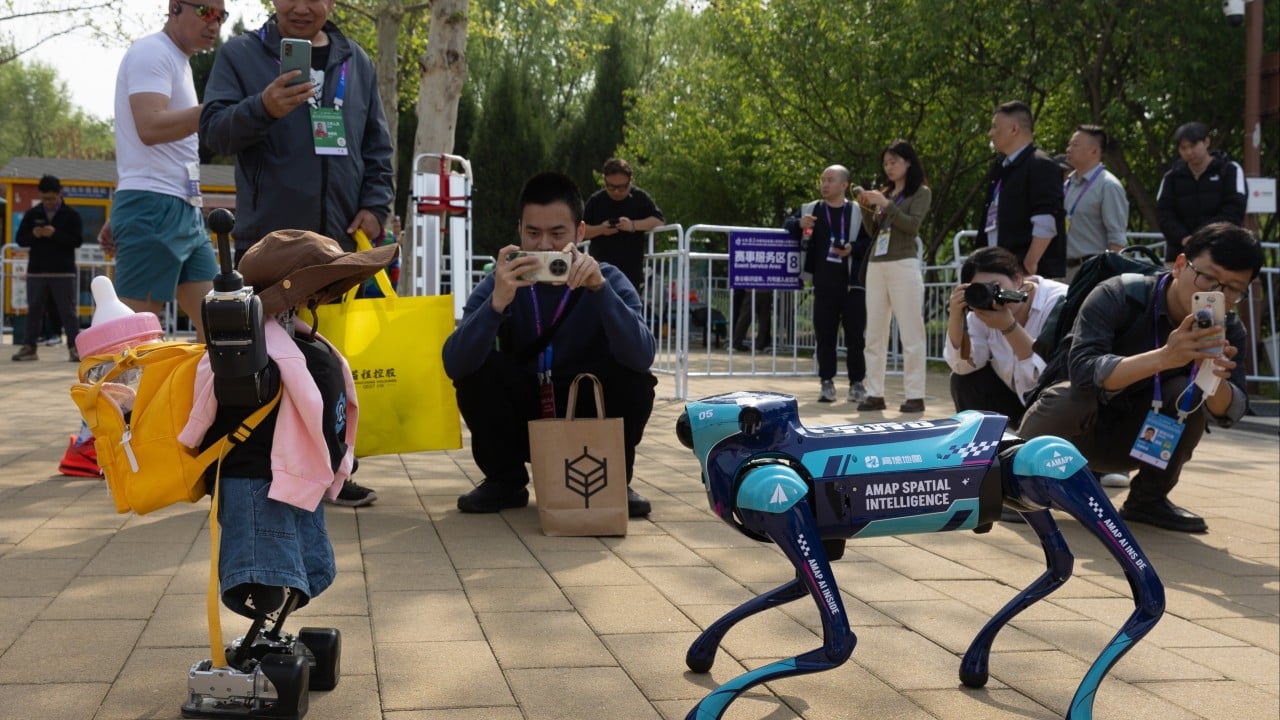
Alibaba research teams recently unveiled a 5-in-1 AI framework designed to run a robot's brain, body, and limbs under a single model architecture. Traditional robotics splits execution into isolated modules: perception interprets camera feeds, path planning calculates trajectories, and low-level controllers send voltage signals to motors. Alibaba’s integrated system attempts to collapse these layers into one unified model, handling multimodal processing, spatial reasoning, task planning, force control, and execution simultaneously. This direct connection between high-level reasoning and low-level motor commands addresses the delay and loss of detail that routinely break autonomous hardware when moving from simulation to the physical world.
The Problem With Split Robotic Architectures
Building a working robot usually means stitching together radically different software pipelines. One neural network processes vision. A separate physics solver calculates joint angles. A third control loop manages motor torque fifty times a second. Every boundary between these systems creates a potential failure point.
Information gets lost in translation. A vision model might identify a glass cup on a table, but when it passes a bounding box coordinate down to the motion planner, fine details vanish. The system strips away surface friction, material fragility, and minor sensor noise. The execution layer receives a rigid geometric instruction and proceeds to crush the glass or drop it entirely.
Multimodal models brought conversational intelligence to computers, yet they struggled to interact with physical objects. Text models excel at syntax. Physical machines require precise kinematics. Bridging that gap required training models on paired sensorimotor data rather than standard internet text.
Alibaba’s 5-in-1 approach targets this exact structural friction. By processing camera pixels, tactile feedback, kinematic joint states, task directives, and direct motor outputs inside a single unified transformer architecture, the system reduces latency and preserves contextual nuance from perception straight down to physical actuation.
How Unified Neural Architectures Control Physical Hardware
Traditional robotics relies on clean abstraction layers. Engineers prefer these abstractions because they make debugging straightforward. If a robot trips, you can inspect the motor controller logs independently from the vision logs.
Merging these systems creates a single black box. Inputs enter as visual pixels, force sensor readings, and text commands. Outputs emerge as raw joint torques or pulse-width modulation commands sent directly to hardware actuators.
+-----------------------------------------------------------------------+
|                       UNIFIED 5-IN-1 MODEL                            |
|                                                                       |
|  Inputs: Camera Pixels + Tactile Feedback + Kinematic States + Text   |
|                                  │                                    |
|                                  ▼                                    |
|  Outputs: Motor Torques + Joint Velocities + Direct Hardware Commands |
+-----------------------------------------------------------------------+
To achieve this, the architecture uses unified tokenization. Visual frames, spatial depth maps, sensor telemetry, and desired task descriptions are translated into vector tokens. The model attends across all inputs at once. A change in tactile resistance alters vector states across the entire system, immediately modifying predicted motor trajectories before a high-level planner would even finish processing its next frame.
Latency drops significantly. Instead of waiting for a visual processing loop running at 30 Hertz to pass updates to a motion planning loop running at 100 Hertz, the unified neural network outputs direct actions at high frequencies. Fast response times allow physical systems to handle unexpected perturbations, like catching an object mid-fall or adjusting grip pressure on slippery surfaces.
The Real Technical Obstacles
Hardware deployment remains brutal. Operating inside a software sandbox offers infinite retries, but physical gears wear down and battery levels fluctuate.
- Data Scarcity: Unlike language models that train on trillions of web words, physical robotic demonstration data is extremely scarce and expensive to collect.
- Hardware Variance: A model trained on one specific robot arm often fails when transferred to another due to minor differences in gear backlash, motor manufacturing tolerances, or joint flex.
- Safety Boundaries: end-to-end neural control lacks deterministic guarantees. If a unified model outputs an unpredictable joint velocity spike, physical equipment breaks and humans nearby face real danger.
The Data Bottleneck in Physical Intelligence
Software scales smoothly. Physical hardware does not.
To train a unified 5-in-1 model, developers must gather millions of hours of physical interaction data. Teleoperation, where human operators control arms using VR headsets or haptic suits, yields high-quality motion sequences. However, it requires thousands of human hours to generate even modest datasets.
Simulation offers a partial workaround. Developers spawn millions of virtual robots inside physics engines to practice grasping, walking, and manipulation. Yet simulation presents a persistent gap known as the sim-to-real transfer problem. Physics engines approximate friction, fluid dynamics, and contact forces using mathematical shortcuts. When a model trained purely in simulation hits real iron and rubber, those mathematical shortcuts cause the robot to hesitate or jitter uncontrollably.
Alibaba and competing laboratories address this by combining synthetic data generation with real-world fine-tuning. They inject artificial noise into simulations, forcing the model to adapt to unpredictable physics. When deployed onto physical hardware, the network uses real-time tactile feedback to calibrate its internal weight predictions on the fly.
Comparing Architectural Paradigms
Industry approaches to autonomous physical systems vary widely across major tech firms and research institutes.
| Approach | Latency | Debugging Difficulty | Adaptability to Novel Objects |
|---|---|---|---|
| Modular Pipeline | High | Low | Low |
| Hierarchical Policy | Medium | Medium | Medium |
| Unified 5-in-1 Architecture | Low | High | High |
Modular setups remain the workhorse of industrial automation. Factories use them because predictable behavior matters more than adaptability. If a conveyor belt moves parts to precise coordinates, a classical control loop never fails.
Unified architectures shine in unconstrained environments. Homes, construction sites, and dynamic warehouses require systems that handle total chaos. When an object sits at an unexpected angle or a room features weird lighting, end-to-end models adjust far better than rigid classical software pipelines.
Financial and Industrial Implications
Automation costs remain tied to engineering labor. Deploying a classic industrial robot arm to handle a new task requires weeks of manual programming by specialized robotics engineers. They program safe zones, write custom vision scripts, and carefully calibrate grasping speeds.
If a single AI model handles vision, pathing, and motor execution out of the box, integration costs collapse. Instead of writing custom software for every factory line variation, operators show the system a demonstration video or provide a written prompt. The system translates those instructions directly into coordinated joint movements.
This shift threatens traditional industrial automation software vendors. Value migrates away from proprietary PLC controllers and hard-coded motion libraries toward hardware-agnostic foundation models capable of driving any mechanical frame.
China’s manufacturing sector provides an aggressive testing ground for this transition. Facing changing workforce demographics and rising labor overhead, Chinese industrial conglomerates are incentivized to test flexible automation directly on production floors.
The Tradeoffs of Removing Deterministic Control
Unifying every capability into one neural model introduces risks that safety regulators struggle to quantify. Traditional control theory relies on hard mathematical bounds. Engineers compute precise stability margins, proving mathematically that an arm will never strike its frame or exceed joint speed limits.
Neural networks do not provide mathematical proofs. They operate on probabilities.
When an end-to-end model controls a heavy industrial actuator, a bad prediction leads to direct physical impact. Safety teams attempt to solve this by wrapping neural controllers in external guardrail filters. These hard-coded physical limiters intercept neural outputs and block commands that exceed safe acceleration or torque thresholds.
Yet wrapping a flexible neural model in rigid rules recreates the structural boundary problems the system was designed to eliminate. If the guardrail overrides the neural network during a high-speed stabilization maneuver, the system can wobble unpredictably.
Engineers face a direct choice: accept the strict limitations of deterministic rulebooks, or grant neural models full control over raw physical force while absorbing the unpredictable failures that come with probabilistic decision-making.