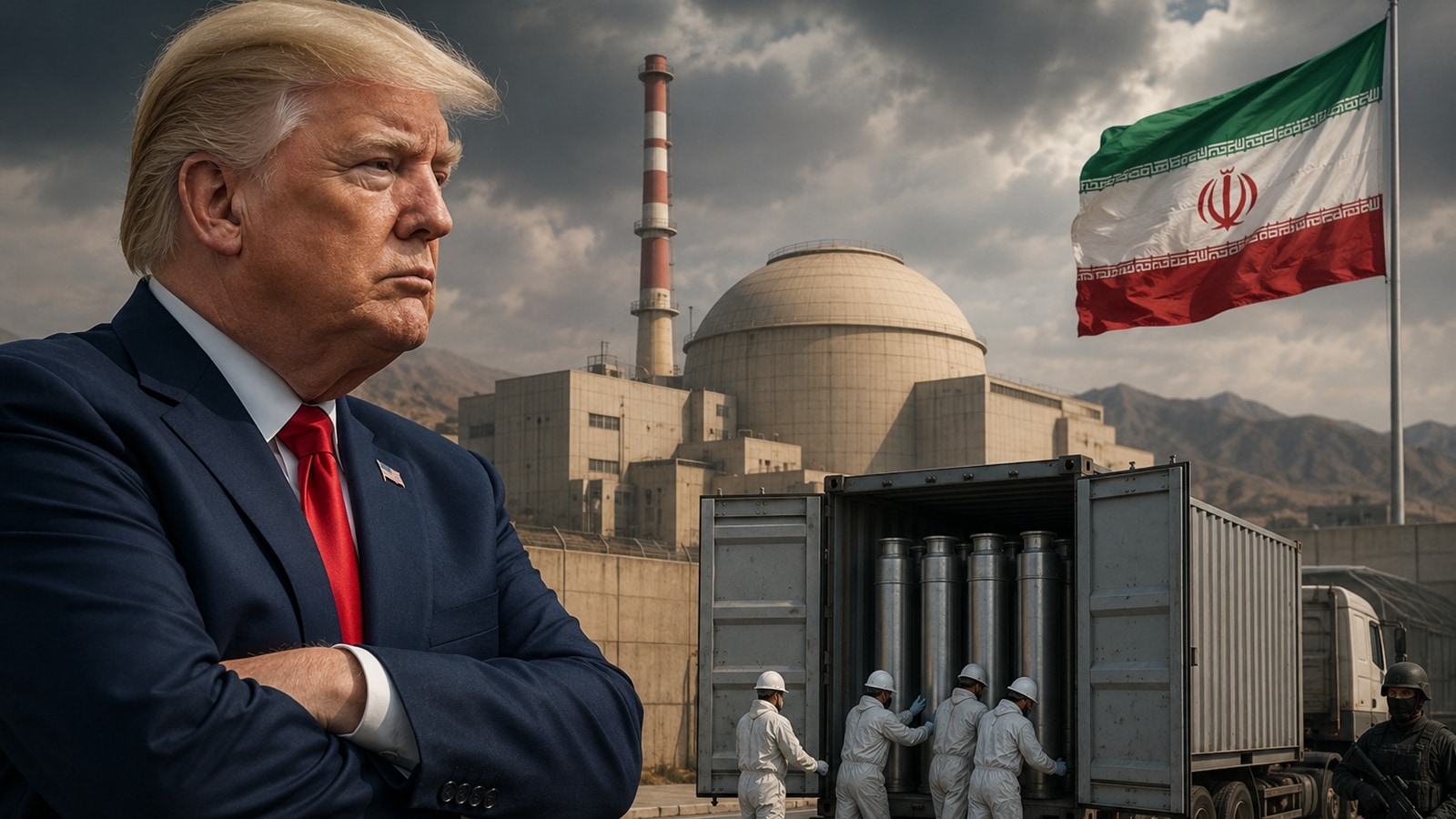
The centrifuge does not care about geopolitics. It is a cylinder of aluminum and carbon fiber, spinning at the speed of sound, screaming in a frequency only physics truly understands. Inside its hollow core, hexfluoride gas separates by the atomic weight of its ghosts. A single digit marks the difference between a nuclear fuel rod and a city reduced to ash.
When Donald Trump looks at Iran, he sees a map of transactions. He sees an adversary, yes, but he also sees a vault. Specifically, he sees an estimated 1,500 kilograms of enriched uranium—a stockpile painstakingly accumulated behind fortified concrete walls and deep beneath desert mountains. The rhetoric from Washington suggests a simple equation: take the leverage, secure the world, strike the ultimate deal.
But geography and chemistry are notoriously stubborn negotiators. You cannot simply repossess a nuclear program like a failing casino.
To understand the sheer weight of what this means, you have to leave the briefing rooms of Washington and stand, hypothetically, in the shoes of a technician at the Natanz enrichment facility. Let us call him Javad. He is not a fanatic; he is a mechanical engineer with a mortgage and a profound respect for pressure valves. For Javad, uranium is not a talking point on cable news. It is a volatile, corrosive substance that reacts violently with moisture in the air.
If you breach the seals of his facility to seize the material, you are not just taking a payload. You are breaking a fragile ecosystem of containment.
The public often imagines enriched uranium as glowing green bricks, easily stacked into the back of a cargo plane. The reality is far more tedious, and far more terrifying. The vast majority of Iran's stockpile exists as uranium hexafluoride, or $UF_6$. At room temperature, it is a white, crystalline solid. Warm it just a fraction, and it transforms into a highly toxic gas that moves with aggressive fluidity.
Imagine trying to confiscate a cloud that can liquefy your lungs.
A standard extraction operation requires specialized transport cylinders, vacuum pumps that can withstand extreme corrosion, and a team of physicists willing to gamble their cellular structure on a timeline dictated by politicians. The logistics alone are staggering. Every cylinder must be shielded, monitored for temperature fluctuations, and guarded against the slightest kinetic shock. A single rupture during transport does not just cause a diplomatic incident; it creates a dead zone.
Washington's strategists speak of "coercive denuclearization" as if it were a boardroom takeover. They point to historical precedents, but history is a messy teacher.
Consider the Libyan precedent of 2003. Muammar Gaddafi agreed to dismantle his nuclear weapons program in exchange for sanctions relief. White House officials flew into Tripoli, packed crates of centrifuge parts and design blueprints into the belly of a C-130 transport plane, and flew away. It was clean. It was televised.
But Iran is not Libya.
Gaddafi’s program was a purchased kit, largely uninstatled and entirely dependent on foreign expertise. Iran’s program is indigenous. It is woven into the country's infrastructure, its universities, and its national pride. You cannot crate up the knowledge inside the minds of thousands of Iranian scientists. You cannot airlift the mountain at Fordow, which was bored deep into a granite massif specifically to survive American bunker-busters.
This is where the transactional mindset hits a wall of solid rock. The Fordow enrichment plant sits under hundreds of feet of stone, protected by air defense systems and guarded by the Islamic Revolutionary Guard Corps. It was designed to be inaccessible to bombs. It is doubly inaccessible to moving trucks.
To physically remove the uranium against Iran's will requires one of two scenarios. Both are catastrophic.
The first is a total military occupation of the country's nuclear nodes. This would require an invasion force larger than the one deployed to Iraq in 2003, operating in a terrain far more mountainous and against a disciplined, entrenched military. The cost would be measured in trillions of dollars and tens of thousands of lives. The uranium would likely be sabotaged, dispersed, or hidden long before the first foreign boot touched the facility floors.
The second scenario is a decapitation strike followed by a rapid, special-operations raid to secure the material. This is the stuff of Hollywood scripts. It relies on the assumption that a small team can infiltrate a burning, chaotic combat zone, locate hundreds of cylinders of toxic gas, load them onto helicopters under fire, and exit without a single valve cracking.
It is a plan that survives only on paper.
The real danger of this rhetoric isn't just that it is logistically impossible; it is that it fundamentally misunderstands what makes a nuclear program valuable to a regime. Tehran does not view its uranium stockpile as a commodity to be bartered away under duress. It views it as an existential life insurance policy.
Every kilogram of uranium enriched to 60 percent purity is a testament to survival. It is a shield against the very regime change that the extraction talk implies. When Washington signals that it wants to take the material by force, it doesn't incentivize Iran to negotiate. It incentivizes Iran to rush the final, short distance to 90 percent—weapons-grade—purity.
The distance between 60 percent and 90 percent is not a mountain; it is a hill. Due to the mathematics of enrichment, most of the work has already been done.
The atomic world is counterintuitive that way. It takes an immense amount of energy and time to separate the rare U-235 isotopes from the dominant U-238 isotopes to reach 5 percent purity. To go from 5 percent to 20 percent takes far less. To go from 60 percent to bomb-grade requires only a few weeks of cascading centrifuge adjustments.
By demanding the uranium through threats of seizure, the West may inadvertently trigger the precise event it seeks to prevent. The gas will be fed back into the centrifuges. The screaming cylinders will spin faster. The window for diplomacy will slam shut.
There is a quiet desperation among the international inspectors who actually visit these sites. Men and women from the International Atomic Energy Agency wear yellow booties and carry radiation monitors into Natanz. They see the reality on the ground. They know that peace is maintained not by grand gestures of dominance, but by the tedious, unglamorous work of sealing valves and checking cameras.
They understand that the uranium is real, it is dangerous, and it cannot be wished away by political willpower.
The desire to simply reach into an enemy's territory and pluck out their teeth is an ancient imperial impulse. It feels decisive. It sounds powerful on a campaign trail. But the atoms do not care about the theater of strength. They obey the laws of thermodynamics, which state that chaos is far easier to create than order.
The silence inside a decommissioned bunker is heavy. If the cylinders ever break, if the pressure drops, the white crystals turn to gas and vanish into the atmosphere, leaving behind a quiet, invisible poison. You cannot capture it. You cannot bring it home as a trophy. You can only stand by and watch as the air itself becomes the enemy.