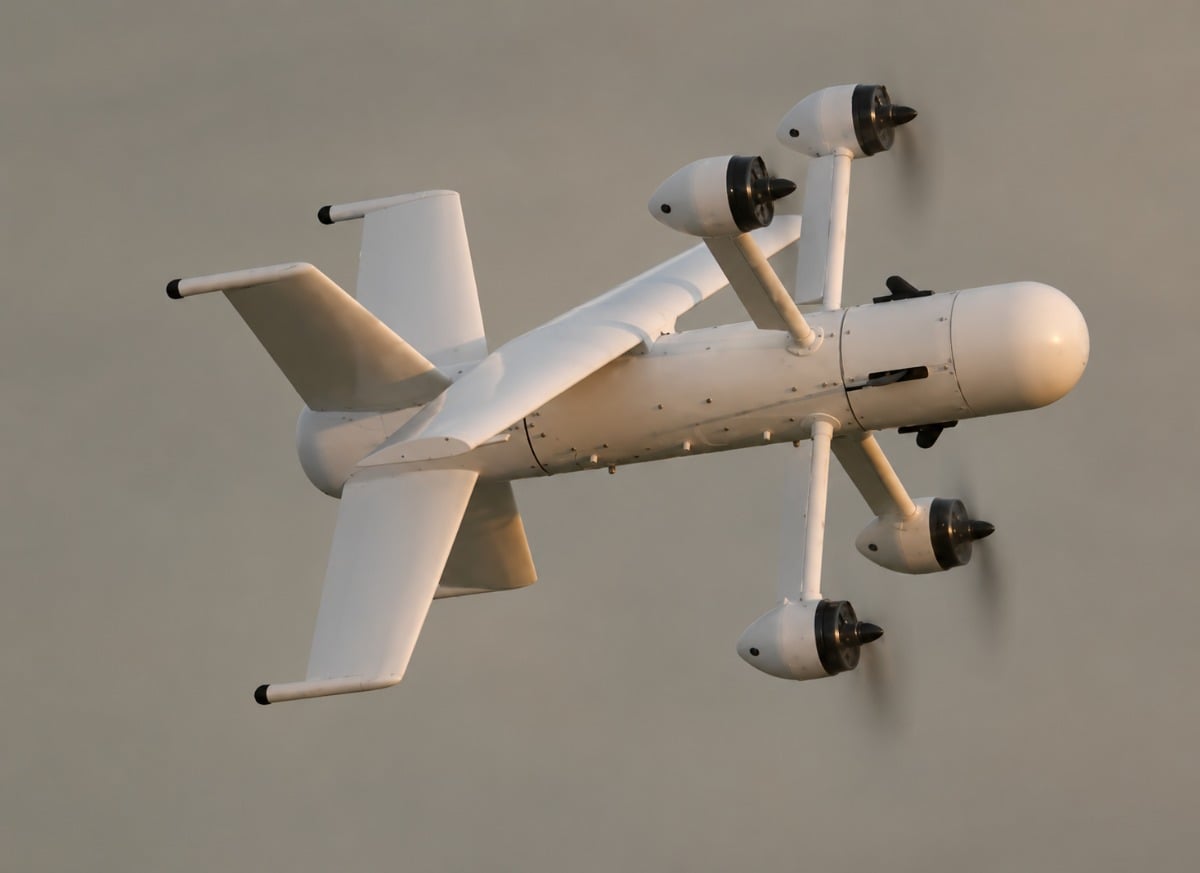
The cost curve of modern air defense is mathematically broken. Expending $2 million Patriot interceptors or $100,000 ground-based kinetic missiles to destroy $1,000 commercial off-the-shelf drones creates a rate of fiscal attrition that favors the attacker by multiple orders of magnitude. Lockheed Martin’s unveiling of the MORFIUS X-Rotor airborne High-Power Microwave (HPM) counter-unmanned aircraft system (C-UAS) directly targets this operational disparity.
Analyzing the system requires stripping away defense marketing terminology and dissecting the core mechanics: airborne non-kinetic effectors, sensor-agnostic command architectures, and field-reusable platforms.
The Physics of Microwave Engagement
Ground-based HPM systems suffer from a fundamental geometric limitation: the inverse-square law of electromagnetic radiation. Power density drops off rapidly over distance. As the electromagnetic beam travels from a fixed ground emitter toward a target, its power density $S$ at range $r$ is expressed as:
$$S = \frac{P_{t} G_{t}}{4 \pi r^2}$$
Where $P_{t}$ represents transmitter power and $G_{t}$ represents antenna gain. To deliver the field strength required to fry the integrated circuits of a drone at a range of 5 kilometers, ground systems require massive generators, heavy capacitors, and large physical antennas.
[Ground-Based HPM System]
    |
    |-- Long Range Distance (r) --------------------> [Target Drone]
    |   (Power density degrades by factor of 1/r²)
    v
[Requires Massive Ground Power Generator & Heavy Antenna]

vs.

[Ground Launch Platform]
    |
    |-- Airborne Deployment (Tube Launch)
    v
[MORFIUS Airborne HPM Platform]
    |
    |-- Short Range Distance (r_close) -------------> [Target Drone Swarm]
    |   (High power density delivered at close proximity)
    v
[Disrupts / Destroys Integrated Circuits (50+ Kills)]
By moving the HPM payload onto an airborne platform—in this case, an altered rotary/fixed-wing airframe—the distance variable $r$ between the weapon and the target drone swarm approaches near-zero. Delivering microwave bursts in close proximity negates the need for gigawatt-class ground generators.
When high-intensity radio frequency energy hits an incoming threat, it induces high-voltage electrical surges through unshielded wiring, printed circuit boards (PCBs), and control buses. These surges cause:
- Thermal runaway in board-level semiconductor junctions.
- Bit-flip errors in flash memory, forcing immediate system reboots.
- Sensor saturation, rendering optical flow modules and inertial measurement units (IMUs) unusable.
The result is a non-kinetic electronic disruption that forces target drones into immediate catastrophic control failure.
Decoupling Guidance from Fire Control Radars
Traditional air defense networks require tight integration between target acquisition radar, dedicated fire-control radar, and tracking receivers on the interceptor. Fire-control radars are high-value targets; they emit constant radio frequency signatures, making them vulnerable to anti-radiation missiles and electronic jamming.
+-------------------------------------------------------------------+
|               TRADITIONAL AIR DEFENSE ARCHITECTURE                |
+-------------------------------------------------------------------+
|                                                                   |
|  [Acquisition Radar] ---> [Fire-Control Radar] ---> [Interceptor] |
|                                (Single Point                      |
|                                  of Failure)                      |
|                                                                   |
+-------------------------------------------------------------------+

                                 vs.

+-------------------------------------------------------------------+
|                  SENSOR-AGNOSTIC ARCHITECTURE                     |
+-------------------------------------------------------------------+
|                                                                   |
|  [Any C2 System / Sensor] ------------------------> [MORFIUS HPM] |
|  (Radar, Optical, Acoustic)                         (Onboard      |
|                                                      Terminal     |
|                                                      Guidance)    |
|                                                                   |
+-------------------------------------------------------------------+
MORFIUS operates using an open-architecture, command-and-control (C2) agnostic framework. The system relies on initial coarse vector data provided by any sensor on the network—ranging from acoustic detection arrays and optical tracking cameras to standard search radars. Once tube-launched into the target area, the onboard terminal guidance seeker takes over, closing the distance autonomously.
This decouples the system from dedicated fire-control infrastructure, providing three critical operational advantages:
- Reduced Target Footprint: Eliminating dedicated tracking radars lowers the electromagnetic profile of the defending unit.
- Interoperability: The interceptor integrates directly into existing Joint All-Domain Command and Control (JADC2) frameworks without bespoke interface hardware.
- Distributed Launch Capability: Launch vehicles can operate at significant distances from the primary sensor network, preserving force protection.
The Cost Function of Reusable Interceptors
Counter-drone tactics are governed by the economics of the engagement cycle. The strategic viability of a defense platform depends on three key parameters: unit acquisition cost ($C_u$), expected operational lifecycle engagements ($N_e$), and payload energy cost ($C_e$).
Traditional kinetic interceptors are single-use expendables where $N_e = 1$. The engagement cost equals the full production cost of the missile.
Traditional Missile:   Engagement Cost = Cu (Full Missile Cost)
HPM Airborne Platform: Engagement Cost = (Cu / Ne) + Ce (Fractional Platform Cost + Recharging Cost)
MORFIUS structures its cost profile through field recovery and reusability. Designed to return to base, undergo a battery swap or rapid recharge, and re-arm for subsequent deployment, the platform amortizes its manufacturing cost over dozens of missions.
Because an HPM payload delivers directed energy rather than consuming explosive material, a single sortie can execute multiple "shots". Firing a microwave pulse drains a portion of the onboard energy storage without depleting physical magazine capacity. Neutralizing up to 50 targets per flight drops the cost per kill from six figures to nominal operational fuel and electrical recharge overhead.
Operational Vulnerabilities and System Bottlenecks
Despite its structural advantages over single-use missiles, an airborne HPM platform introduces technical trade-offs that limit its application:
- RF Shielding Countermeasures: Adversaries can apply Faraday cage shielding, conductive coatings, or hardened component architectures to cheap drones, increasing the power density required to defeat them.
- Atmospheric and Weather Interference: Heavy precipitation, humidity, and atmospheric particulate scatter high-frequency electromagnetic waves, reducing effective range.
- Friendly Fire Risk: The omnidirectional or wide-beam nature of close-range HPM bursts disrupts all unhardened electronics within its footprint. Deploying an HPM airborne weapon near friendly tactical radios, communications relays, or friendly UAVs risks collateral electronic damage.
- Turnaround Latency: Reusability requires physical recovery, diagnostics, battery replacement, and re-launch. During high-density, multi-wave swarm saturation attacks, the latency of recovering platforms creates temporary defensive gaps.
Ground-launched, airborne microwave effectors must be integrated into a broader layered defense architecture. Short-range kinetic weapons, optical blinders, and localized RF jamming remain necessary to fill operational gaps during system recovery windows. Military acquisition teams evaluating counter-drone platforms should mandate open-standard hardware interfaces, prioritize systems capable of autonomous target discrimination in GPS-denied environments, and conduct high-power RF testing against hardened micro-electronics before committing to fleet procurement.