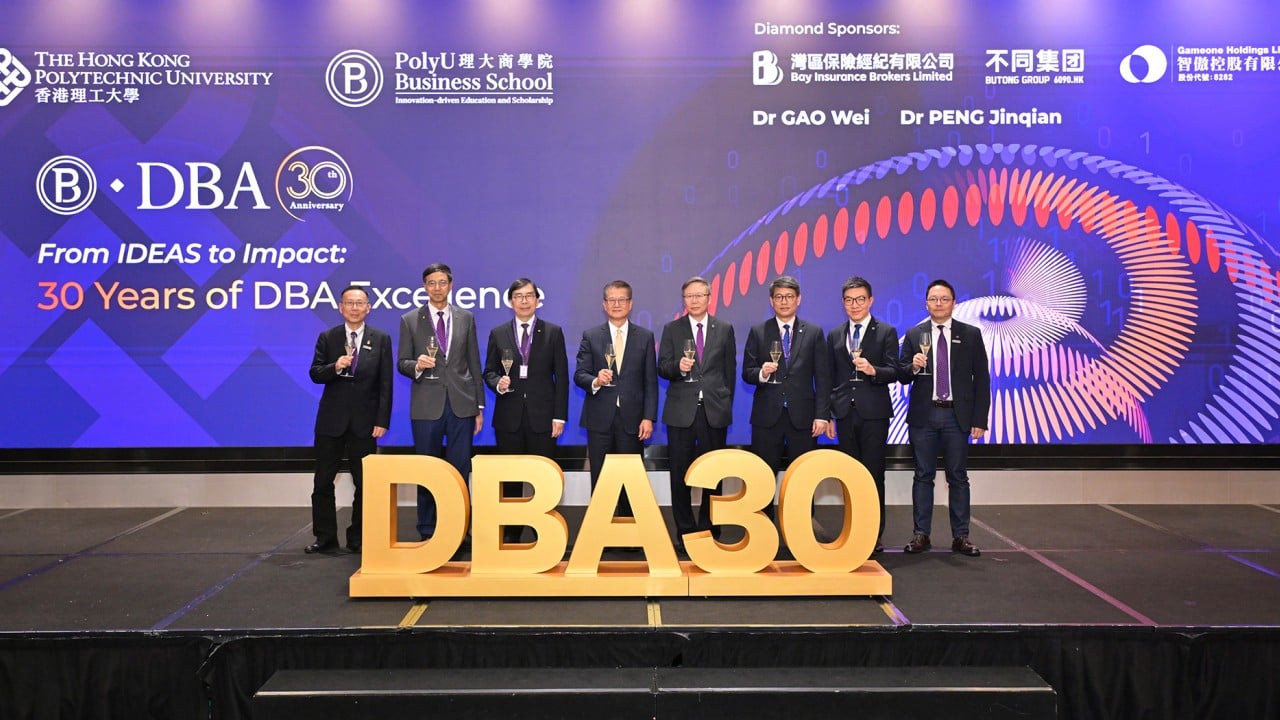
Universities love a good anniversary. They gather hundreds of executives in sharp suits, hand out crystal plaques, and toast to decades of producing "scholar-leaders."
Case in point: the recent celebration of executive doctorates, like the Doctor of Business Administration (DBA) milestones we see across elite Asian business hubs, where the grand proclamation was made that artificial intelligence requires a new breed of academic-executive hybrid.
They have it completely backward.
The traditional "scholar-leader" model—the idea that you can marry slow, methodical academic research with fast-paced corporate governance—is dead. AI did not create a need for this hybrid. AI exposed its fundamental flaw.
While business schools brag about turning CEOs into part-time academics who can write peer-reviewed papers, the market is screaming for something else entirely. We do not need executives who know how to format a regression analysis for a journal that three people will read. We need leaders who understand that information monopoly is gone, and that bureaucratic academic frameworks are too slow to survive the current technological shift.
The Fatal Flaw of the Executive Doctorate
Let’s dismantle the premise of the modern executive doctorate. The pitch is enticing: take your 20 years of corporate battle damage, apply rigorous academic theory, and produce groundbreaking insights that bridge the gap between ivory towers and boardrooms.
It sounds noble. In practice, it is an expensive mismatch of incentives.
Academic research values perfection, replication, and exhaustive literature reviews. It operates on a timeline of months, if not years. Corporate survival in an algorithmic economy demands speed, dirty data utilization, and rapid iteration.
When you force a high-performing executive to spend three years studying structural equation modeling, you aren't upgrading their leadership capabilities. You are training them to hesitate.
I have watched boards spend millions on consultants and executive education programs designed to turn senior VPs into "theorists." The result? Analysis paralysis wrapped in academic jargon. While your newly minted doctor of business is busy defining the theoretical boundaries of organizational learning, an uncredentialed 24-year-old with an open-source API has just automated your primary revenue stream.
The academic pipeline rewards people for staring at the rearview mirror. It analyzes what has happened. True business leadership requires placing bets on what will happen, often with incomplete data. AI compresses the time between strategy and execution to near-zero. If your decision-making process requires a conceptual framework approved by a thesis committee, you are already obsolete.
The Data Delusion: Why More Frameworks Won't Save You
The common defense of the scholar-leader track is that it teaches advanced critical thinking and data literacy. The narrative goes that in an AI-driven market, leaders must know how to interrogate data deeply.
This is a profound misunderstanding of how modern technology operates.
The Evolution of Strategic Insight
| Era | Source of Competitive Advantage | Leadership Trait Required |
|---|---|---|
| Pre-Digital | Information Asymmetry (Knowing what others don't) | Command and Control |
| Digital/Big Data | Analytical Capability (Processing data faster) | Data-Driven Scholar |
| AI/Algorithmic | Execution Speed & Curation (Validating outputs) | Agile Synthesizer |
The digital era required data-driven scholars because humans still had to do the heavy lifting of statistical modeling. Today, LLMs and neural networks handle the crunching. They find correlations that human researchers cannot even conceptualize.
The bottleneck is no longer a lack of frameworks; it is an overabundance of noise.
When business schools teach executives to build complex, rigid theoretical models, they are preparing them for a world that no longer exists. C-suite leaders do not need to know how to construct an econometric model from scratch. They need to know how to stress-test the assumptions of an algorithm that is making millions of micro-decisions per second.
Harvard Business Review contributors frequently point out that the failure rate of digital transformation projects hovers around 70%. If academic rigor solved execution problems, companies stacked with PhDs and DBAs would never fail. Yet, they trip over the same execution hurdles as everyone else because theory breaks the moment it hits legacy IT infrastructure and human politics.
The Hidden Cost of Academic Preen
Let's talk about the downside nobody admits: the pursuit of executive credentials is often an exercise in status signaling rather than competence building.
Getting a doctoral degree while running a company requires an immense sacrifice of cognitive bandwidth. That bandwidth belongs to your shareholders, your employees, and your customers.
Imagine a scenario where a mid-market financial institution is facing a severe margin squeeze due to decentralized finance protocols and automated lending platforms. The CEO is spending weekends writing a 50,000-word dissertation on "The Impact of Transformational Leadership on Employee Retention in Post-Pandemic Environments."
The dissertation will eventually sit in a digital archive. Meanwhile, the company's core product is being unbundled by lean startups.
This is the hidden cost of the scholar-leader obsession. It diverts the attention of top-tier talent away from immediate, existential market threats and redirects it toward abstract, academic navel-gazing. The prestige of putting "Dr." on a business card is a vanity metric.
Dismantling the "People Also Ask" Flaws
If you look at what people ask about executive education and leadership in the tech era, the questions themselves reveal how deeply ingrained these misconceptions are. Let's fix the premises of these questions.
Does a DBA make you a better leader in the AI era?
No. It makes you a slower leader. It trains you to seek permission from historical data before making a move. AI rewards rapid experimentation, failure, and pivot cycles. Academic training punishes failure—if your hypothesis is wrong or your methodology is flawed, you fail your defense. In business, a failed hypothesis is just a pivot point, provided you didn't bet the whole company on it.
How should business schools adapt to train future leaders?
By destroying the traditional dissertation. If business schools want to remain relevant, they need to stop forcing executives to mimic career academics. Replace the thesis with a live, high-stakes implementation project. Instead of writing about how AI impacts supply chains, the executive should be required to deploy an autonomous sourcing system within their organization and defend the real-world P&L statement, not a literature review.
Can theory keep up with technological disruption?
Never. Academic publishing cycles take 12 to 24 months from submission to print. In that same timeframe, underlying technological architectures undergo multiple major iterations. Relying on peer-reviewed business literature to guide your 2026 AI strategy means you are executing strategies designed for 2024 technology. It is a losing proposition.
The Execution Asset: What to Do Instead
If the scholar-leader model is broken, what replaces it? The Operator-Synthesizer.
This isn't a person who hides behind academic credentials or theoretical safety nets. This is a leader who treats the entire market as a live laboratory. They do not wait for academic consensus; they create data through action.
To thrive, you must shift your focus from acquiring theoretical frameworks to building execution speed.
- Audit for speed, not compliance: Look at your decision-making pipeline. If a strategic initiative requires more than two layers of theoretical validation or committees, kill it.
- Devalue the credential, value the output: Stop hiring or promoting based on acronyms after a name. Look for leaders who have built, broken, and fixed systems in chaotic environments.
- Treat AI as a colleague, not a tool: A tool requires a skilled technician to operate it. A colleague requires a leader to direct, question, and evaluate them. Shift your mindset from learning how to use technology to learning how to govern it.
The illusion that you can sit back, analyze the market through a pristine academic lens, and lead a modern enterprise is comforting. It is also an incredibly fast way to get left behind.
Stop trying to turn your executives into scholars. The ivory tower is burning, and the crowd celebrating its history inside the ballroom hasn't noticed the smoke yet.