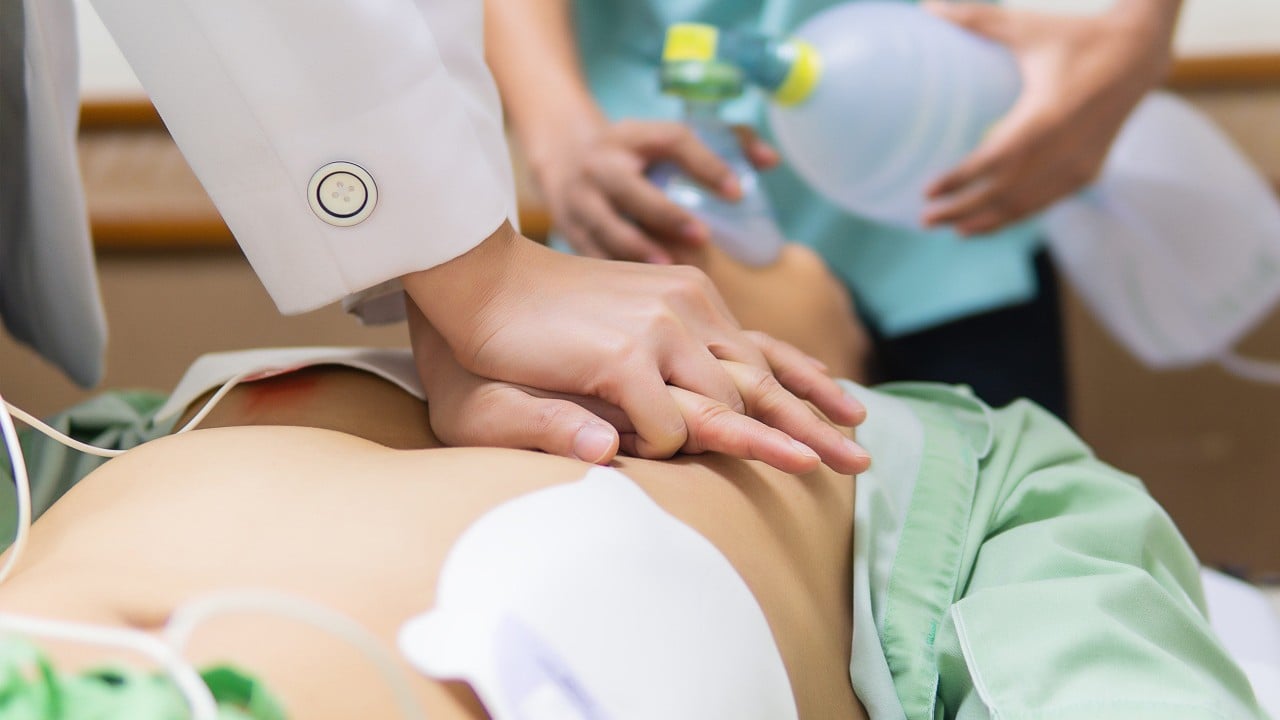
A 40-year-old man in Fujian Province, China, has rewritten the medical understanding of death after his heart remained stopped for a staggering 40 hours. This was not a miraculous spontaneous recovery in a morgue, but the result of an aggressive, high-stakes medical intervention known as ECPR (Extracorporeal Cardiopulmonary Resuscitation). While traditional CPR often fails after 30 minutes, the deployment of advanced life-support machinery allowed doctors to bypass the patient’s non-functioning heart and lungs, keeping his brain alive long enough for his body to restart. This case forces a uncomfortable confrontation with the traditional definition of "dead."
The incident began when the patient, identified as Mr. Chen, collapsed from a massive myocardial infarction. In most hospitals, a heart that refuses to beat after nearly two days of effort is a lost cause. However, the medical team utilized Extracorporeal Membrane Oxygenation (ECMO), a process that draws blood from the body, scrubs it of carbon dioxide, saturates it with oxygen, and pumps it back into the arterial system. By doing the work the heart could not, they maintained a biological bridge.
The Biological Bridge Between Life and Decay
To understand how a human can survive 40 hours without a pulse, one must look at the distinction between clinical death and biological death. Clinical death occurs the moment the heart stops pumping. Biological death, however, is a staggered process. It is the point where cells begin to liquefy and brain tissue sustains irreversible damage due to oxygen starvation.
In this specific case, the medical team at the First Affiliated Hospital of Xiamen University didn't just perform chest compressions. They bypassed the patient's internal plumbing entirely. When a person is on ECMO, they are technically in a state of suspended animation regarding their primary organs. The blood moves, the brain receives its fuel, but the heart remains a motionless muscle. The 40-hour window was not a period of "nothingness" but a period of artificial circulation.
The real struggle wasn't the heart. It was the kidneys and the liver. When the heart stops, the "shock" to the system causes a cascade of organ failures. The doctors had to manage a metabolic storm, using continuous renal replacement therapy to filter toxins that the body’s own failing systems could no longer handle. It was a symphony of mechanical intervention designed to prevent the cellular rot that usually follows a cardiac arrest.
Why This Case Is an Outlier in Global Medicine
Most patients who suffer a cardiac arrest outside of a hospital have a survival rate that hovers around 10 percent. If the heart does not restart within the first 20 minutes, the chances of neurological recovery plummet. Mr. Chen’s survival is an anomaly because it combined immediate bystander intervention with the rapid availability of a specialized ECMO team.
There is a significant "why" behind the location. China has been aggressively expanding its ECMO capabilities, transforming it from a niche, last-resort treatment into a frontline tool for cardiac emergencies in major urban centers. However, this level of care is not a universal standard. It requires a massive amount of resources—six to eight specialized staff members around the clock for a single patient.
The Cost of Defying the Reaper
The financial and physical toll of such a recovery is immense. An ECMO run can cost tens of thousands of dollars per day. Furthermore, the complications are brutal. Patients often suffer from massive internal bleeding because the blood must be thinned to prevent it from clotting inside the machine. There is also the risk of "Harlequin Syndrome," where the upper body receives different oxygen levels than the lower body, potentially starving the brain even while the legs remain pink and warm.
Mr. Chen survived, but the recovery of a "resurrected" patient is rarely a clean slate. The body undergoes a massive inflammatory response. It is as if every cell in the body has been through a war. The fact that he woke up with his cognitive functions largely intact is perhaps more surprising than the heart restarting itself. This suggests that the cooling protocols and the precision of the oxygen flow were handled with surgical accuracy.
The Ethical Grey Zone of the Non Beating Heart
This case shatters the comfort of the "flatline." In the past, a flatline on an EKG was the end of the story. Now, it is merely a technical problem to be solved. If we can keep a body "alive" for 40 hours without a heartbeat, how long is too long?
Doctors are now forced to decide when "life support" becomes "grave robbing." If a patient’s heart cannot be restarted, but the machine is keeping their brain functional, the person is caught in a mechanical limbo. In the Fujian case, the bet paid off. The heart eventually regained its rhythm after intensive drug therapy and the mechanical rest provided by the ECMO. But for every Mr. Chen, there are dozens of patients who never wake up, whose families are left watching a machine pump blood through a body that has already essentially departed.
Redefining the Point of No Return
Medical professionals are beginning to advocate for a shift in how we view the "Golden Hour" of resuscitation. We have traditionally viewed the cessation of the heartbeat as the definitive curtain call. We were wrong.
The brain is more resilient than we gave it credit for, provided the temperature is managed and the blood flow is consistent. The success in China proves that the "limit" of human survival is often a limit of our current infrastructure, not necessarily our biology. If every ambulance carried the equivalent of a portable bypass machine, the "40-hour miracle" might eventually become a standard medical protocol.
The Technical Execution of the Recovery
The 40-hour window was characterized by a specific medical phenomenon: Stunned Myocardium. After a major heart attack, the heart muscle isn't necessarily dead; it’s paralyzed. It is in a state of deep "hibernation" due to the trauma. By using the ECMO to take over the workload, the doctors allowed the heart's mitochondria to recover and the cellular edema to subside.
They used a combination of:
- Targeted Temperature Management: Keeping the body slightly cool to reduce the brain's demand for oxygen.
- Vasoactive Support: Using high-dose adrenaline and noradrenaline to force the blood vessels to maintain pressure.
- Electrolytic Balancing: Constantly adjusting potassium and calcium levels to create the perfect electrical environment for the heart to spark back to life.
On the 40th hour, the heart didn't just explode into action. It began with a few erratic flickers—ventricular escape beats. Then, slowly, the sinus node reclaimed its role as the pacemaker. It was a slow climb out of a very deep well.
The Reality of Post Resuscitation Syndrome
Survival is only the first hurdle. The "Post-Resuscitation Syndrome" involves a systemic inflammatory response similar to sepsis. When the blood starts flowing normally again after a period of stagnation, it can actually cause more damage—a phenomenon known as reperfusion injury. The sudden influx of oxygen creates free radicals that can tear through cell membranes.
The Fujian medical team had to carefully "dial in" the oxygen levels. Too much oxygen is actually toxic to a recovering brain. They had to keep the patient in a state of controlled hypoxia-avoidance, ensuring the brain got exactly what it needed and nothing more. This level of granular control is what separates modern "miracles" from the lucky breaks of the past.
The patient’s age was also a deciding factor. At 40, the vascular system has a level of plasticity and resilience that a 70-year-old simply doesn't possess. His organs could take the beating that the ECMO and the massive drug cocktail dealt them.
Moving Toward a New Standard of Emergency Care
We are entering an era where "death" is becoming a reversible condition under the right circumstances. The 40-hour heartbeat-free survival is a proof of concept. It demonstrates that the human frame is capable of enduring far more than the 20th-century medical manuals suggested.
The challenge now is not just the technology, but the distribution of that technology. In most parts of the world, if your heart stops and doesn't restart in 30 minutes, you are pronounced dead. There is no ECMO team waiting. There is no 40-hour bridge. The gap between the "miracle" in Fujian and the reality of a standard ER is a chasm of resources and specialized training.
The medical community must now grapple with the fact that many "deaths" are currently premature. If a 40-hour gap can be bridged with a successful neurological outcome, the standard 20-minute code blue looks increasingly like an antique practice. We are moving toward a future where the heart is treated as just another pump—one that can be replaced, bypassed, and eventually restarted, provided the technician is fast enough and the machine is ready.
Stop looking at the heart as the soul of the machine. It is a biological motor, and like any motor, it can be jump-started if you have a long enough set of cables and enough patience to wait out the storm.