The morning mist over the water in St James’s Park does not care about history. It hangs low and heavy, blurring the sharp edges of the London skyline, turning the distant shape of Buckingham Palace into a chalky watercolor. If you stand near the water’s edge at dawn, the city sounds like a muffled hum. It is a fragile kind of quiet.
For nearly four centuries, that quiet remained unbroken by a specific, prehistoric sound.
Then came a sharp, wet crack. Then a tiny, demanding hiss.
To understand why a handful of park keepers were holding their breath by a lakeside in the heart of a bustling metropolis, you have to look past the modern tourists dropping chip wrappers and the bureaucrats rushing toward Whitehall with leather briefcases. You have to look at the mud. Underneath the manicured lawns of London's oldest Royal Park lies a timeline of human obsession, royal whimsy, and a staggering biological silence that lasted exactly 360 years.
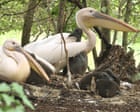
Two pelican chicks have hatched in St James’s Park.
It sounds like a quirky bit of local trivia, the sort of light news item that flashes on a screen at the back of a subway car and vanishes from your mind before the next stop. But breathe in the damp air of the lake for a moment. Consider the sheer improbability of it. The last time a pelican egg successfully cracked open on this patch of earth, the Great Fire of London hadn't even burned the old St Paul’s Cathedral to ash. King Charles II was walking these same banks, surrounded by spaniels and exotic birds, trying to forget the trauma of his father’s execution by building a playground of living curiosities.
We think we control nature when we build cities. We pave over the marshland, channel the streams into concrete pipes, and draw neat little green squares on maps, labeling them "parks." We treat the animals inside them like living statues—decorations meant to stay exactly where we put them.
But life is stubborn. It waits.
The Russian Gift and the King's Boredom
Go back to 1664. The air in London smelled of woodsmoke, open sewers, and sea coal. King Charles II, newly restored to the throne after years of dreary Puritan rule, wanted color. He wanted theatricality. He wanted to show the world that England was grand again.
Enter the Russian ambassador.
As a diplomatic gesture, the ambassador presented the King with a pair of bizarre, prehistoric-looking creatures: Great White Pelicans. With their massive, expandable pouches and absurdly wide wingspans, they looked entirely out of place against the gray, damp backdrop of seventeenth-century England. They were spectacular. They were a flexing of global muscle.
The King put them in St James’s Park.
For the next three and a half centuries, the pelicans became a permanent fixture of London life. Generation after generation of birds was brought in to keep the tradition alive. They became as iconic to the park as the ravens are to the Tower of London. Tourists marveled at them. Office workers ate their sandwiches while watching the birds swallow whole fish in a single, grotesque gulp.
But there was a catch. A deep, systemic failure masked by the beautiful scenery.
The birds never bred.
For 360 years, every single pelican that glided across the lake was an outsider. They were imports, brought in from zoos or donated by foreign governments to replace the ones that grew old and died. The park was a beautiful gilded cage, a place where the birds could live, but where their future always stopped dead. They were a living exhibit, entirely dependent on human intervention to exist in the heart of London.
To the casual observer, the pelicans were thriving. But to anyone paying attention, the silence of the nests was a quiet indictment. We could keep them alive, but we couldn't make them home.
The Invisible Architecture of Home
Imagine you are a park keeper. Let’s call him absolute devotion personified. Day in and day out, your boots sink into the same lakeside mud. You know the individual personalities of the birds. You know that Sun, Moon, and Star—the current resident pelicans—are not just biological specimens; they are stubborn, heavy, incredibly powerful creatures with distinct moods.
You feed them fresh fish. You protect them from loose dogs. You watch them preen their feathers under the shadow of the London Eye.
But you also know that a city park is an inherently hostile place for a bird trying to build a dynasty.
Pelicans are notoriously sensitive breeders. They don't just need food; they need safety, secrecy, and a very specific kind of peace that is hard to find when millions of humans clog the pathways just yards away. They need isolated islands. They need the right kind of twigs. Most importantly, they need to feel that the world around them isn't about to collapse.
Think about the sheer sensory overload of central London. The thrum of the underground trains vibrating through the bedrock. The low, constant rumble of red double-decker buses on Birdcage Walk. The flashbulbs of cameras. The glare of artificial streetlights destroying the natural rhythm of day and night.
For three centuries, the birds looked at the environment we provided and collectively decided: No. Not here.
Every year, the keepers would watch for signs of courtship. Every year, the birds would go through the motions—the bowing, the changing colors of their pouches, the gathering of sticks—and every year, the effort would fizzle out into nothing. It became an accepted truth of London lore. Pelicans live in St James’s Park, but they do not belong to it. They are guests who never unpack their bags.
The Day the World Shifted
Then, the world changed in ways the birds couldn't possibly understand, but deeply felt.
Biologists often talk about the concept of ecological pressure. When an environment is too loud, too crowded, or too stressed, wildlife retreats into survival mode. Reproduction requires a surplus of peace. It requires a belief, wired deep into the animal’s DNA, that the immediate future is secure enough to support new, fragile life.
Over the last few years, the management of London's Royal Parks underwent a quiet, unglamorous revolution. It wasn't the kind of change that makes front-page news. It involved letting grass grow longer in certain areas, reducing the use of harsh chemicals, creating wilder, less manicured sanctuaries on the park's islands, and managing human foot traffic more mindfully.
We stopped trying to dominate the landscape and started trying to listen to it.
The result? The invisible stakes shifted.
Consider what happens next: a pair of pelicans, settled on a secluded island in the middle of the lake, away from the prying eyes of the midday crowds, began to build. Not a casual pile of debris, but a real nest. A deliberate, structurally sound home.
When the first egg appeared, the keepers didn't celebrate. They held their breath. They knew the statistics. They knew the history. Three hundred and sixty years of failure weighs heavily on a single shell. The egg had to be incubated. It had to be protected from predatory gulls, from sudden cold snaps, and from the sheer stress of the environment.
Day after day, the parents took turns sitting on the nest, their massive bodies hunched over the fragile future of their lineage. The city roared on just beyond the treeline. Politicians argued in Westminster; tourists queued for the Changing of the Guard; millions of lives hurried past, completely oblivious to the quiet miracle occurring on a tiny patch of dirt in the middle of the water.
The Crack in the Timeline
And then, the silence broke.
The hatching of the chicks is not just a victory for conservationists or a neat milestone for the park archives. It is a profound disruption of a historical narrative. It proves that the damage we do to our urban spaces is not entirely irreversible. It shows that if we give nature even the smallest, most precarious foothold, it will claw its way back toward equilibrium.
When you see the chicks now—awkward, naked, bizarre little things that look more like tiny dinosaurs than the majestic white birds they will become—you are looking at something that shouldn't exist according to the rules of modern urbanization.
They are the first true Londoners of their species.
They don't know about Charles II. They don't know about the Russian ambassador, or the centuries of imported birds that preceded them. They only know the water of the lake, the taste of the fish provided by the keepers, and the sound of the wind through the London plane trees.
This success forces us to confront a uncomfortable truth about our relationship with the natural world. For centuries, we treated the environment as something to be curated, managed, and kept under lock and key for our own amusement. We thought success meant keeping the birds alive on our terms.
We were wrong.
True success looks like a messy, frantic, fiercely guarded nest on a muddy island. True success looks like a wild thing deciding that our concrete jungle is finally safe enough to bring new life into the world.
The mist eventually clears from St James’s Park as the sun climbs higher, exposing the asphalt, the iron railings, and the thousands of people pouring into the city. But down on the lake, beneath the willow branches, something fundamental has changed. The chain of dependency is broken. The long, three-century wait is over.
A tiny, hungry beak reaches up toward its mother's pouch, perfectly at home in the middle of the oldest city in the world.